Pinyin Chart: The Complete Guide to Chinese Sounds
If you've ever looked at a word like "xièxie" and had no idea how to say it out loud, pinyin is the tool that fixes that.
If you've ever looked at a word like "xièxie" and had no idea how to say it out loud, pinyin is the tool that fixes that. It's the bridge between the Roman alphabet you already know and the actual sounds of Mandarin Chinese, and it's usually the very first thing a new student learns, whether that student is a curious six-year-old or an adult prepping for the HSK.
This guide lays out the full pinyin chart in text form (not just a picture, so you can actually search it, copy from it, and study it on your phone), explains how the tone system works, flags the sounds that trip up most English speakers, and gives you a free printable version to keep on your desk. Beijing, where Connect Mandarin is based, is also where Standard Mandarin pronunciation comes from, so we'll touch on why that matters for how you learn.
What Is Pinyin and Why It Matters
Pinyin (拼音, literally "spelled sounds") is the official romanization system for Mandarin Chinese. It was developed in the 1950s and adopted by mainland China in 1958 as a way to represent Chinese pronunciation using letters from the Latin alphabet. Today it's the system used in Chinese textbooks, on street signs, in phone keyboards, and on every major exam, including the HSK.
Every syllable in Mandarin is built from two parts: an initial (the consonant sound the syllable opens with) and a final (the vowel sound that follows it). Put an initial and a final together, add one of Mandarin's tones, and you get a spoken syllable. Learn the full set of initials and finals, plus how tones work, and you can technically pronounce any word in the language, even ones you've never seen before.
This is why pinyin comes before characters in almost every curriculum. Characters tell you meaning, but they rarely tell you sound. Pinyin does the opposite: master it first, and reading and writing become much less overwhelming later. If you're also curious about how Mandarin fits into the broader picture of spoken versus written Chinese, our post on Mandarin vs. Chinese vs. Simplified Chinese covers that in more depth.
The Complete Pinyin Chart
A full pinyin chart has two halves: the initials, which are the consonant sounds a syllable can start with, and the finals, which are the vowel sounds that follow. Standard Mandarin uses 23 initials and 24 finals. Combine them (not every initial pairs with every final) and you get roughly 400 possible syllables, before tones are even added.
Initials Chart (23 Sounds)
| Initial | Sound (with vowel) | Example Word | Pronunciation Note |
|---|---|---|---|
| b | bo | 包 (bāo) – bun | Like English "b," but softer and unaspirated |
| p | po | 苹果 (píngguǒ) – apple | Like English "p," with a strong puff of air |
| m | mo | 妈妈 (māma) – mom | Same as English "m" |
| f | fo | 飞机 (fēijī) – airplane | Same as English "f" |
| d | de | 蛋糕 (dàngāo) – cake | Like English "d," unaspirated |
| t | te | 兔子 (tùzi) – rabbit | Like English "t," strongly aspirated |
| n | ne | 牛奶 (niúnǎi) – milk | Same as English "n" |
| l | le | 老虎 (lǎohǔ) – tiger | Same as English "l" |
| g | ge | 狗 (gǒu) – dog | Like English "g," but softer |
| k | ke | 可乐 (kělè) – cola | Like English "k," with a strong puff of air |
| h | he | 河马 (hémǎ) – hippo | Raspier than English "h," from the back of the throat |
| j | ji | 鸡蛋 (jīdàn) – egg | Like "j" in "jeep," but with lips spread and tongue flat |
| q | qi | 汽车 (qìchē) – car | Like "ch" in "cheese," tongue tip down, lots of air |
| x | xi | 西瓜 (xīguā) – watermelon | A soft "sh," tongue behind the lower teeth — a common trouble spot |
| zh | zhi | 猪 (zhū) – pig | A retroflex "j," tongue curled back |
| ch | chi | 长颈鹿 (chángjǐnglù) – giraffe | Retroflex, and strongly aspirated |
| sh | shi | 狮子 (shīzi) – lion | Retroflex "sh," tongue curled further back than English |
| r | ri | 热狗 (règǒu) – hot dog | A buzzy sound between "r" and "zh," no real English match |
| z | zi | 枣 (zǎo) – jujube | Like "ds" in "kids," unaspirated |
| c | ci | 草莓 (cǎoméi) – strawberry | Like "ts" in "cats," with a strong puff of air |
| s | si | 三明治 (sānmíngzhì) – sandwich | Same as English "s" |
| y | yi | 鱼 (yú) – fish | Same as English "y" |
| w | wu | 乌龟 (wūguī) – turtle | Same as English "w" |
Notice that a handful of these, like zh/ch/sh and j/q/x, sound almost identical to English ears at first. They're not. The zh/ch/sh group is retroflex, meaning the tongue tip curls up and back, while j/q/x is made with the tongue flat and the lips spread wide. Getting this distinction early saves you from mixing up words later.
Finals Chart (24 Sounds)
| Final | Example Word | Pronunciation Note |
|---|---|---|
| a | 阿姨 (āyí) – auntie | Open "ah," like in "father" |
| o | 哦 (ó) – oh | Rounded "aw" sound |
| e | 鹅 (é) – goose | An "uh" sound made toward the back of the throat |
| i | 衣服 (yīfu) – clothes | "Ee" as in "see" (buzzes differently after zh/ch/sh/r/z/c/s) |
| u | 五 (wǔ) – five | "Oo" as in "moon" |
| ü | 鱼 (yú) – fish | Round your lips and say "ee" — no English equivalent |
| ai | 爱 (ài) – love | Like "eye" |
| ei | 黑 (hēi) – black | Like "ay" in "say" |
| ui | 灰色 (huīsè) – grey | A quick "way" sound |
| ao | 猫 (māo) – cat | Like "ow" in "cow" |
| ou | 狗 (gǒu) – dog | Like "oh" in "go" |
| iu | 六 (liù) – six | Like "yo," said quickly |
| ie | 姐姐 (jiějie) – older sister | Like "yeh" |
| üe | 月亮 (yuèliang) – moon | ü blended straight into "eh" |
| er | 耳朵 (ěrduo) – ear | An r-colored vowel, tongue curls mid-syllable |
| an | 伞 (sǎn) – umbrella | "Ahn," tongue tapping behind the front teeth |
| en | 门 (mén) – door | "Uhn," a soft nasal ending |
| in | 心 (xīn) – heart | "Een," nasal |
| un | 云 (yún) – cloud | Sounds closer to "ün" after j/q/x/y |
| ün | 裙子 (qúnzi) – skirt | ü with a nasal ending |
| ang | 糖 (táng) – candy | "Ahng," open and nasal |
| eng | 灯 (dēng) – lamp | "Uhng," nasal, further back |
| ing | 星星 (xīngxing) – star | "Eeng," nasal |
| ong | 龙 (lóng) – dragon | "Oong," rounded and nasal |
A few of these finals shift slightly depending on which initial comes before them, which is normal and part of why listening practice matters as much as reading the chart. The nasal endings (an/en/in/un/ün and ang/eng/ing/ong) are also where most learners need the most repetition, since English doesn't really have a clean equivalent for several of them.
The 4 Tones of Mandarin (Plus the Neutral Tone)
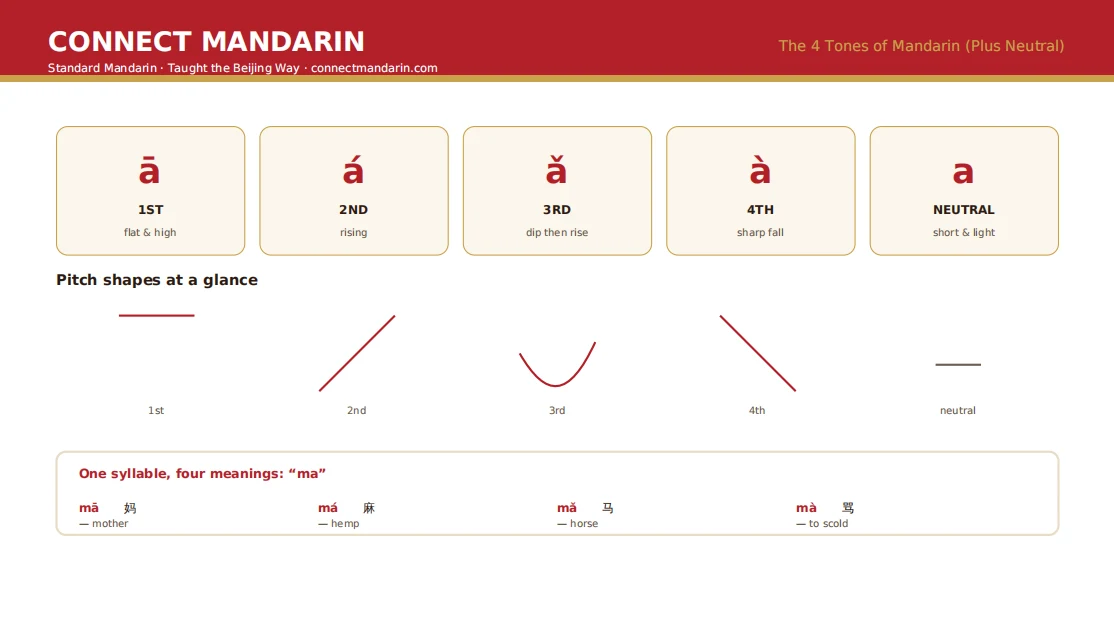
Pinyin only tells you half the story. The other half is tone, and in Mandarin, tone changes meaning entirely. The same syllable "ma" can mean mother, hemp, horse, or scold, depending on which of the four tones you use, plus a fifth, neutral tone that carries no pitch of its own.
First tone (ā): flat and held high, like you're sustaining a musical note.
Second tone (á): rises sharply, similar to how your voice goes up when asking "what?" in English.
Third tone (ǎ): dips down and then curves back up. In casual speech, this is often shortened to just the dip.
Fourth tone (à): falls sharply from high to low, like a firm command.
Neutral tone (a): short and light, with no strong pitch of its own, often attached to the end of a word.
Tone marks sit directly above the vowel in a syllable (or the first vowel in a multi-vowel final), which is why you'll see "mā," "má," "mǎ," and "mà" rather than a number or symbol tacked on elsewhere. Getting comfortable reading these marks at a glance, rather than sounding them out one at a time, is one of the clearest signs a student is moving past the beginner stage.
How to Read the Pinyin Chart: Combination Rules
Not every initial pairs with every final, and the chart follows a few consistent rules once you know what to look for.
Some initials only ever appear with certain groups of finals. The retroflex group (zh, ch, sh, r) and the sibilant group (z, c, s) never combine with "i" the way you'd expect from English. Instead, that "i" becomes a buzzed, almost vowel-less sound, which is why "zhi," "chi," "shi," and "ri" don't rhyme with "yi" the way a new learner might guess.
The finals "u" and "ü" also cause confusion, mostly because of spelling shortcuts. After j, q, x, and y, the written "u" is actually pronounced "ü," even though the umlaut gets dropped on the page. So "ju," "qu," and "xu" all use the rounded ü sound, not the plain "oo" you'd get after b, p, m, or f.
Finally, some finals change their spelling depending on what comes before them. "Iu" is really a shortened form of "iou," and "ui" is a shortened form of "uei." The middle vowel gets dropped in writing but you'll still hear a trace of it in careful speech. None of this needs to be memorized as a rule set on day one. It clicks naturally once you've heard and repeated enough real syllables, which is exactly why chart reading and listening practice need to happen side by side.
Common Mispronunciations for English Speakers
A few sounds account for the majority of pronunciation mistakes we hear from new students, and knowing them in advance can save weeks of correcting bad habits later.
X, Q, and J versus SH, CH, and ZH. These two groups feel interchangeable to English ears, but they're made in completely different parts of the mouth. X/Q/J are made with a flat tongue and spread lips. ZH/CH/SH are retroflex, with the tongue tip curled back. Mixing them up is the single most common error we see.
Aspiration. English speakers often don't aspirate consonants like "p," "t," and "k" strongly enough. In Mandarin, the difference between b/p, d/t, and g/k isn't voicing (like in English), it's whether there's a strong puff of air. Holding a piece of paper in front of your mouth while practicing is a classic, effective trick.
The neutral tone. Many learners either give every syllable a full tone or flatten everything out entirely, when the neutral tone should be genuinely short and unstressed, almost swallowed compared to its neighbors.
Third tone in connected speech. Textbooks teach the full dip-and-rise shape, but in natural conversation, a third tone often just becomes a low, flat dip unless it's the last syllable in a sentence. Students who only ever practice the "textbook" version can sound stiff.
Pinyin Chart for Kids vs. Adult Learners
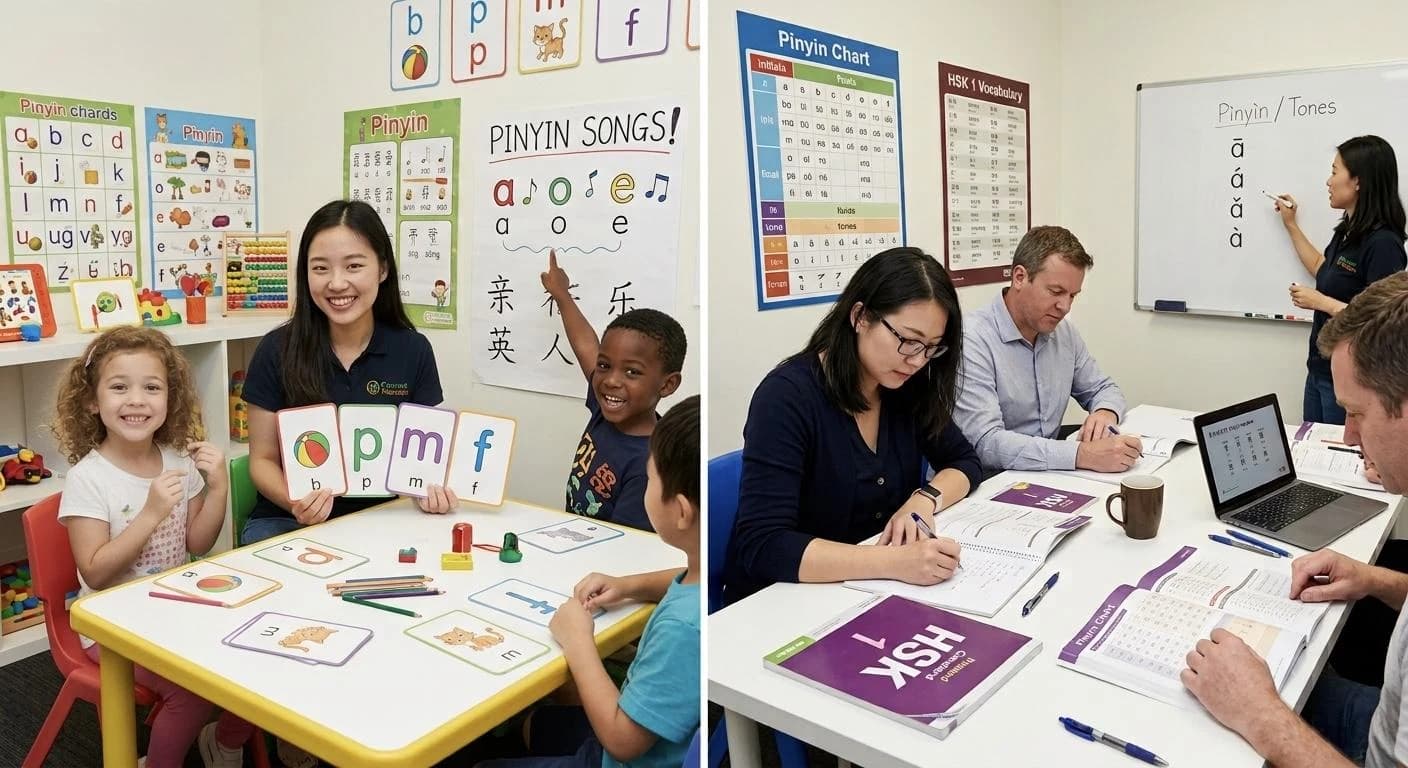
The core chart doesn't change based on age, but how it's taught usually should.
For kids, pinyin sticks best when it's tied to something concrete: a picture, a toy, a snack, a familiar word. That's why our example words above lean on things like 猫 (cat), 狗 (dog), and 蛋糕 (cake) rather than more abstract vocabulary. Repetition through songs, flashcards, and short games also tends to work better than drilling the chart in rows and columns. If you're looking for a more immersive, hands-on way for a child to build these skills over a longer stretch of time, our summer and winter camps are built around exactly this kind of active, everyday practice.
Adult learners generally do better moving faster through the full chart, understanding the linguistic logic behind aspiration and retroflex sounds, and connecting pinyin directly to tone pairs and exam requirements early on. Since most adult students are working toward a specific goal, whether that's travel, business, or an HSK level, tying pinyin practice to that goal from the start tends to keep motivation higher than treating it as an isolated first unit to get through.
Either way, the fundamentals are identical. What changes is pacing, context, and how much theory versus repetition a learner needs.
Free Printable Pinyin Chart Download
Reading the chart on a screen is useful, but most students get more out of it once it's sitting next to them on paper, especially during early practice sessions when you're sounding things out slowly.
We've put together a printable version of the full pinyin chart with all 23 initials, 24 finals, and tone marks included, designed for both classroom walls and home desks. Download the free Connect Mandarin printable pinyin chart here. Pinyin Chart: The Complete Guide to Chinese Sounds
How Connect Mandarin Teaches Pinyin the Beijing Way
Where you learn pinyin actually matters, because pinyin is meant to represent a specific accent, and that accent is Standard Mandarin, or Putonghua. Putonghua is based on the Beijing dialect, and it's the pronunciation standard used in national broadcasting, official documents, and every level of the HSK exam.
Connect Mandarin is based in Beijing, which means our teachers speak, and teach, the accent that pinyin was actually built to represent. That's a meaningfully different starting point than learning from a school based in a city with its own strong regional accent, since a student's ear gets trained to whichever sounds surround them from day one.
This matters most once you move past pinyin basics and start working toward exams. Pinyin is the foundation for both the listening and reading sections of HSK 1, and getting comfortable with accurate Beijing pronunciation early makes every level after that easier to build on. If you're working toward certification, our HSK Exam Preparation Program starts from these same fundamentals and builds systematically toward exam-level fluency. For students who want a broader foundation first, our Beginner Course covers pinyin alongside early vocabulary and everyday conversation.
Frequently Asked Questions
What is a pinyin chart?
A pinyin chart is a table showing every sound in Mandarin Chinese, built from 23 initials (starting consonants) and 24 finals (vowel sounds), each written in the Roman alphabet. It's the standard tool for learning correct Mandarin pronunciation before reading Chinese characters.
How many sounds are on a full pinyin chart?
A complete pinyin chart covers 23 initials and 24 finals, which combine to form about 400 distinct syllables. Add in Mandarin's four tones (plus the neutral tone), and these syllables produce the full range of sounds used in spoken Chinese.
Do I need to learn pinyin before Chinese characters?
Yes, most teachers recommend learning pinyin first. It gives you an accurate pronunciation foundation using letters you already know, so you can speak and understand Mandarin before tackling the added challenge of reading and writing Hanzi characters.
What are the 4 tones in Mandarin pinyin?
Mandarin has four main tones: first (flat and high), second (rising), third (dipping then rising), and fourth (sharp and falling), plus a light neutral tone. The same pinyin syllable can mean different things depending on which tone is used.
Is Beijing or Shanghai Mandarin more standard for learning pinyin?
Beijing Mandarin is the basis for Putonghua, China's official Standard Mandarin and the pronunciation used in national exams like the HSK. Learning pinyin from Beijing-based teachers means training your ear to the accent used in official broadcasting and testing.
Can I download a printable pinyin chart?
Yes. Connect Mandarin offers a free printable pinyin chart covering all initials, finals, and tone marks, suitable for both classroom use and home study. It's designed to be a quick-reference sheet while you build up your pronunciation.
How long does it take to learn pinyin?
Most beginner students can recognize and read all pinyin sounds within 2 to 4 weeks of regular practice, though refining accurate tone pronunciation typically takes a few months of consistent speaking and listening practice alongside a teacher.
About the Author
Connect Mandarin Team
We are built by a team of native-speaking teachers and language educators who focus on real, usable Chinese - not just textbook phrases. With 15+ years of combined teaching experience.
Continue Reading
What Are You Doing in Chinese? 你在做什么 (Nǐ Zài Zuò Shénme) Explained
Learn how to say "what are you doing" in Chinese, from the textbook-standard 你在做什么 to the casual Beijing favorite 你在干嘛, with pinyin, tone tips, and real dialogues.

Where Are You From in Chinese? (5 Natural Ways to Ask in Mandarin)
Learn 5 natural ways to ask "where are you from" in Chinese, from the everyday nǐ shì nǎlǐ rén to the formal nǐ láizì nǎlǐ, with pinyin and real conversation examples.
How to Say "Not This Time" in Chinese: 5 Natural Mandarin Phrases
Learn how to say 'not this time' in Chinese with 5 natural Mandarin phrases. Get pinyin, real examples, and tips on which one fits each situation.