Mandarin, Chinese, and Simplified Chinese: What's the Real Difference?
Chinese, Mandarin, and Simplified Chinese aren't the same thing. Here's the real difference explained, and which one you should actually learn.
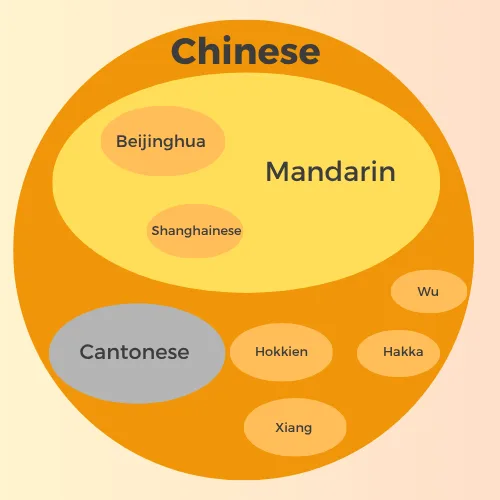
If you've started looking into learning Chinese, you've probably already hit this wall: people throw around "Chinese," "Mandarin," and "Simplified Chinese" like they mean the same thing. They don't. One's a language family, one's a spoken standard, one's a way of writing. Mixing them up isn't a big deal in casual conversation, but it matters the moment you're picking a course, a textbook, or a tutor.
The short version: Chinese is the big umbrella. Mandarin is the spoken standard most people learn. Simplified and Traditional are just two ways of writing that same Mandarin down. Pinyin isn't even a writing system, it's training wheels for pronunciation and typing.
Here's the longer version, if you want it.
"Chinese" isn't one thing
Say "Chinese" and you're really talking about a whole family: Mandarin, sure, but also Wu (spoken around Shanghai), Cantonese down in Guangdong and Hong Kong, Hakka, Min, Xiang, Gan. These aren't accents of each other. A Shanghainese speaker and a Cantonese speaker genuinely cannot understand each other by ear, even though both would read the exact same newspaper without trouble. That's the part that trips people up: wildly different sounds, one shared writing system underneath.
Mandarin is the standard, not "the" Chinese
Mandarin is what gets taught in schools, what shows up in HSK textbooks, what you'll hear on CCTV. In mainland China it's called Putonghua. In Taiwan, Guoyu. Singapore has it as one of four official languages. If you're starting from zero, this is almost certainly what you're learning, and for good reason: it's the one with the most speakers, the most resources, and the most practical use across business and travel.
There's a popular idea that Mandarin is basically just the Beijing accent, cleaned up a little. Not quite. In the early 1950s, linguists went out to survey pronunciation across northern China, and a set of villages in Luanping County, Hebei, ended up being the reference point, partly because the speech there was clear, tonally distinct, and light on heavy local slang. Beijing phonology shaped it heavily, but "Standard Mandarin" was something closer to an engineered compromise than a direct copy of the capital's speech. The government made it official in 1954.
Simplified Chinese is a script, not a language
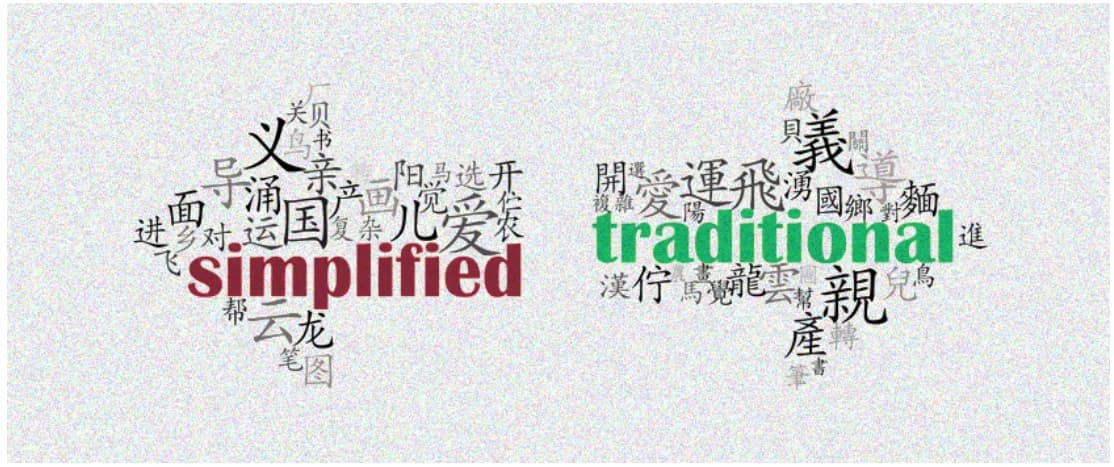
This is where a lot of confusion starts. Simplified Chinese isn't a separate language from Traditional Chinese, it's a different set of characters for writing the same Mandarin. Mainland China and Singapore use Simplified. Taiwan, Hong Kong, and Macau use Traditional. Same grammar, same vocabulary, same spoken language underneath both.
我爱学中文 (Simplified) and 我愛學中文 (Traditional) mean exactly the same thing: "I love learning Chinese." Pronounced identically too, Wǒ ài xué Zhōngwén either way. The only thing that changed is how many strokes it takes to draw a few of the characters.
And Pinyin, the romanized spelling you see in textbooks, isn't a third option sitting alongside those two. Nobody writes emails in Pinyin. It's a teaching and typing tool, full stop, the thing that lets a beginner sound out 中文 before they can read the characters, or lets anyone type Chinese on a regular keyboard.
For a closer look at how the two scripts developed, see Traditional vs. Simplified Chinese.
Where dialects and Mandarin actually overlap (and where they don't)
Because they share characters, someone from Fujian and someone from Beijing can text each other in Chinese and understand every word, even if they'd struggle badly on a phone call. The grammar underneath is also basically the same across dialects: word order does the heavy lifting, not verb conjugation, and that holds whether you're speaking Mandarin or Cantonese or Hakka.
What actually splits them apart is sound and vocabulary. Standard Mandarin runs on four tones. Some dialects have six, seven, more, and honestly some of them sound closer to singing than speaking. Vocabulary drifts too, and this is where dialects get genuinely fun: Cantonese has 猴赛雷 for "awesome," Northeastern Mandarin has its own slang for sliding around on ice that doesn't really translate cleanly. That's local flavor Mandarin just doesn't carry.
None of this makes dialects lesser or Mandarin "purer." Mandarin is the bridge that lets the whole country talk to each other. Dialects are what people still speak at home, and plenty of people do both without any conflict.
Where Mandarin stands today
China has been pushing Mandarin nationwide since 1956, and it shows: government, schools, broadcasting, basically anything official runs in Putonghua now. China's Ministry of Education put mainland proficiency above 80 percent as of 2025, with over 90 percent of school-age kids already fluent in it, which is a genuinely fast shift for a country this size.
Outside China, Chinese has quietly become one of the more useful languages to know, period. It's taught in something like 190+ countries, over 30 million people are learning it worldwide, and it's an official working language at the UN, the UNWTO, IATA. That's not just a China story anymore.
The exams, briefly
If you're planning to study, work, or get certified in Chinese, you'll eventually run into one of these:
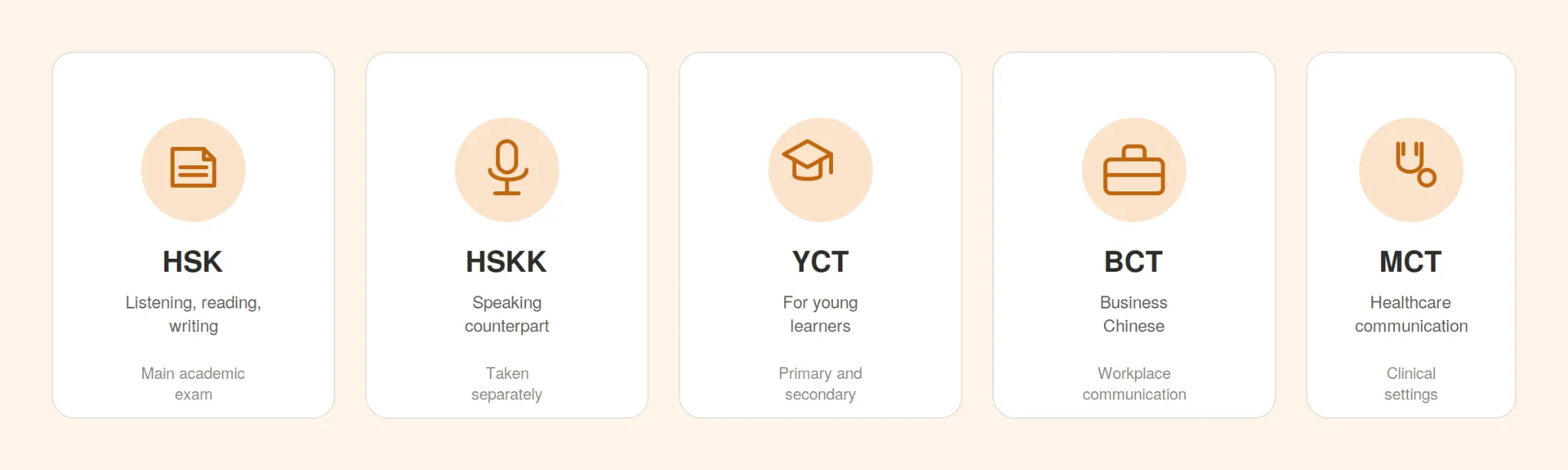
HSK is the one most people mean when they say "the Chinese exam," recently expanded from 6 levels to 9 under HSK 3.0. HSKK covers speaking specifically, taken as its own separate test. YCT is the version built for younger students. BCT is aimed at business and workplace Chinese. MCT is a more niche one, for healthcare communication.
If HSK is on your radar, a proper HSK preparation course genuinely cuts down the guesswork versus grinding through practice papers alone.
So, bottom line
Chinese: the whole language family. Mandarin: the spoken standard almost everyone learns. Simplified and Traditional: two scripts, same language. Pinyin: a tool, not a script at all. Once that clicks, everything else about learning Chinese gets a lot less confusing.
Frequently Asked Questions
Is Mandarin a language or a dialect?
A language. Chinese is really a family, Mandarin, Cantonese, Wu, Min, Hakka, and others, similar to how French and Italian are related but distinct. Spoken aloud, many of these aren't mutually intelligible at all.
Which Chinese language should beginners learn first?
Mandarin, almost without exception. Most speakers, most resources, and it's the standard across business, education, and travel in Greater China. Starting with a dialect only makes sense if you know exactly where you're headed, like Hong Kong specifically.
Simplified or Traditional, which one should I actually learn?
Depends where you'll use it. Simplified for the mainland or Singapore, Traditional for Taiwan, Hong Kong, or Macau. Don't overthink it too much either way, once you know one well, picking up the other later is a lot easier than starting from scratch.
Is Mandarin harder than other Chinese languages?
Not really, if anything it's the more forgiving entry point. Four tones instead of Cantonese's six, no verb conjugations, no grammatical gender, and by far the deepest well of learning resources out there. That combination is why most people start here.
About the Author
Connect Mandarin Team
We are built by a team of native-speaking teachers and language educators who focus on real, usable Chinese - not just textbook phrases. With 15+ years of combined teaching experience.
Continue Reading

What Are You Doing in Chinese? 你在做什么 (Nǐ Zài Zuò Shénme) Explained
Learn how to say "what are you doing" in Chinese, from the textbook-standard 你在做什么 to the casual Beijing favorite 你在干嘛, with pinyin, tone tips, and real dialogues.

Where Are You From in Chinese? (5 Natural Ways to Ask in Mandarin)
Learn 5 natural ways to ask "where are you from" in Chinese, from the everyday nǐ shì nǎlǐ rén to the formal nǐ láizì nǎlǐ, with pinyin and real conversation examples.
How to Say "Not This Time" in Chinese: 5 Natural Mandarin Phrases
Learn how to say 'not this time' in Chinese with 5 natural Mandarin phrases. Get pinyin, real examples, and tips on which one fits each situation.