
Mandarin vs. Cantonese: Which One Should You Learn?
Still unsure about Mandarin and Cantonese? Compare tones, regions, difficulty, and career value to choose the Chinese variety that fits your goals.
Still unsure about Mandarin and Cantonese? You aren't alone. Students often ask which style of Chinese they will benefit from more, be easier to learn, or better for their purposes. The reality is that both languages have a great deal of history and unparalleled benefits. The "right" choice will depend on where you want to go, with whom to discuss it, and how much of a challenge you are willing to take!

At a Glance: What's the Difference?
They are both part of the same language family, but sound like worlds apart. Consider them two separate linguistic entities that share a DNA of characters, but sound completely different when spoken. They are not "mutually intelligible" — that is, speakers with Mandarin as their native language don't understand speakers with Cantonese as their native language, and vice versa, without extensive study.
Quick Comparison
| Feature | Mandarin (Pǔtōnghuà) | Cantonese (Yuèyǔ) |
|---|---|---|
| Primary Areas | Mainland China, Taiwan, Singapore | Hong Kong, Macau, Guangdong |
| Tones | 4 Tones + 1 Neutral | 6 to 9 Tones |
| Characters | Simplified (Standard) | Traditional (Standard) |
| Romanization | Pinyin | Jyutping / Yale |
| Difficulty | Moderate (Highly Standardized) | High (Complex Phonetics) |
Fun Fact: Even though the sounds are different, the grammar is remarkably similar! If you learn the sentence structure for "I want to eat rice" in Mandarin, you've already learned 90% of the logic for Cantonese.
Breaking It Down
1. Global Reach vs. Regional Power
Mandarin is the language of China and one of the UN working languages. It is widely spoken by more than 920 million people and is the business language of choice in cities such as Beijing, Shanghai, and Shenzhen.
Cantonese is a regional stronghold. It is spoken by approximately 84 million people, but has a much larger cultural reach due to the Chinese diaspora. From New York to London, one can hear more Cantonese spoken in Chinatowns than is commonly thought.
2. The "Music" and Tones
Mandarin is generally easier for beginners because it uses 4 basic tones. Using the Pinyin system, you can start speaking basic sentences relatively quickly.
Cantonese is the more "musical" but difficult sibling, featuring up to 9 tones. It preserves ancient "entering tones" — short, clipped sounds (like -p, -t, and -k endings) that Mandarin lost over the centuries.
Note for Musicians: If you have a "musical ear," you might actually find Cantonese fascinating. The 6–9 tones mean that Cantonese sounds much more like singing than Mandarin does!
3. Simplified vs. Traditional Writing
Mainland China uses Simplified characters (fewer strokes, faster to learn). Hong Kong and Macau stick with Traditional characters, which many find more beautiful but time-consuming to memorize.
Pro-Tip: If you plan on reading old literature or visiting historical temples, Traditional characters (associated with Cantonese and Taiwan) are like a window into the past. If you want to read a modern newspaper or text your friends in Shanghai, Simplified is the way to go.

Cultural Impact: Why Choose?
- Choose Mandarin for the Future: It is the gateway to the world's second-largest economy and the key to exploring the vast landscapes of Mainland China. It's also the language of the booming "Mandopop" scene and modern C-Dramas.
- Choose Cantonese for the Vibe: If you grew up on Bruce Lee, Jackie Chan, or Wong Kar-wai films, Cantonese is your backstage pass. It's the language of Dim Sum — it feels "earthier" and is packed with colorful, punchy slang that makes you feel like a local.
Which One is Right for YOU?
Go with Mandarin if:
- You want to work in international business or finance.
- You plan to travel extensively across all of China.
- You need the HSK certificate for a resume or university application.
- You want the widest selection of learning apps and resources.
Go with Cantonese if:
- You are moving to Hong Kong, Macau, or Guangzhou.
- You have family roots in Southern China and want to connect with heritage.
- You are a die-hard fan of 90s Hong Kong cinema and Cantopop.
- You love a linguistic challenge and want to stand out from the crowd.
Common Myths & FAQs
Myth: They are completely different languages.
Actually, they share "linguistic DNA." For example, the word for "Mountain" (山) looks identical in both. Only the sound changes.
Myth: You can't learn both.
You absolutely can! However, we suggest mastering Mandarin first. Because Mandarin resources are so standardized, you can build your "character foundation" much faster. Transitioning to Cantonese later is like an Italian speaker picking up Portuguese — you'll already have a massive head start.
Q: Can I use Mandarin in Hong Kong?
About 48% of people in Hong Kong can speak Mandarin, but it isn't the primary daily language.
Travel Tip: If you are a foreigner in Hong Kong, people will likely respond to you in English first. While Mandarin is understood, English remains a major official language and is very common for daily errands.
Tips for Success (No Matter Which You Pick!)
- Don't Fear the Tones: Everyone makes tonal mistakes at first. The key is to speak confidently. Context usually helps people understand you anyway!
- Watch with Subtitles: Whether it's a Mandarin drama on Netflix or an old-school Cantonese kung-fu flick, turn on the Chinese subtitles. It helps your brain link the sounds to the characters.
- Start with Pinyin/Jyutping: Don't try to learn characters and sounds at the same time on day one. Learn how to "read" the sounds using the Romanized alphabet first to build your confidence.
Ready to Start?
The best time to start was yesterday; the second-best time is now. For most, the path to fluency begins with Mandarin Pinyin. It gives you the strongest foundation for everything that comes next.
Whether you are a total beginner or looking to polish your business vocabulary, we have a path for you.
👉 Discover our courses at Connect Mandarin and book your first lesson today!
About the Author
Connect Mandarin Team
We are built by a team of native-speaking teachers and language educators who focus on real, usable Chinese - not just textbook phrases. With 15+ years of combined teaching experience.
Continue Reading
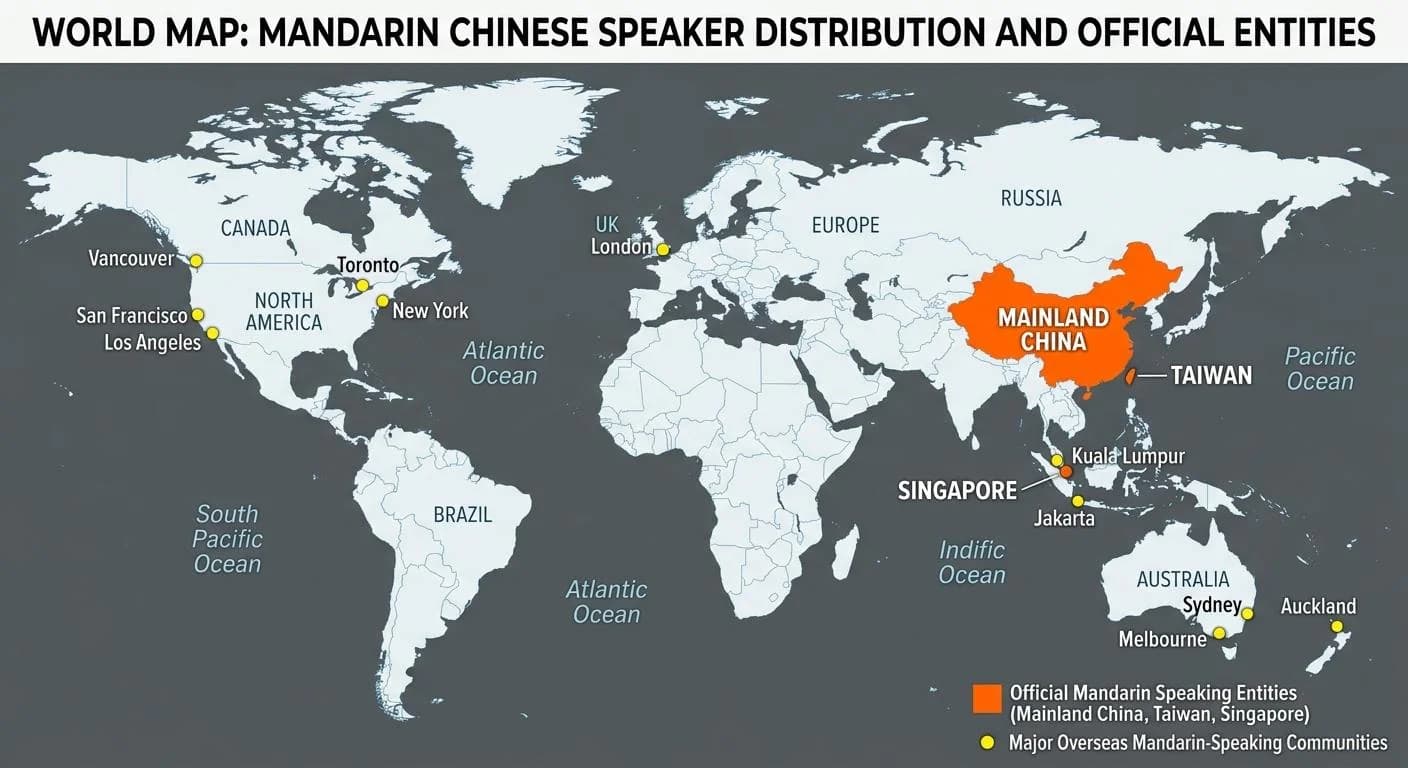
What Countries Speak Mandarin? Official Languages and Where It Is Spoken Worldwide
Which countries speak Mandarin? See where it's official (China, Taiwan, Singapore), where it's widely spoken, and which version to learn first.

What Are You Doing in Chinese? 你在做什么 (Nǐ Zài Zuò Shénme) Explained
Learn how to say "what are you doing" in Chinese, from the textbook-standard 你在做什么 to the casual Beijing favorite 你在干嘛, with pinyin, tone tips, and real dialogues.

Where Are You From in Chinese? (5 Natural Ways to Ask in Mandarin)
Learn 5 natural ways to ask "where are you from" in Chinese, from the everyday nǐ shì nǎlǐ rén to the formal nǐ láizì nǎlǐ, with pinyin and real conversation examples.