A Brief History of China For Language Learners
Mandarin isn't random grammar — it's a living map of China's history. From oracle bones to simplified characters, discover how ancient dynasties shaped the language you're learning today.
When you start learning Mandarin, it's easy to feel overwhelmed by the sheer volume of characters, tones, and unfamiliar grammar structures. But here is a secret that will change how you study: The Chinese language is a living map of China's history.
Let's be honest: At some point while studying Mandarin, you've stared at a page of characters or tried to master the third tone and thought, "Who came up with this system, and why are they punishing me?"
It's a fair question. But here is the secret to staying sane: Mandarin isn't just a random collection of grammatical hurdles. It's a literal historical map.
Every time you type a character on your phone or drop a four-character idiom into conversation, you aren't just speaking — you are resurrecting thousands of years of imperial drama, ancient fortunetelling, and 20th-century political survival.
If you want to understand why the language works the way it does, you have to look at where it's been.
The Shang Dynasty: Decoding 3,000-Year-Old Fortune Cookies
Next time you are wrestling with character strokes, blame the Shang Dynasty priests.
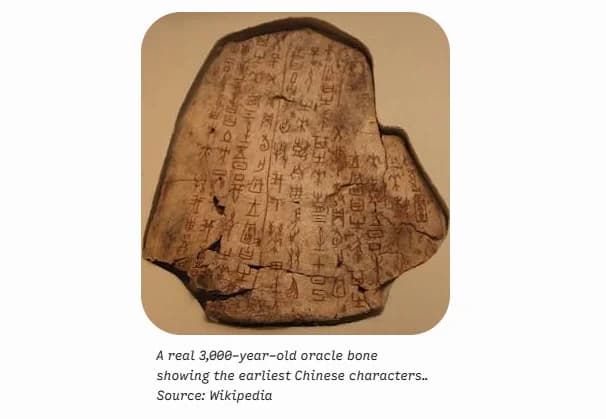
Around 1600 BCE, these priests would carve questions onto turtle shells or ox bones ("Will it rain tomorrow?" "Should the King go to war?"), stick a hot metal rod into them, and read the cracks that formed to predict the future. This was Oracle Bone Script (甲骨文 - jiǎgǔwén).
Why this helps you learn: Those ancient cracks are the literal ancestors of your flashcards. Chinese characters didn't start as abstract lines; they were doodles of real things.
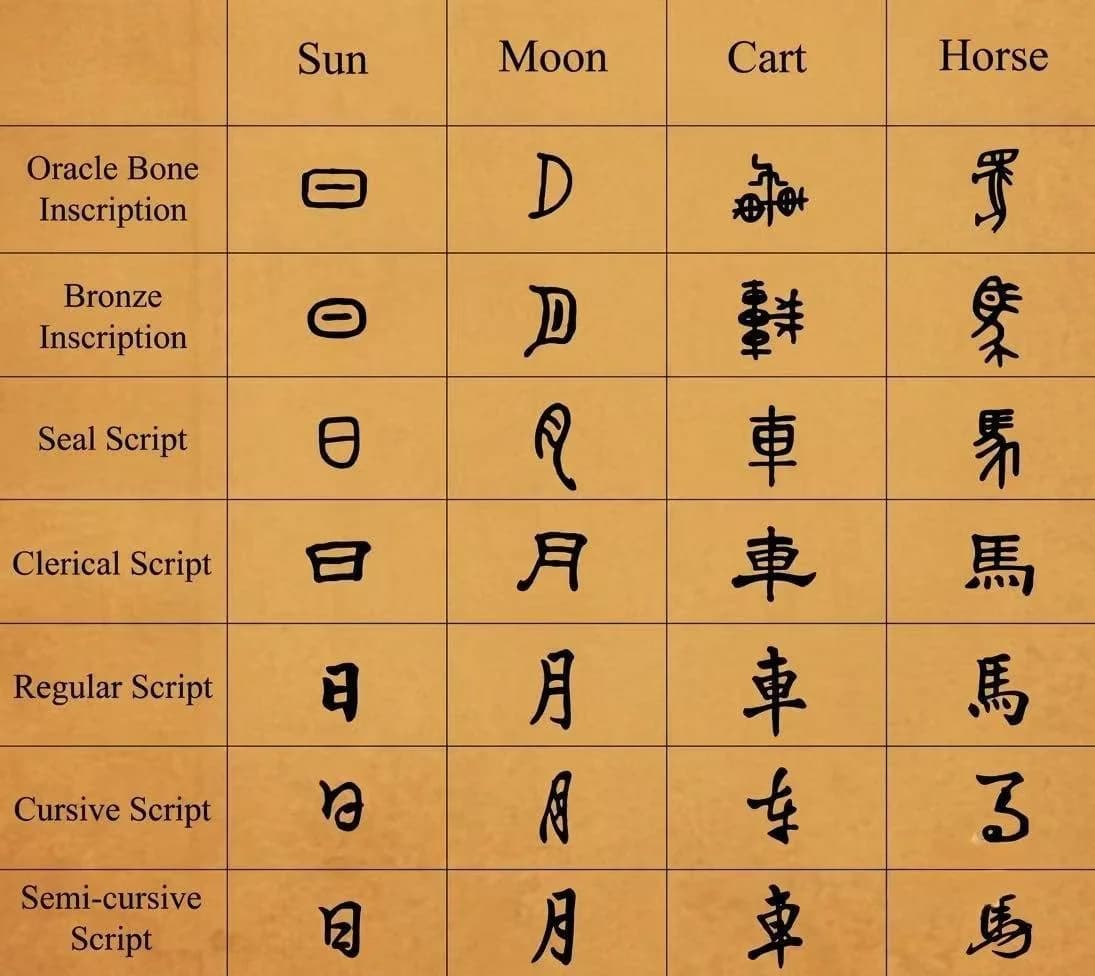
- The character for sun (日 - rì) was just a circle with a dot.
- The character for mountain (山 - shān) was a drawing of three peaks.
When you struggle to memorize a character, stop looking at it as an abstract code. Try to find the ancient drawing hidden inside it. You aren't just writing; you're sketching history.
The Qin Dynasty: The Ultimate Formatting Reset
Before 221 BCE, "China" didn't exist as one country. It was a chaotic mess of Warring States. Everyone spoke differently, and worse, everyone wrote characters differently. If you moved three towns over, your writing was useless.
Then came Qin Shi Huang — China's brutal first emperor (the guy behind the Terracotta Army). He realized that if he wanted to run a massive empire, he needed everyone on the same page. Quite literally.
Why this helps you learn: The Qin Dynasty standardized the written language. They told the entire empire: "You can speak whatever regional dialect you want, but when you write, you use THIS script."
This explains a massive quirk of modern China: why a person from Beijing (speaking Mandarin) and a person from Hong Kong (speaking Cantonese) can sit down and read the exact same newspaper, even though they can't understand a single word the other says out loud. The script is the glue that holds China together.
The Tang & Song Dynasties: Why Idioms Run the World
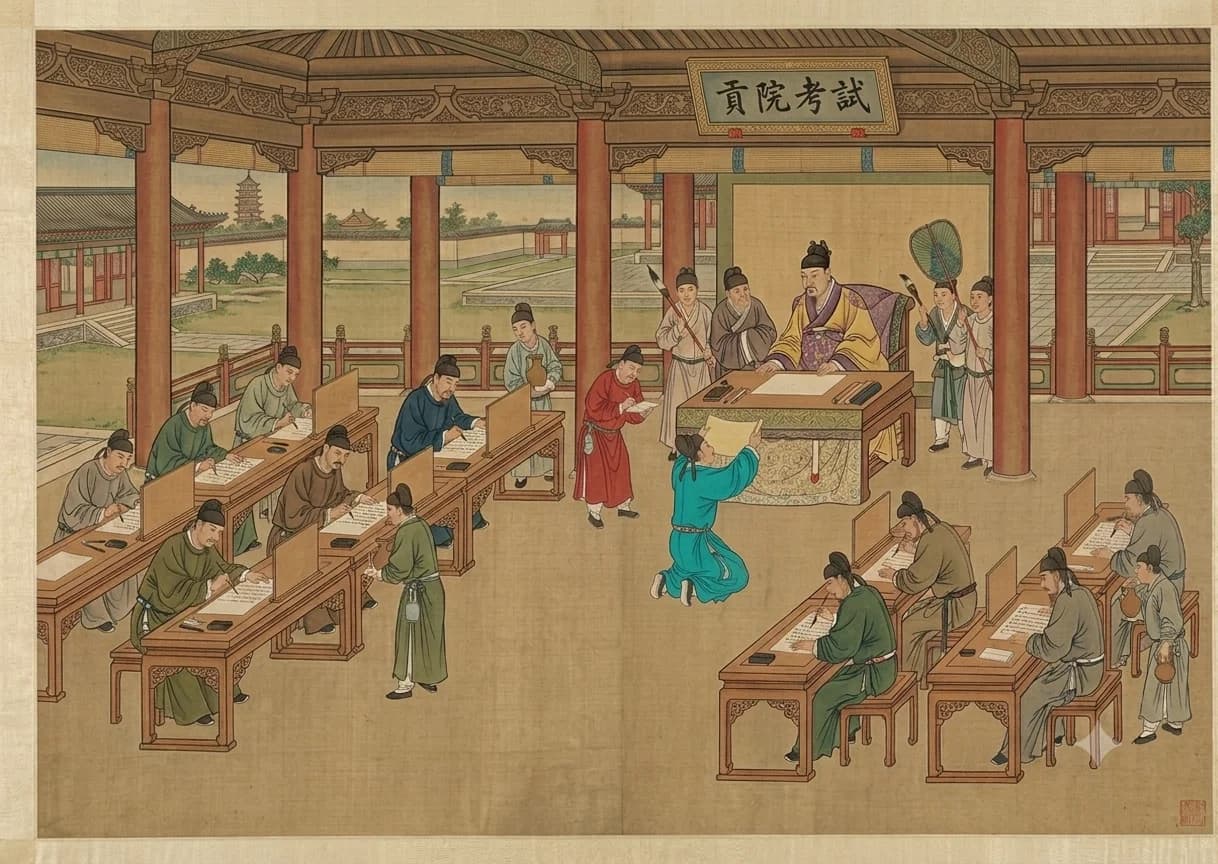
For centuries, if you wanted a government job in China, you had to pass the grueling Imperial Examinations. This required memorizing thousands of lines of Classical Chinese (文言文 - wényánwén).
Classical Chinese was incredibly dense because writing materials like silk and bamboo were expensive. Writers cut out every single non-essential word. There was no punctuation, no fluff — just pure meaning.
Why this helps you learn: This era left us with 成语 (chéngyǔ) — those infamous four-character idioms that advanced learners love and hate.
Take the phrase 马到成功 (mǎ dào chéng gōng). Literally, it means "horses arrive, success achieved." It sounds weird until you realize it's a historical callback to ancient generals winning a war the moment their cavalry showed up.
When you use a chéngyǔ, you aren't just memorizing vocab; you're throwing a tiny historical inside joke into your conversation. Native speakers appreciate it because it proves you don't just know the words — you know the culture.
The 20th Century: Students and Heartless Characters
By the early 1900s, China's imperial system collapsed, and the country was in an absolute crisis. Literacy rates were painfully low because Classical Chinese was so complex that only elite scholars could master it. The everyday person was completely left in the dark.
This triggered two massive, dramatic linguistic revolutions that completely changed how you study Chinese today:
The May Fourth Movement (1919)
Tired of an elitist system, a massive wave of passionate college students took to the streets of Beijing on May 4, 1919. Alongside political protests, they demanded a literary revolution: they wanted Vernacular Chinese (白话文 - báihuàwén). They argued that books, news, and poetry should be written exactly how people actually speak in daily life. Because of those students, Chinese text became conversational and vastly easier to learn.
The 1950s Simplification: Where did the heart go?
To push literacy even further, the government systematically chopped the number of strokes out of complex characters to create Simplified Chinese (used in Mainland China, while Taiwan and Hong Kong retained the intricate Traditional characters).
But this simplification sparked a massive cultural debate that language nerds still argue about today. Take a look at the character for "love":
- Traditional: 愛
- Simplified: 爱
Notice anything missing? Right in the exact middle of the traditional character for love is the character for heart (心 - xīn). When they simplified it, they completely removed the heart, replacing it with a flat roof structure. To this day, traditional character purists joke that modern simplified love has no heart!
On the flip side, simplified characters saved millions of people from literal writer's cramp. For instance, the traditional word for horse (馬) has 10 strokes and looks like a literal horse with a mane and legs. The simplified version (马) takes just 3 quick strokes.
Why This Matters For Your Learning Journey
Every layer of Chinese history has left a footprint on the language you are studying:
| Historical Era | Impact on Modern Mandarin | Why It Helps You Learn |
|---|---|---|
| Shang Dynasty | Created Pictographs | Helps you visualize character meanings. |
| Qin Dynasty | Unified Script | Why characters unite completely different spoken dialects. |
| Imperial Era | Classical Idioms (Chéngyǔ) | Adds deep cultural nuance and humor to your speech. |
| The 20th Century | Pinyin & Simplified Script | Created the vernacular text and phonetic systems you use on your phone today. |
The next time a grammar pattern or character layout drives you crazy, don't get frustrated. Take a breath and remember that you are interacting with one of the oldest continuous written languages on the planet. You aren't just a student; you're a time traveler.
Want to master Mandarin with context, culture, and zero boring textbook fluff? Discover how we teach real, living Chinese at Connect Mandarin.
Frequently Asked Questions
Do I need to learn the history of China to learn the language?
No, but it makes memorization significantly easier. Understanding the historical context behind characters and idioms acts as a memory anchor, helping you understand why the language functions the way it does instead of just memorizing abstract rules.
Can people who read Simplified Chinese understand Traditional Chinese?
Yes, usually. Most native speakers can read both due to context, media exposure, and structural similarities, even if they can only write in one system. For language learners, transitioning from Traditional to Simplified is generally easier than the other way around.
Is Modern Mandarin spoken exactly the same way as ancient Chinese?
Not at all. Ancient Chinese (Classical Chinese) was primarily a written language optimized for density. Modern Mandarin is based on the northern dialects spoken during the Ming and Qing dynasties, formalized as the national language in the 20th century to prioritize daily spoken communication.
Why does Hong Kong and Taiwan still use Traditional characters if Simplified is easier?
Because the political and cultural movements of the 1950s that introduced Simplified Chinese only took place in Mainland China. Taiwan and Hong Kong were politically separate at the time and chose to preserve the traditional script to maintain historical continuity and cultural heritage.
Are all Chinese characters pictographs (drawings of real things)?
No, only about 4% of modern characters are pure pictographs (like 日 for sun or 山 for mountain). The remaining 96% are phono-semantic compounds — characters made by combining one part that gives you a hint about the meaning, and another part that gives you a hint about how it sounds.
Why does Connect Mandarin focus on culture in its courses?
Because memorizing word lists in a vacuum doesn't work. We integrate cultural context and historical insights directly into our lessons because it builds stronger mental hooks. When you understand the "why" behind a character or phrase, you learn it faster, retain it longer, and speak it with genuine confidence.
About the Author
Connect Mandarin Team
We are built by a team of native-speaking teachers and language educators who focus on real, usable Chinese - not just textbook phrases. With 15+ years of combined teaching experience.
Continue Reading

Jokes in Chinese: Funny Phrases and Wordplay to Learn Mandarin
Learn jokes in Chinese, from dad-joke puns to internet slang, with pinyin, translations, and explanations of the wordplay behind each one.

How to Say Good Morning in Chinese: Phrases, Pinyin & Culture
Learn how to say good morning in Chinese with pinyin, tones, and etiquette. Discover formal, casual, and texting phrases used across Mandarin culture.

How to Say I Love You in Chinese Mandarin: Phrases, Meanings & Culture
Learn how to say I love you in Chinese Mandarin, plus the number codes, family customs, and cultural etiquette behind expressing love and affection.