
Master Mandarin Chinese: Your Roadmap to Success
New to Mandarin? Follow this step-by-step roadmap to build pronunciation, characters, and daily immersion habits — and start learning Chinese with confidence.
Learning Mandarin Chinese may seem a little daunting in the beginning. Characters seem strange, like they are telling some stories, tones unfamiliar, and sentence structures different from your own language; these are the thoughts of each and every beginner level student or the person who is just introduced to the language.
However, here's the good news: Mandarin Chinese can absolutely be learned, with the right strategy and a structured plan.
It is important to get the big picture before going into the small details. You don't need to try and memorize hundreds of characters or learn perfect grammar immediately. Instead, this guide will help you see what the road ahead looks like. In an hour of reading, you will have a clear step-by-step roadmap to get you started confidently on your language journey.
Part 1: Core Skills (Your 5-Step Strategy)
To learn to speak Mandarin clearly and listen and understand quickly, it is important to approach the language smartly. Focus on the following five fundamental pillars from day one:
1. Master tones as quickly as possible
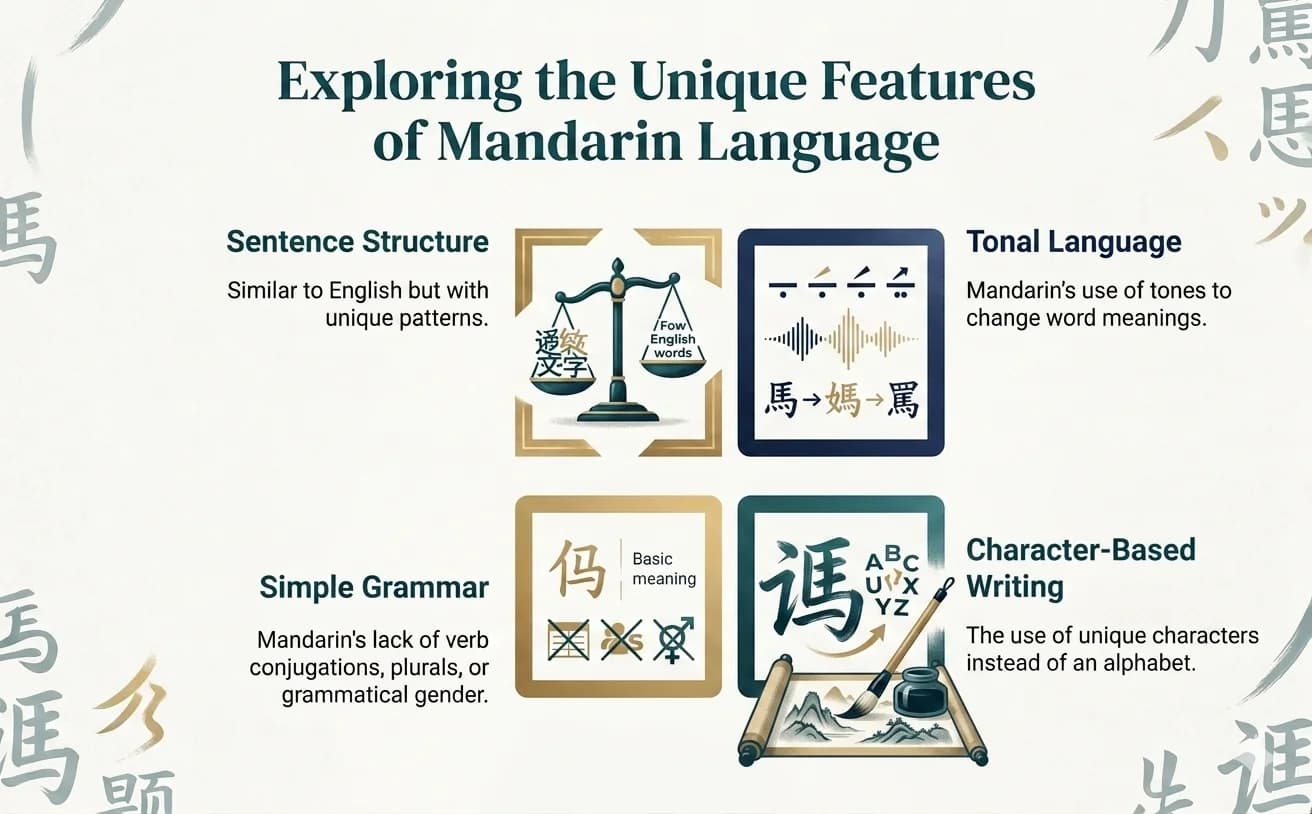
Mandarin is a tone language, meaning a single sound may change meaning depending on the rise or fall of the voice. There are four main tones and a neutral tone in Mandarin.
Don't skip this aspect – it is the absolute key to understanding Mandarin. Make sure to learn the tone pairs right at the beginning until you can intuitively recognize and distinguish them.
2. Learn Pinyin as your primary pronunciation tool
Before starting to memorize characters, familiarize yourself with Pinyin—the official system that uses the regular Latin alphabet to spell out sounds in Mandarin. Using Pinyin will help you to:
- Pronounce new words from day one.
- Quickly look up words in a digital dictionary.
- Type Chinese characters on your phone or computer.
3. Learn Characters strategically
There is no need to learn 10,000 characters at once. Prioritize what you need:
- Learn the most frequent 1,000 words first (this will allow you to understand up to 90% of general texts).
- Understand radicals—the components within a character that provide clues about its meaning or pronunciation.
- Use spaced repetition system (SRS)—apps like Anki is invaluable for reviewing characters before you forget them, saving you hours of study.
4. Try to Speak from Day 1
Do not wait until you feel "ready" to begin speaking. Start right away! Speaking out loud from the start will build your confidence, train your muscles of pronunciation, and help you fix your mistakes before they become a habit. It makes the language a practical communication tool, rather than just an academic subject.
5. Immerse yourself daily
The more you integrate Mandarin into your daily life, the faster you will learn it. Creating an immersive environment at home is easier than you think:
- Listen to Chinese music and podcasts during your commute or at home.
- Watch TV shows and movies in Mandarin with subtitles (English first, then Mandarin).
- Change your smartphone display language to Mandarin (it is tough at first, but worth the effort).
- Stick Chinese labels with words on household items like the fridge or a mirror.

Part 2: A 2-Phase Beginner Roadmap
To keep your progress on track, consider following a structured plan with realistic milestones. This roadmap will cover your first 6 months.
Phase 1: Basics (Months 1–3)
Objective: Build a strong foundation in pronunciation and conversational survival phrases.
- Learn: Master the Pinyin system and tones, basic greetings, numbers, how to tell time and dates, and a few essential verbs (like "to be", "to have", "to want", "to go").
- Vocabulary: 300–500 high-frequency words.
- Sentence Structure: Simple Subject-Verb-Object construction.
Phase 2: Elementary (Months 3–6)
Objective: Expand vocabulary and begin to link words together in longer sentences.
- Learn: Start moving from phrases to sentences, learning to combine different words and ideas. Begin recognizing common character radicals and reading very simple texts.
Common Questions About Learning Mandarin
Is Mandarin very hard to learn?
Mandarin is commonly cited as one of the hardest languages in the world. This is, however, not entirely true. Mandarin possesses many features that simplify learning and, in some ways, are far more straightforward than learning another European language:
- Super simple grammar: No verb conjugations (past/present/future), no grammatical gender, no complex plural forms.
- Logical sentence structure: The basic sentence structure is predictable and, once memorized, simple to implement.
- Compound words: New words are built like LEGO bricks. "Computer" is simply "electric brain". This feature simplifies new word acquisition considerably.
How Long Does It Take?
The amount of time required depends on your previous language learning experience, the amount of time you practice per day and your immersion environment.
According to professional language institutions, an English speaker needs about 2,200 hours to become proficient. This is about 1 to 2 years if you attend full-time immersion programs. However, there is no need for that many hours just to be able to have simple conversations, travel and have basic business dealings. This conversational level is achievable much more quickly with daily practice.
Elevate Your Learning with Connect Mandarin
Apps and videos are very useful for vocabulary building, but the fastest, most efficient, and most effective way to learn Mandarin is through a structured teaching environment. At Connect Mandarin we offer a human element to what can be a very lonely process of learning a language on your own:
- Expert feedback on your pronunciation and tone to prevent bad habits from forming early on.
- Insights into the culture of China and understanding of Chinese idioms and etiquette.
- Motivation and accountability from your instructors and fellow learners to keep you engaged.
Whether you prefer an intensive group class or an individualized one-on-one session, Connect Mandarin offers a tailored program to fit your schedule and your learning style.
Start your learning journey today by checking out our classes at Connect Mandarin.
About the Author
Connect Mandarin Team
We are built by a team of native-speaking teachers and language educators who focus on real, usable Chinese - not just textbook phrases. With 15+ years of combined teaching experience.
Continue Reading

What Countries Speak Mandarin? Official Languages and Where It Is Spoken Worldwide
Which countries speak Mandarin? See where it's official (China, Taiwan, Singapore), where it's widely spoken, and which version to learn first.

What Are You Doing in Chinese? 你在做什么 (Nǐ Zài Zuò Shénme) Explained
Learn how to say "what are you doing" in Chinese, from the textbook-standard 你在做什么 to the casual Beijing favorite 你在干嘛, with pinyin, tone tips, and real dialogues.

Where Are You From in Chinese? (5 Natural Ways to Ask in Mandarin)
Learn 5 natural ways to ask "where are you from" in Chinese, from the everyday nǐ shì nǎlǐ rén to the formal nǐ láizì nǎlǐ, with pinyin and real conversation examples.