How to Say Good Morning in Chinese: Phrases, Pinyin & Culture
Learn how to say good morning in Chinese with pinyin, tones, and etiquette. Discover formal, casual, and texting phrases used across Mandarin culture.
If you're learning Mandarin, "good morning" is probably one of the first things you'll want to say with confidence. The good news is that the core phrase is simple. The trickier part is knowing which version to use with your teacher versus your classmate, and when a morning greeting quietly turns into an afternoon one. This guide walks through the main phrase, the more polite Beijing version most textbooks skip, the texting slang your Chinese friends actually use, and the etiquette that makes a greeting land the right way.
The Main Way to Say Good Morning – 早上好 (Zǎoshang hǎo)
The standard, textbook-correct way to say good morning in Chinese is:
早上好 (Zǎoshang hǎo)
Break it down and it's straightforward: 早上 (zǎoshang) means "morning," and 好 (hǎo) means "good." Put them together and you get exactly what it sounds like: "morning good," or "good morning."
Pay attention to the tones. 早 is third tone, 上 is a light neutral-leaning tone, and 好 is third tone as well, though in fast, natural speech the second 3rd-tone often shifts and softens (a change known as tone sandhi). Don't worry too much about the mechanics at first; just keep 好 rounded and confident rather than flat and clipped.
You'll also hear two shorter, more casual versions:
- 早 (Zǎo) — literally just "morning." This is the version people actually shout across the office or say to a neighbor in passing. It's the Chinese equivalent of a quick "Morning!" instead of the full "Good morning!"
- 早安 (Zǎo ān) — a softer, gentler variant. Here, 安 (ān) carries a sense of peace or calm rather than "good" in the literal sense, so 早安 reads more like "peaceful morning." It shows up often in texts, on social media captions, and in Taiwan and southern China, where it's used just as commonly as 早上好.
As for timing, 早上好 works from whenever you wake up until around 10 a.m. After that, Mandarin actually has a separate greeting, 上午好 (shàngwǔ hǎo), for the late morning stretch before lunch. English doesn't really split the morning this way, so it catches a lot of learners off guard the first time they hear it.
您早 (Nín Zǎo) — A More Formal Way to Say Good Morning in Beijing
Here's a phrase most guides skip entirely, and it's worth knowing about: 您早 (Nín zǎo).
The key is 您 (nín), the honorific, respectful form of "you." Where 你 (nǐ) is the everyday "you" you'd use with a friend or classmate, 您 signals deference and respect. It's built into 您早 the same way it is into 您好, which you've probably already heard used constantly in customer service, on the phone with businesses, or when addressing officials.
您早 itself, though, is more specific and less common in day-to-day speech than 您好. Realistically, you won't hear most young people in Beijing say it to each other, and it's not something you need to use with classmates or coworkers your own age. Where it still shows up is:
- From older Beijingers greeting each other, especially neighbors, in daily conversation
- When younger speakers greet a grandparent, older relative, or elder in the family or neighborhood
- In formal or customer-facing settings, like a hotel receptionist or an assistant greeting a boss or a guest first thing in the morning
- Occasionally in workplace settings, when greeting someone clearly senior in age or position
So it's not a phrase in heavy everyday rotation the way 早 or 早上好 are, and you shouldn't expect to hear it constantly. But it hasn't disappeared either. It's closer to a marker of respect that Mandarin speakers reach for in specific situations, similar to how "good morning, sir" still exists in English without being something people say to their friends. Knowing it, and knowing when it actually gets used, is more useful than either overusing it or assuming it's obsolete.
A quick note so you don't overcorrect: 您早 is for individuals, not groups, and it's specifically a morning greeting. You wouldn't say 您早 to a room full of people (you'd use something like 大家早上好, "good morning everyone"), and you wouldn't use it in the afternoon.
Good Afternoon, Evening & Night in Chinese
Once the morning window closes, Mandarin has its own set of time-specific greetings, just like English does. Here's the quick version before the reference table below.
下午好 (Xiàwǔ hǎo) is the formal way to say good afternoon, used from around noon until early evening. Its casual counterpart, 午安 (Wǔ ān), works the same way 早安 does: softer, friendlier, and common between friends or family rather than in a business meeting.
In the evening, 晚上好 (Wǎnshang hǎo) is your polite, all-purpose "good evening," suitable for greeting someone in person or opening a phone call after dark. When it's time to say goodnight rather than hello, switch to 晚安 (Wǎn ān), which is specifically for parting ways or wishing someone a good night's rest, not for greeting someone who's just arrived in the evening.
Quick-Reference Table: Morning, Afternoon & Evening Greetings
| Chinese | Pinyin | Meaning | When to Use |
|---|---|---|---|
| 早上好 | Zǎoshang hǎo | Good morning | General use, until around 10 a.m. |
| 早 | Zǎo | Morning! (short form) | Casual, quick greeting |
| 早安 | Zǎo ān | Good morning (softer) | Friendly, texting, common in Taiwan |
| 您早 | Nín zǎo | Good morning (polite) | Elders, teachers, formal settings, Beijing etiquette |
| 上午好 | Shàngwǔ hǎo | Good (late) morning | Late morning, roughly 10 a.m. to noon |
| 下午好 | Xiàwǔ hǎo | Good afternoon | Formal, noon to early evening |
| 晚上好 | Wǎnshang hǎo | Good evening | Formal, evening greeting |
| 晚安 | Wǎn ān | Good night | Bedtime or when parting ways |
Texting & Casual Morning Greetings
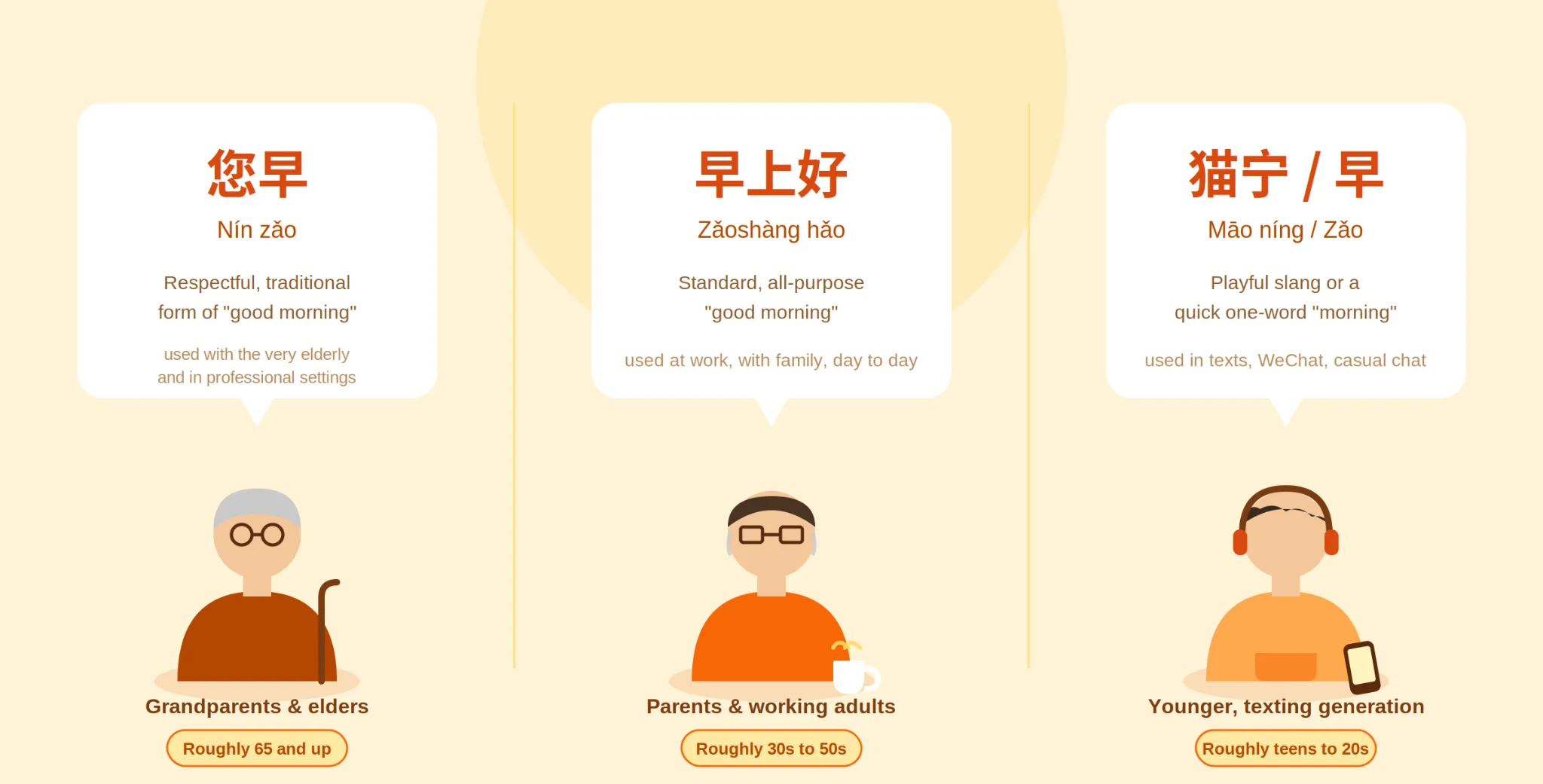
If you spend time chatting with Chinese friends on WeChat, you'll eventually run into 猫宁 (Māo níng). Taken literally, the characters mean something like "cat" and "peaceful," but that's not the point: read aloud, 猫宁 just sounds like the English word "morning." It's internet slang, mostly used by younger people in texts, and it's playful rather than something you'd ever say out loud in a formal setting.
There's a second, very different morning-greeting habit worth knowing about, and it has nothing to do with slang. Many older relatives in China, particularly parents and grandparents, have a daily ritual of sending "good morning" images in family and group chats on WeChat. These are usually stock photos of flowers, sunrises, or scenic landscapes, sometimes with 早上好 written directly on the image, sometimes paired with a short blessing or motivational quote. It's such a common habit that it's become something of a running joke among younger Chinese people, who often groan affectionately about their parents' group chats being flooded with these images every single morning.
If an older relative or family friend sends you one, the polite response is simple: a thumbs-up emoji, a quick 早上好 or 谢谢 (thank you) back, or even just forwarding a similar image in return. Understanding this habit will make sense of a lot of WeChat activity that otherwise looks a little mysterious to newcomers.
How to Respond to a Good Morning Greeting
Responding to a morning greeting in Chinese is refreshingly simple: you generally just echo it back. If someone says 早上好 to you, replying 早上好 is completely natural and expected, in the same way that "Morning!" gets answered with "Morning!" in English.
If you want to keep the conversation going, you can add a short line afterward. A common one is:
早上好,今天天气不错。 (Zǎoshang hǎo, jīntiān tiānqì búcuò.) "Good morning, the weather's nice today."
Small talk about the weather is just as much of a conversational bridge in Chinese as it is in English, so it's a safe, easy way to extend a greeting into a real exchange.
Regional & Dialect Variations
Everything above reflects Standard Mandarin, which is what you'll use nearly everywhere in mainland China and Taiwan, and what the vast majority of Chinese speakers will understand regardless of their home dialect. That said, if you travel to Hong Kong or Cantonese-speaking parts of Guangdong, you'll hear a different greeting entirely, since Cantonese pronunciation and vocabulary diverge quite a bit from Mandarin. You don't need to learn it to get by; sticking with Mandarin greetings will still be understood almost everywhere.
Common Mistakes English Speakers Make
A few small errors show up again and again with new learners:
Using 早上好 too late in the day. Because English "good morning" often stretches informally until lunchtime, learners sometimes carry that habit into Chinese. Remember that Mandarin has a dedicated late-morning greeting (上午好), so 早上好 really is meant for the earlier part of the day.
Skipping 您 in formal situations. Defaulting to 你 out of habit, even with a teacher or an elder, is one of the most common slips. If you're ever unsure whether a situation calls for it, it's safer to use 您.
Flattening the tone on 好. 好 needs its full third-tone shape to sound natural. Said too flat or too quickly, it can come across as clipped or even slightly rude, even though the word itself is right.
Treating 猫宁 as a spoken phrase. It's texting slang, built purely on how it sounds. Saying it out loud in conversation will likely just confuse people rather than come across as casual.
The Culture Behind Chinese Morning Greetings
In Beijing's old hutong neighborhoods, mornings still carry a rhythm that's been around for generations. Residents head out early to walk their birds in cages, practice tai chi in the local park, or gather at a neighborhood teahouse before the day gets going. Greeting the people you pass, especially anyone older than you, isn't optional small talk here; it's a basic courtesy woven into the neighborhood's daily life.
That's really the thread running through all of this: in Chinese culture, a greeting is less about starting a conversation and more about acknowledging a relationship. Greeting elders before peers, using 您 rather than 你 with someone senior, these aren't arbitrary rules. They reflect a broader cultural emphasis on hierarchy, respect, and social harmony, ideas that run deep in Confucian tradition and still shape everyday interactions across China today. Learning to say 早上好 correctly is a fine start. Learning when to reach for 您早 instead is what actually shows you understand the culture behind the language.
How Connect Mandarin Teaches Everyday Phrases Like This
Phrases like 您早 rarely show up in a straightforward vocabulary list, because they're really about context: who you're speaking to, where you are, and what the moment calls for. That's the kind of nuance that's easy to miss from an app or a static phrasebook, and it's exactly what we focus on at Connect Mandarin, drawing on Beijing's role as the home of Standard Mandarin and its living traditions of formality and respect.
In our Part-Time Group Class, you won't just memorize 早上好 and move on. You'll learn how real greetings shift depending on who's in the room, build the instinct for when to use 您, and start picking up the cultural context that makes your Mandarin sound natural rather than textbook-stiff. It's the difference between saying the right words and actually sounding like you belong in the conversation.
Book a free trial class and start putting these greetings to use with native speaking teachers, or explore more guides like this one on the Connect Mandarin blog.
FAQ
How do you say "good morning" in Chinese?
The standard way is 早上好 (Zǎoshang hǎo), meaning "good morning." For a quick, casual greeting, Chinese speakers often just say 早 (zǎo). In more formal or respectful settings, especially with elders or teachers, 您早 (nín zǎo) is the more polite choice.
What does 您早 (nín zǎo) mean and when should I use it?
您早 (nín zǎo) is a polite way to say good morning, built on 您 (nín), the honorific form of "you." It's commonly used with elders, teachers, or anyone you'd address formally, and reflects an etiquette closely tied to Beijing's Standard Mandarin traditions.
How do you say "good afternoon" in Chinese?
The formal way is 下午好 (xiàwǔ hǎo). For a more relaxed tone among friends or family, 午安 (wǔ ān) works just as well and is common from around midday until early evening.
How do you say "good evening" and "good night" in Chinese?
晚上好 (wǎnshang hǎo) means "good evening" and fits polite conversation in the evening hours. 晚安 (wǎn ān) means "good night" and is used specifically when parting ways or before bed.
Is there a casual or texting way to say good morning in Chinese?
Yes, 猫宁 (māo níng) is internet slang that sounds like the English word "morning" and is popular in texts among younger Chinese speakers. It's playful and informal, not something you'd say out loud in a formal setting.
How should I respond when someone greets me with good morning in Chinese?
The simplest response is to echo the greeting back, such as replying 早上好 (zǎoshang hǎo) with the same phrase. You can also add a short comment, like mentioning the weather, to keep the exchange natural.
Until what time can I say 早上好 (good morning) in Chinese?
早上好 (zǎoshang hǎo) is generally used until around 10 a.m. After that, speakers typically switch to 上午好 (shàngwǔ hǎo) for late morning, then 下午好 (xiàwǔ hǎo) once afternoon begins.
About the Author
Connect Mandarin Team
We are built by a team of native-speaking teachers and language educators who focus on real, usable Chinese - not just textbook phrases. With 15+ years of combined teaching experience.
Continue Reading
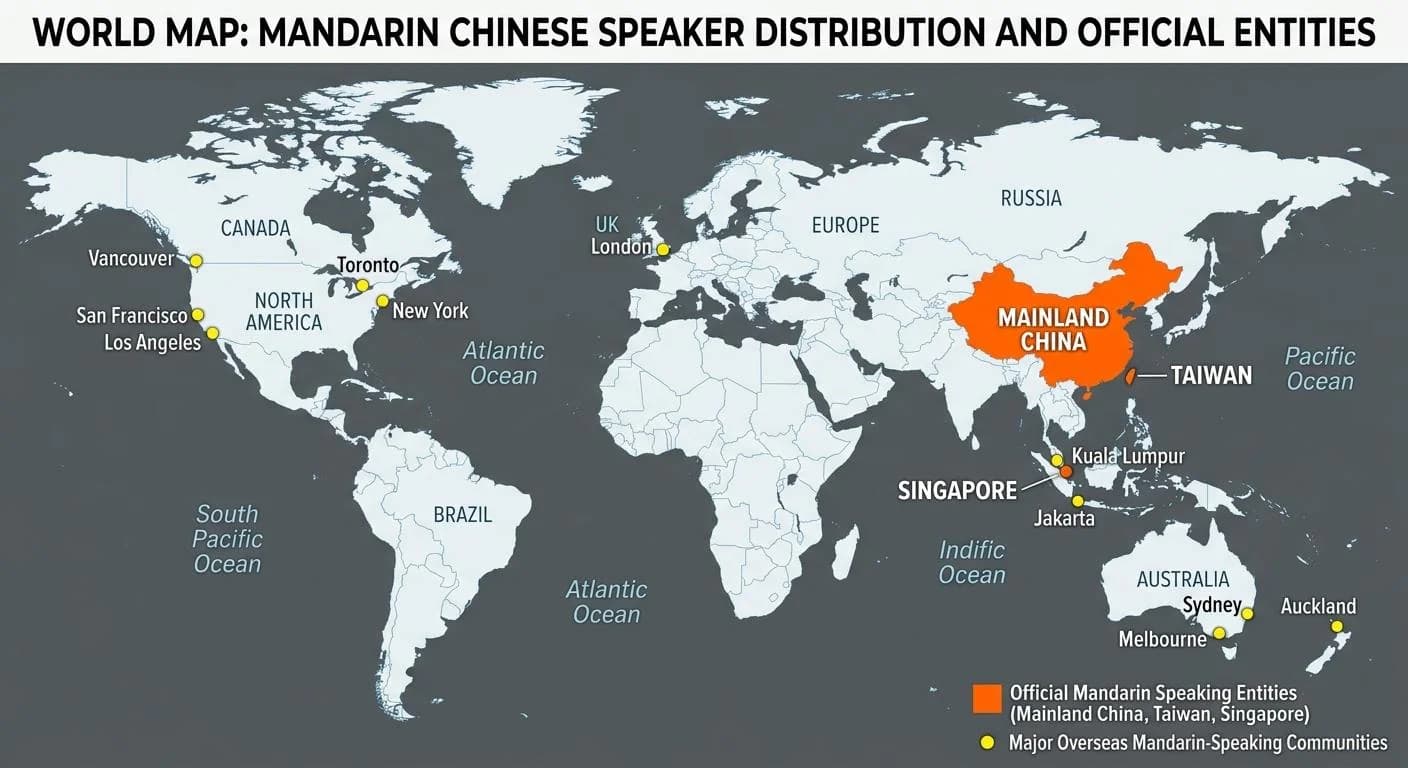
What Countries Speak Mandarin? Official Languages and Where It Is Spoken Worldwide
Which countries speak Mandarin? See where it's official (China, Taiwan, Singapore), where it's widely spoken, and which version to learn first.
What Are You Doing in Chinese? 你在做什么 (Nǐ Zài Zuò Shénme) Explained
Learn how to say "what are you doing" in Chinese, from the textbook-standard 你在做什么 to the casual Beijing favorite 你在干嘛, with pinyin, tone tips, and real dialogues.

Where Are You From in Chinese? (5 Natural Ways to Ask in Mandarin)
Learn 5 natural ways to ask "where are you from" in Chinese, from the everyday nǐ shì nǎlǐ rén to the formal nǐ láizì nǎlǐ, with pinyin and real conversation examples.