
Where Are You From in Chinese? (5 Natural Ways to Ask in Mandarin)
Learn 5 natural ways to ask "where are you from" in Chinese, from the everyday nǐ shì nǎlǐ rén to the formal nǐ láizì nǎlǐ, with pinyin and real conversation examples.

Picture this: you just sat down next to a new classmate at your Chinese class, or you're chatting with a colleague from Beijing over coffee, or you matched with a language partner online. Within the first minute, you want to ask the most obvious question of all: where are they from?
In English, "Where are you from?" is a flexible question. It can mean your country, your hometown, your birthplace, or just wherever you grew up. Mandarin doesn't collapse all of that into one phrase. Instead, there are several ways to ask, and each one leans toward a slightly different answer.
The good news is you only need one phrase to get started: 你是哪里人?(Nǐ shì nǎlǐ rén?). It's the phrase most Chinese speakers use in everyday conversation, and it will get you through almost any first meeting. But once you know the other four ways to ask, you'll sound noticeably more natural, and you'll avoid the awkward moment of asking a much more specific question than you meant to.
Below, we'll walk through all five expressions with characters, pinyin, and real conversational examples, so you can start using them with confidence.
How Do You Say "Where Are You From?" in Chinese?
Here's a quick overview before we break each one down:
| Chinese | Pinyin | Meaning | Best used for |
|---|---|---|---|
| 你是哪里人? | Nǐ shì nǎlǐ rén? | Where are you from? | Origin or hometown, everyday use |
| 你来自哪里? | Nǐ láizì nǎlǐ? | Where do you come from? | Slightly more formal |
| 你的家乡在哪里? | Nǐ de jiāxiāng zài nǎlǐ? | Where is your hometown? | Hometown specifically |
| 你是哪个国家的? | Nǐ shì nǎge guójiā de? | Which country are you from? | Nationality |
| 你的出生地是哪里? | Nǐ de chūshēngdì shì nǎlǐ? | Where were you born? | Birthplace |
They all translate loosely to "where are you from" in English, but a native speaker hears real differences between them. Let's go through each one.
你是哪里人?(Nǐ Shì Nǎlǐ Rén?) — The Everyday Go-To
Break this phrase down and it's almost self-explanatory: 你 means you, 是 means "to be," 哪里 means where, and 人 means person. Put together, it literally asks "you are a person from where," which naturally lands as "where are you from."
This is the phrase to memorize first. It works in casual chats, classroom introductions, and pretty much any situation where you're getting to know someone. You'll hear it constantly in real life.
Example conversation:
A: 你好!你是哪里人?
Nǐ hǎo! Nǐ shì nǎlǐ rén?
Hello! Where are you from?
B: 我是德国人。
Wǒ shì Déguó rén.
I'm German.
You can swap in a city or region just as easily:
我是上海人。(Wǒ shì Shànghǎi rén.) — I'm from Shanghai.
我是四川人。(Wǒ shì Sìchuān rén.) — I'm from Sichuan.
Notice the pattern: 我是 + place + 人. That formula works for countries, provinces, and cities alike, which is part of why this phrase is so useful.
你来自哪里?(Nǐ Láizì Nǎlǐ?) — A Touch More Formal
来自 (láizì) means "to come from" or "to originate from." Swap it into the question and you get 你来自哪里, which still asks about origin but carries a slightly more polished, neutral tone than 你是哪里人.
You'll hear this version in interviews, at conferences, in professional introductions, or any setting where people are being a bit more careful with their language.
Examples:
您来自哪里?
Nín láizì nǎlǐ?
Where do you come from? (using the polite 您)
他来自澳大利亚。
Tā láizì Àodàlìyà.
He comes from Australia.
我来自一个小城市。
Wǒ láizì yí ge xiǎo chéngshì.
I come from a small city.
If 你是哪里人 is what you'd say to a new friend, 你来自哪里 is closer to what you'd say when meeting someone's boss.
你的家乡在哪里?(Nǐ de Jiāxiāng Zài Nǎlǐ?) — Asking About Someone's Hometown
家乡 (jiāxiāng) specifically means hometown, the place someone considers home even if they've since moved away. This question digs a little deeper than simply asking where someone is from. It's the kind of thing you'd ask once a conversation is already flowing and you want to learn more about a person's background.
Example conversation:
A: 你是哪里人?
Nǐ shì nǎlǐ rén?
Where are you from?
B: 我在北京工作,但我不是北京人。
Wǒ zài Běijīng gōngzuò, dàn wǒ bú shì Běijīng rén.
I work in Beijing, but I'm not originally from Beijing.
A: 那你的家乡在哪里?
Nà nǐ de jiāxiāng zài nǎlǐ?
So where is your hometown?
B: 我的家乡在澳大利亚。
Wǒ de jiāxiāng zài Àodàlìyà.
My hometown is in Australia.
This is a great follow-up question once you realize someone lives somewhere different from where they grew up, which is extremely common in China.
Small aside here: if terms like Mandarin, Chinese, and Simplified Chinese still feel a bit tangled up in your head, that confusion is completely normal, and it's worth untangling before you go much further with the language. We actually broke it all down in a separate post: Mandarin vs Chinese vs Simplified Chinese. Worth a read if you've ever wondered why we say "Mandarin" here instead of just "Chinese."
你是哪个国家的?(Nǐ Shì Nǎge Guójiā de?) — Asking About Nationality
哪个 means "which" and 国家 means "country," so this phrase zeroes in on nationality rather than hometown or region. It's especially useful when you're meeting people from different countries and you want a clear, direct answer about where they're from nationally, without any ambiguity about provinces or cities.
How to answer:
我是加拿大人。
Wǒ shì Jiānádà rén.
I'm Canadian.
我是韩国人。
Wǒ shì Hánguó rén.
I'm Korean.
我是巴西人。
Wǒ shì Bāxī rén.
I'm Brazilian.
Same formula as before: 我是 + country + 人. This is one of the most useful sentence patterns in beginner Mandarin, so it's worth practicing until it feels automatic.
你的出生地是哪里?(Nǐ de Chūshēngdì Shì Nǎlǐ?) — Asking Where Someone Was Born
出生地 (chūshēngdì) means "place of birth." This phrase is the most specific of the five, and it's not something you'd typically open a conversation with. Save it for moments when someone's story doesn't line up neatly with where they live or where they call home.
Example:
A: 你的出生地是哪里?
Nǐ de chūshēngdì shì nǎlǐ?
Where were you born?
B: 我出生在法国,但是我在美国长大。
Wǒ chūshēng zài Fǎguó, dànshì wǒ zài Měiguó zhǎngdà.
I was born in France, but I grew up in America.
That kind of answer, where birthplace and upbringing are two different places, is exactly why this question exists separately from the others.
Where Are You From vs. Where Do You Live in Chinese
One common mix-up for beginners is confusing "where are you from" with "where do you live." These ask about completely different things, and mixing them up can lead to some confusing answers.
| English | Chinese | Meaning |
|---|---|---|
| Where are you from? | 你是哪里人? | Origin |
| Where do you come from? | 你来自哪里? | Origin, more formal |
| Where is your hometown? | 你的家乡在哪里? | Hometown |
| Where do you live? | 你住在哪里? | Current residence |
住 (zhù) means "to live" or "to reside," so 你住在哪里 is purely about someone's current address or city, not their background at all. Someone could easily be 英国人 (from the UK) while currently answering 我住在上海 (I live in Shanghai).
How to Answer "Where Are You From?" in Chinese
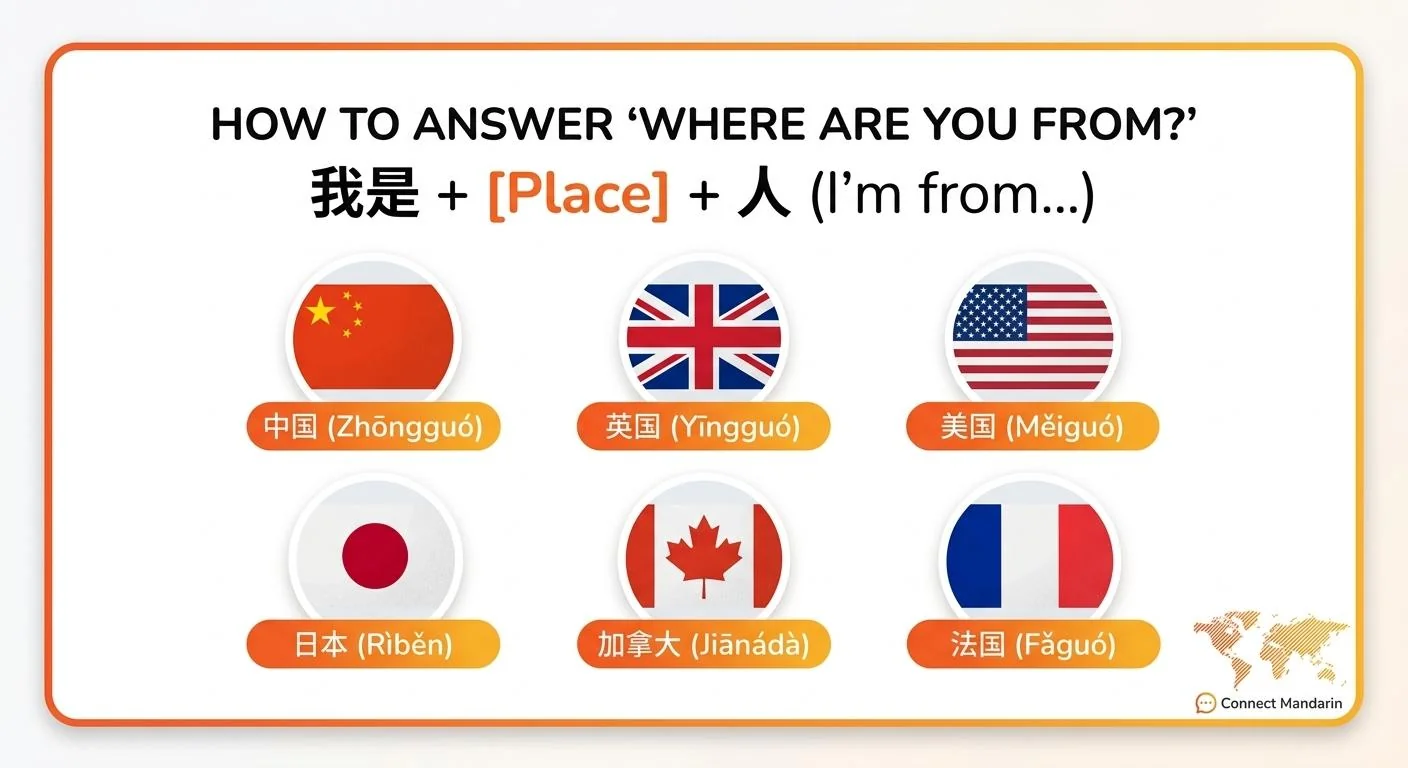
Once you've asked the question, you'll want to be ready to answer it too. Here are the most common patterns:
- 我是 + place + 人 — I'm from + place
- 我来自 + place — I come from + place
- 我的家乡是 + place — My hometown is + place
- 我在 + place + 长大 — I grew up in + place
Mini dialogue:
A: 你是哪里人?
Nǐ shì nǎlǐ rén?
Where are you from?
B: 我是澳大利亚人。
Wǒ shì Àodàlìyà rén.
I'm from Australia.
A: 你的家乡在哪里?
Nǐ de jiāxiāng zài nǎlǐ?
Where is your hometown?
B: 我的家乡在悉尼。
Wǒ de jiāxiāng zài Xīní.
My hometown is Sydney.
How to Keep the Conversation Going
Asking where someone is from is usually just the opening move. Here are a few natural follow-ups to keep things flowing:
- 你来中国多久了?— How long have you been in China?
- 你会说中文吗?— Can you speak Chinese?
- 你为什么学中文?— Why are you learning Chinese?
- 你喜欢这里吗?— Do you like it here?
These aren't alternative ways of asking "where are you from." Think of them as the next steps once that initial question has been answered.
Common Mistakes to Avoid
A few things trip up learners again and again with this topic:
- Using 你来自哪里 in every situation without noticing it can sound a bit stiff among close friends.
- Mixing up nationality and hometown, since someone's passport country and where they grew up aren't always the same.
- Reaching for 出生地 as a casual opener when a simple 你是哪里人 would fit better.
- Confusing 哪里 (where) with 哪个国家 (which country), which changes the question from general origin to specifically nationality.
- Giving a technically correct answer that sounds too formal or textbook for a relaxed conversation.
- Skipping tone practice on 哪里, 来自, 家乡, and 国家, all of which are easy to mispronounce at first.
Quick Cheat Sheet
| Phrase | Pinyin | English | Use when |
|---|---|---|---|
| 你是哪里人? | Nǐ shì nǎlǐ rén? | Where are you from? | Everyday conversation |
| 你来自哪里? | Nǐ láizì nǎlǐ? | Where do you come from? | Neutral or formal settings |
| 你的家乡在哪里? | Nǐ de jiāxiāng zài nǎlǐ? | Where is your hometown? | Asking about hometown |
| 你是哪个国家的? | Nǐ shì nǎge guójiā de? | Which country are you from? | Asking nationality |
| 你的出生地是哪里? | Nǐ de chūshēngdì shì nǎlǐ? | Where were you born? | Asking birthplace |
FAQs
How do you say "Where are you from?" in Chinese?
The most common way is 你是哪里人?(Nǐ shì nǎlǐ rén?), which literally breaks down to "you are a person from where." It works in almost any casual or semi-formal setting and is usually the first phrase Mandarin learners pick up for making small talk. If you only learn one version of this question, this is the one to know.
What does 你是哪里人 mean?
It breaks down into 你 (you), 是 (to be), 哪里 (where), and 人 (person). Together it asks about someone's origin, whether that's their country, province, or city. It's flexible enough to answer with anything from "我是德国人" (I'm German) to "我是北京人" (I'm from Beijing), which is part of why it's so widely used.
How do you ask someone's nationality in Chinese?
Use 你是哪个国家的?(Nǐ shì nǎge guójiā de?), which translates to "which country are you from?" This phrase makes nationality the clear focus, unlike 你是哪里人, which could just as easily be answered with a hometown or region instead of a country.
How do you say "Where do you come from?" in Mandarin?
That would be 你来自哪里?(Nǐ láizì nǎlǐ?). It carries a slightly more formal or neutral tone than 你是哪里人, making it a good fit for interviews, professional introductions, or conversations with someone you've just met in a formal setting.
How do you ask "Where is your hometown?" in Chinese?
Ask 你的家乡在哪里?(Nǐ de jiāxiāng zài nǎlǐ?). Unlike the more general 你是哪里人, this phrase specifically targets someone's hometown, which is useful once you learn that someone currently lives somewhere different from where they grew up.
How do you answer "Where are you from?" in Chinese?
Common patterns include 我是 + place + 人 (I'm from + place), 我来自 + place (I come from + place), and 我的家乡是 + place (my hometown is + place). Pick whichever matches the level of formality in the question you were asked, and you'll sound natural in return.
What is the difference between 你是哪里人 and 你来自哪里?
Both ask about origin, but 你是哪里人 feels more casual and conversational, while 你来自哪里 leans slightly formal. In daily life among friends or classmates, 你是哪里人 is far more common. Save 你来自哪里 for more polished or professional settings.
How do you ask where someone was born in Chinese?
Use 你的出生地是哪里?(Nǐ de chūshēngdì shì nǎlǐ?). This is the most specific of the five phrases here, asking about birthplace rather than hometown, nationality, or current residence, so it's best used once you already know someone a bit rather than as an opening question.
Want to feel more confident starting conversations in Mandarin? Learning useful phrases in context, with a teacher who corrects your tones on the spot, makes a real difference. Take a look at all the Mandarin lessons Connect Mandarin offers, or jump straight into a part-time Chinese class if you want something structured but flexible.
About the Author
Connect Mandarin Team
We are built by a team of native-speaking teachers and language educators who focus on real, usable Chinese - not just textbook phrases. With 15+ years of combined teaching experience.
Continue Reading

How to Say "Not This Time" in Chinese: 5 Natural Mandarin Phrases
Learn how to say 'not this time' in Chinese with 5 natural Mandarin phrases. Get pinyin, real examples, and tips on which one fits each situation.

Jokes in Chinese: Funny Phrases and Wordplay to Learn Mandarin
Learn jokes in Chinese, from dad-joke puns to internet slang, with pinyin, translations, and explanations of the wordplay behind each one.

How to Say Good Morning in Chinese: Phrases, Pinyin & Culture
Learn how to say good morning in Chinese with pinyin, tones, and etiquette. Discover formal, casual, and texting phrases used across Mandarin culture.