
What Countries Speak Mandarin? Official Languages and Where It Is Spoken Worldwide
Which countries speak Mandarin? See where it's official (China, Taiwan, Singapore), where it's widely spoken, and which version to learn first.
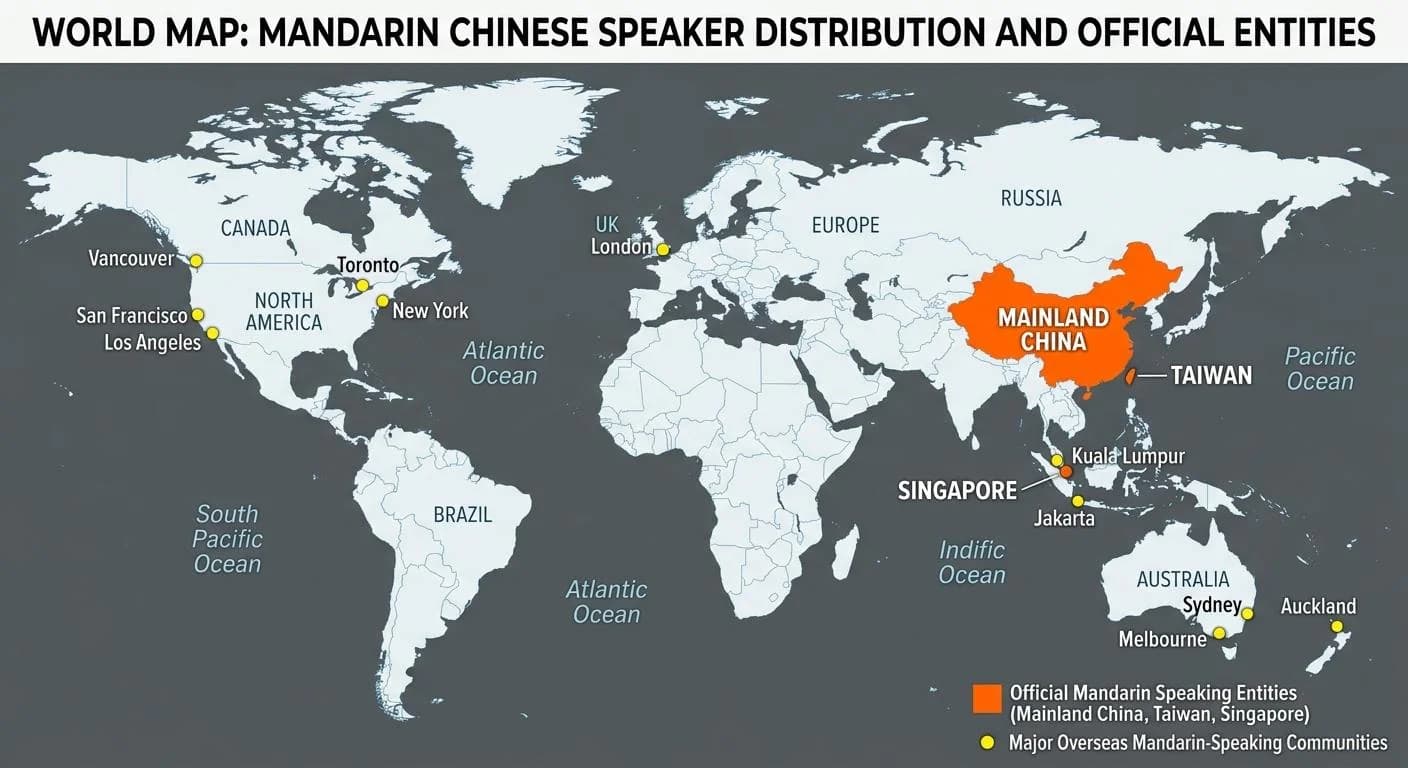
Mandarin is an official or national language in mainland China, Singapore and, in practice, Taiwan, and it is spoken by large communities across Southeast Asia, North America, Oceania and Europe.
That adds up to a lot of people. According to Ethnologue, Mandarin has approximately 940 million native speakers and well over a billion speakers in total, which makes it one of the most widely spoken languages on earth.
In this guide, we sort out what is official and what is simply widely spoken, why "Chinese-speaking" does not always mean Mandarin, and which version is best to learn first. We teach at Connect Mandarin in Beijing, and the standard form of Mandarin is built on Beijing pronunciation, so we are happy to explain it from the source.
Mandarin-Speaking Countries at a Glance
Here is the short version, split into three tiers so you can find your answer quickly.
| Tier | Country or territory | Role of Mandarin | Local name for Mandarin |
|---|---|---|---|
| Official or national | Mainland China | National standard | Putonghua (普通话, pǔtōnghuà) |
| Official or national | Taiwan | Main language (de facto) | Guoyu (国语, guóyǔ) |
| Official or national | Singapore | One of four official languages | Huayu (华语, huáyǔ) |
| Large communities | Malaysia | Large community | Huayu (华语, huáyǔ) |
| Large communities | Indonesia, Thailand, Philippines, Vietnam | Communities and learners | Varies |
| Large communities | United States, Canada | Large communities | Varies |
| Large communities | Australia, New Zealand, United Kingdom | Communities and learners | Varies |
| Growing through education and business | Hong Kong and Macau | Taught and growing | Putonghua (普通话, pǔtōnghuà) |
| Growing through education and business | Japan, South Korea | Business and study | Varies |
The general term for the Chinese language is Hanyu (汉语, hànyǔ). Each place has its own name for Mandarin, which we explain below.
Where Mandarin Is an Official or National Language
Three places give Mandarin a leading role in public life. Each one uses it a little differently.
Mainland China: Putonghua (普通话, pǔtōnghuà)
In mainland China, Mandarin goes by Putonghua, which means "common speech." It is the national standard used in schools, news media and government, and its pronunciation is based on the Beijing dialect. A student in Chengdu, a banker in Shanghai and a farmer in Heilongjiang can all use it to understand each other.
Putonghua does not replace local speech, though. Regional languages and dialects are alive and well, from Shanghainese to Cantonese, and many people switch between their home language and Putonghua several times a day.
Taiwan: Guoyu (国语, guóyǔ)
In Taiwan, Mandarin is called Guoyu, or "national language." It is the main language of government, education and daily life, so it is best described as the de facto main language of the island. Many people also speak Taiwanese Hokkien and Hakka at home.
Learners will notice a few differences. Taiwan uses traditional characters, and schools teach Zhuyin (Bopomofo) as a sound guide. Some vocabulary differs too. Software is 软件 (ruǎnjiàn) on the mainland and 軟體 (ruǎntǐ) in Taiwan.
Singapore: Huayu (华语, huáyǔ)
Singapore has four official languages: English, Malay, Tamil and Mandarin. English is the common language of administration and business, while Mandarin is taught in schools as part of the Mother Tongue subject. Here, Mandarin is called Huayu.
The government has long encouraged Mandarin use among Chinese Singaporeans through its Speak Mandarin Campaign. In everyday conversation you will often hear English and Mandarin mixed in the same sentence, which is a fun sign of a living language.
Special case: Hong Kong and Macau
Cantonese is the everyday language in Hong Kong and Macau. Putonghua is taught in schools and is used more and more in business, tourism and government. Many residents speak both. A traveler who knows Mandarin can often get by, although Cantonese still leads in daily conversation.
Good to know: Chinese is one of the six official languages of the United Nations. This refers to Chinese as used in formal UN work, in writing and in speech. It does not describe the national status of Mandarin in any single country.

Countries With Large Mandarin-Speaking Communities
Mandarin travels with people. Centuries of migration, followed by more recent waves of students, business owners and professionals, have created Chinese communities around the world.
One honest note before we go further. Many overseas Chinese families speak Hokkien, Teochew, Cantonese or Hakka at home. So the number of "Chinese speakers" in a country and the number of "Mandarin speakers" are not the same thing, and it helps to check which one a statistic is measuring.
Southeast Asia: Malaysia, Indonesia, Thailand, the Philippines and Vietnam
Malaysia has Chinese-medium schools, which makes Mandarin a common language among Chinese Malaysians, alongside Cantonese, Hokkien and Hakka.
Indonesia has a more complicated story. Chinese-language education and public use were restricted for decades, and Mandarin has returned in recent years through schools, tutoring and business.
Thailand, the Philippines and Vietnam are home to large ethnic Chinese populations. Their heritage varieties are often Teochew, Hokkien or Cantonese, while Mandarin keeps growing through schools and trade. Keep in mind that the size of an ethnic Chinese population does not tell you how many people speak Mandarin.
North America: United States and Canada
The biggest Mandarin-speaking hubs include New York, the San Francisco Bay Area and Los Angeles in the United States, and Vancouver and Toronto in Canada. Official numbers come from the US Census Bureau and Statistics Canada. Both agencies count "Chinese" and "Mandarin" in different ways, so look at the exact label before you compare figures.
Oceania and Europe: Australia, New Zealand, the United Kingdom
In these countries, Mandarin is shaped by student and professional communities. It also appears more often in school and university programs, which brings in learners with no family connection to China.
Japan and South Korea
In the big cities of Japan and South Korea, Mandarin is heard in business, tourism and international study. Many Chinese students and professionals live there, and many locals learn Mandarin for work.
Mandarin, Cantonese and Other Chinese Languages: Why "Chinese-Speaking" Is Not Always Mandarin
Think of "Chinese" as a family, a bit like the Romance languages. Mandarin is the largest member. Other members include Cantonese, Wu (which includes Shanghainese), Min (which includes Hokkien and Teochew) and Hakka.
You may read that Mandarin and Cantonese are the only two Chinese languages spoken outside China. That is a common shortcut, and it leaves out a lot. Hokkien, Teochew and Hakka are widespread across the diaspora, especially in Southeast Asia.
Spoken varieties are mostly not understood across groups. A Mandarin speaker will not follow spoken Cantonese without study. Writing is another matter, since the characters are shared to a large degree, so a Mandarin reader can usually make sense of written Cantonese or Hakka text.
Curious about the other side of the family? our article on the Hakka people, one of the best-known Chinese communities abroad.
Why Mandarin Keeps Spreading Beyond Asia
A few steady forces keep Mandarin moving into new places. Trade and business create demand. Schools add Mandarin classes, and universities build full Chinese programs. Heritage learners, the children and grandchildren of Chinese families, return to the language they grew up hearing. Travel adds more, and the HSK exam gives learners a recognized way to show their level.
We do not quote a growth number here, because figures vary by source and change quickly. The pattern is clear enough without one, though. More people each year want to speak with a quarter of the world's population.
Families who want a quick, memorable start can look at our Chinese summer camps in Beijing, where kids learn the language by using it every day.

Which Mandarin Should You Learn? Standard, Taiwanese or Singaporean
Short answer: start with Standard Mandarin. Here is how the three main varieties compare.
| Variety | Local name | Script | What differs | Best for |
|---|---|---|---|---|
| Standard Mandarin | Putonghua (普通话) | Simplified | Based on Beijing pronunciation | Most learners, the HSK, mainland China |
| Taiwanese Mandarin | Guoyu (国语) | Traditional, with Zhuyin in schools | Some vocabulary and accent differences | Living or studying in Taiwan |
| Singaporean Mandarin | Huayu (华语) | Simplified | Everyday mixing with English and local words | Work and life in Singapore |
| Verdict | Start with Standard Mandarin | Almost everyone |
Two things help from day one. Pinyin is the system that writes Mandarin sounds with the Latin alphabet. Mandarin also has four tones, and the same syllable can mean different things depending on the tone.
Putonghua draws on Beijing pronunciation, which is why Beijing is such a natural place to learn it. Standard Mandarin is also the version used in most textbooks and in the HSK. If you plan to sit the exam, our HSK exam preparation program follows exactly that standard.
Try it: 你是哪国人? Nǐ shì nǎ guó rén? means "Where are you from?" It works in every Mandarin-speaking place. Tone reminder: nǐ (third tone, dip), shì (fourth, sharp fall), nǎ (third), guó (second, rising), rén (second). Say it out loud, and you are already speaking Mandarin. Ready to build on it? Our beginner Chinese course.
Learn Mandarin at the Source: Beijing
Mandarin is spoken in more places than most people expect, and each place gives it a slightly different flavor. What ties them together is the standard that began in Beijing, and that is the version we teach every day.
If you would like to try it with a teacher who lives it, start with our beginner Chinese course. You can also look at the HSK exam preparation program or our Chinese summer camps in Beijing.
Frequently Asked Questions
How many countries speak Mandarin?
Mandarin is an official or national language in only a few places: mainland China, Taiwan (de facto) and Singapore. However, Mandarin speakers live in dozens of countries, including Malaysia, Indonesia, Thailand, the United States, Canada and Australia, largely because of Chinese migration and growing interest in learning the language.
Is Mandarin an official language in Singapore?
Yes. Mandarin is one of Singapore's four official languages, alongside English, Malay and Tamil. English is the main language of administration and business, while Mandarin is taught in schools as part of the Mother Tongue curriculum and is widely used in media and daily conversation within Chinese Singaporean communities.
Is Mandarin the same as Chinese?
Not exactly. Mandarin is the most widely spoken variety of Chinese, but "Chinese" also includes other languages such as Cantonese, Shanghainese, Hokkien and Hakka. Standard Mandarin, called Putonghua in mainland China, is the national standard used in schools, government and media, and its pronunciation is based on the Beijing dialect.
Which country has the most Mandarin speakers?
China has by far the most Mandarin speakers, since Standard Mandarin is the national language used in schools, media and government. Taiwan and Singapore also use Mandarin every day. Outside Asia, the United States, Canada and Australia have significant Mandarin-speaking communities, mainly formed through immigration and international study.
Do people speak Mandarin in Hong Kong?
Cantonese is the everyday spoken language in Hong Kong and Macau, but Mandarin (Putonghua) is taught in schools and increasingly used in business, tourism and government. Many residents speak both, so visitors who know Mandarin can often communicate, although Cantonese remains more common in daily conversation.
Which type of Mandarin should I learn first?
Start with Standard Mandarin (Putonghua), which is based on Beijing pronunciation. It is the version used in most textbooks, the HSK exam and mainland media. Taiwanese and Singaporean Mandarin differ slightly in vocabulary and accent, but learners of Standard Mandarin can usually understand all of them.
About the Author
Connect Mandarin Team
We are built by a team of native-speaking teachers and language educators who focus on real, usable Chinese - not just textbook phrases. With 15+ years of combined teaching experience.
Continue Reading

What Are You Doing in Chinese? 你在做什么 (Nǐ Zài Zuò Shénme) Explained
Learn how to say "what are you doing" in Chinese, from the textbook-standard 你在做什么 to the casual Beijing favorite 你在干嘛, with pinyin, tone tips, and real dialogues.

Where Are You From in Chinese? (5 Natural Ways to Ask in Mandarin)
Learn 5 natural ways to ask "where are you from" in Chinese, from the everyday nǐ shì nǎlǐ rén to the formal nǐ láizì nǎlǐ, with pinyin and real conversation examples.

How to Say "Not This Time" in Chinese: 5 Natural Mandarin Phrases
Learn how to say 'not this time' in Chinese with 5 natural Mandarin phrases. Get pinyin, real examples, and tips on which one fits each situation.