
Hakka People: History, Language, and Culture Explained
The Hakka people (客家人) are a Han Chinese subgroup known for their own language, fortified earthen homes, and a cuisine built around preserved ingredients. Here's where they came from, how they live today, and what their story teaches Mandarin learners.
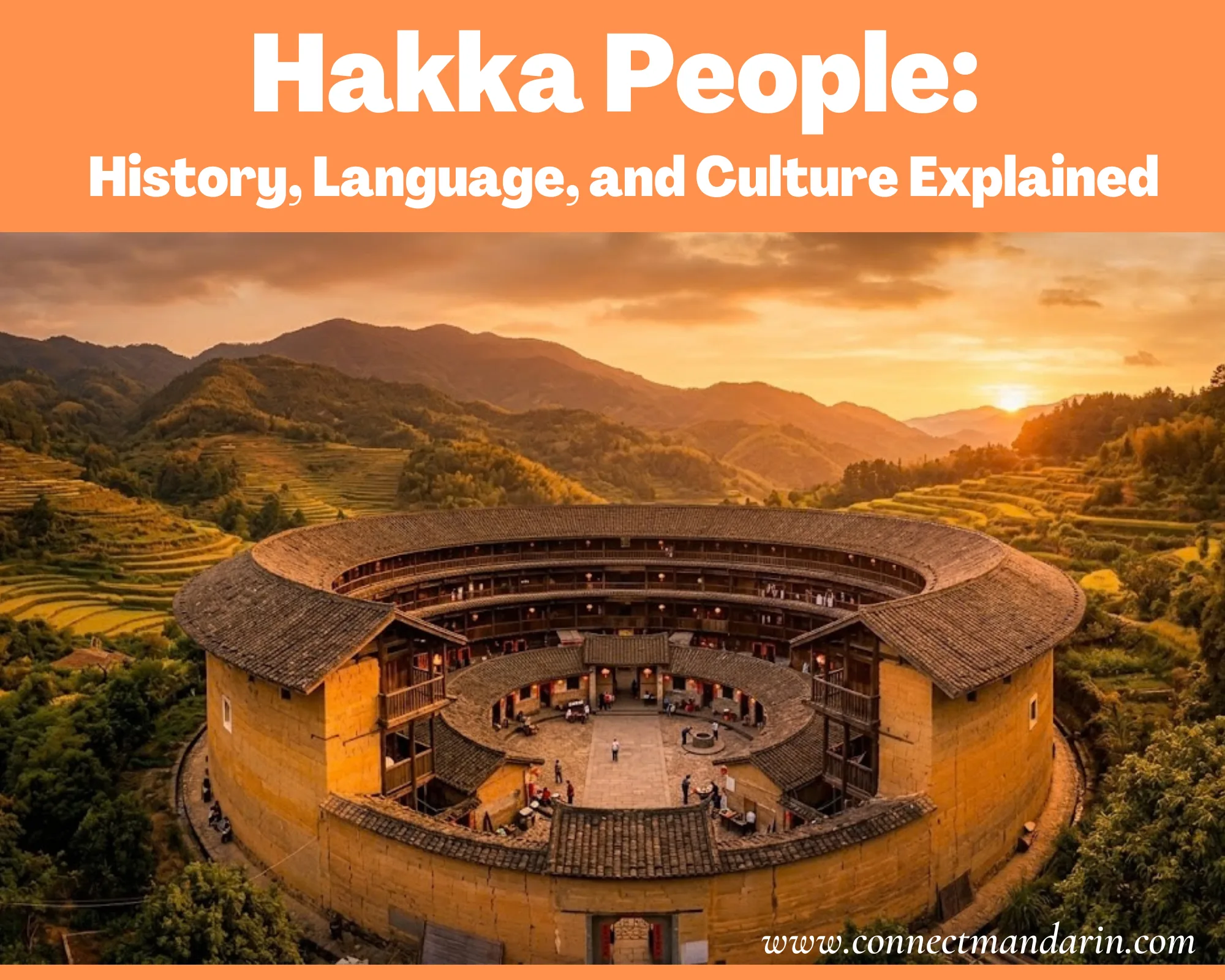
The Hakka people (客家人, Kèjiā rén) are a Han Chinese subgroup known for their own language, their fortified earthen homes, and a cuisine built around preserved ingredients and hearty flavors. They trace their roots to northern China and moved south over many centuries, eventually settling in Guangdong, Fujian, Jiangxi, and Taiwan, with large communities spreading across Southeast Asia and beyond.
This guide walks through where the Hakka came from, how their language compares to Mandarin, what makes their architecture and food distinctive, and why their story matters if you're learning Chinese. We teach Putonghua here at Connect Mandarin, the standard based on Beijing pronunciation, so we'll point out a few Beijing contrasts along the way.
Hakka People at a Glance
| Fact | Detail |
|---|---|
| Chinese name | 客家人 (Kèjiā rén) |
| Meaning | "Guest families" |
| Classification | Han Chinese subgroup |
| Language | Hakka (客家话, Kèjiāhuà) |
| Main regions | Guangdong, Fujian, Jiangxi, plus Guangxi, Sichuan, Taiwan |
| Population | Estimates range roughly from 40 million to over 80 million worldwide |
| Iconic landmark | Tulou (土楼), a UNESCO World Heritage Site in Fujian |
| Signature dish | Stuffed tofu (酿豆腐, niàng dòufu) |
Who Are the Hakka People?
The Hakka aren't one of China's 55 officially recognized ethnic minorities. They're Han Chinese, the same broad ethnic group as most of the country, but they're set apart by a language, a set of customs, and a migration history that gave them a distinct identity.
What does "Hakka" mean? The name comes from 客家 (Kèjiā): 客 kè means "guest" and 家 jiā means "family." "Hakka" is simply how the Hakka language pronounces those same two characters. Local communities in the south originally used the term for the northern newcomers arriving in their region. Over time, the label stopped being an outsider's tag and became something the community wore with pride.
How many Hakka people are there? Counting is tricky because it depends on how you define "Hakka," by language, by ancestry, or by self-identification. Estimates commonly range from about 40 million to more than 80 million people worldwide, with the majority living in southern China.
Where Did the Hakka People Come From?
The story starts in the Central Plains, the region along the Yellow River often described as the cradle of Chinese civilization. Over roughly a thousand years, waves of families left this area, pushed south by war, famine, and political upheaval.
Historians commonly describe this migration in five broad waves:
| Wave | Approximate period | What triggered it | Where people moved |
|---|---|---|---|
| 1st | 4th century (Jin dynasty) | Northern invasions and unrest | Central Plains to the Yangtze and Huai region |
| 2nd | Late Tang, 9th century | The Huang Chao rebellion | Further south to Jiangxi and Fujian |
| 3rd | Southern Song to Yuan, 12th–13th century | Jurchen and Mongol invasions | Into the hill country on the Fujian-Guangdong border |
| 4th | Ming to Qing, 17th–18th century | Dynastic change and population pressure | Guangdong's lowlands, Guangxi, Sichuan, Taiwan |
| 5th | 19th century | Local conflicts, the Taiping era, overseas emigration | Hong Kong, Southeast Asia, and further abroad |
This is the commonly cited model, and historians continue to debate the finer details, but it gives a useful shape to a very long story.
Why the hills, and why "guests"? By the time later waves of Hakka arrived, the fertile lowlands were already settled by other communities. Newcomers ended up in the surrounding hills, land that was harder to farm but easier to defend. That combination, tough terrain and outsider status, shaped a culture built around clan loyalty, self-reliance, and strong defenses, which you can still see in Hakka architecture today.
Where Do Hakka People Live Today?
In China. The heartland runs through Guangdong, Fujian, and Jiangxi. Meizhou in Guangdong is often called the "Hakka capital" (客都, Kèdū). Smaller communities are found in Guangxi and Sichuan as well.
Beyond China. Later migration waves carried Hakka communities to Taiwan, Hong Kong, Malaysia, Singapore, Indonesia, Mauritius, the Caribbean, North America, and Australia. Hakka associations and clan networks still connect many of these communities today.
The Hakka Language: How Is It Different from Mandarin?
This is where things get interesting for anyone studying Chinese, because Hakka and Mandarin are genuinely different varieties, not just accents of the same thing.
| Feature | Hakka | Mandarin (Putonghua) | Cantonese |
|---|---|---|---|
| Standard base | Regional varieties; Meixian speech is often used as a reference | Based on Beijing pronunciation | Guangzhou / Hong Kong |
| Tones | Around 6, varying by dialect | 4, plus a neutral tone | 6, or 9 if you count checked tones |
| Final consonants (-p, -t, -k) | Retained | Lost | Retained |
| Where it's spoken | Guangdong, Fujian, Jiangxi, Taiwan, parts of Southeast Asia | Nationwide; China's official language | Guangdong, Hong Kong, Macau |
Can Mandarin speakers understand Hakka? Not when it's spoken. The two are separate varieties with different sounds, different tone systems, and different vocabulary, so a Mandarin speaker generally can't follow spoken Hakka without study. Because both use Chinese characters, though, there's more common ground in writing.
Why Putonghua is the common language. Putonghua (普通话, Pǔtōnghuà), literally "common speech," is the standard form of Mandarin taught in schools and used in media across China. It's based on the pronunciation of Beijing, which is exactly why studying in Beijing gives learners direct exposure to the accent and rhythm the standard was built around. Hakka speakers, like speakers of Cantonese, Shanghainese, and dozens of other varieties, learn Putonghua for school, work, and travel, while still keeping their home language alive at the family and community level.
Hakka Architecture: Tulou and Encircling-Dragon Houses
What is a tulou? A tulou (土楼) is a large, fortified building made from rammed earth, built to house an entire extended family or clan under one roof. They're known for thick outer walls, a single main gate, and a circular or square layout wrapped around a shared inner courtyard. Living communally like this made practical sense for a community that valued clan solidarity and needed strong, defensible housing in unfamiliar territory.
In the Meizhou area, you'll also find 围龙屋 (wéilóngwū), or "encircling-dragon houses," a related style of Hakka communal home with its own distinct layout.
Fujian Tulou and UNESCO. A group of tulou clusters in Fujian province were inscribed as a UNESCO World Heritage Site, recognized for their scale, their ingenuity, and how well they still stand today. They remain the single most recognizable symbol of Hakka culture.
If stories like this make you want to see Chinese heritage up close rather than just read about it, Connect Mandarin's Culture Explorer Program runs small-group travel and study trips in Beijing built around exactly this kind of hands-on cultural experience: local food, historic sites, and practical Mandarin along the way.
Hakka Food: What Do Hakka People Eat?
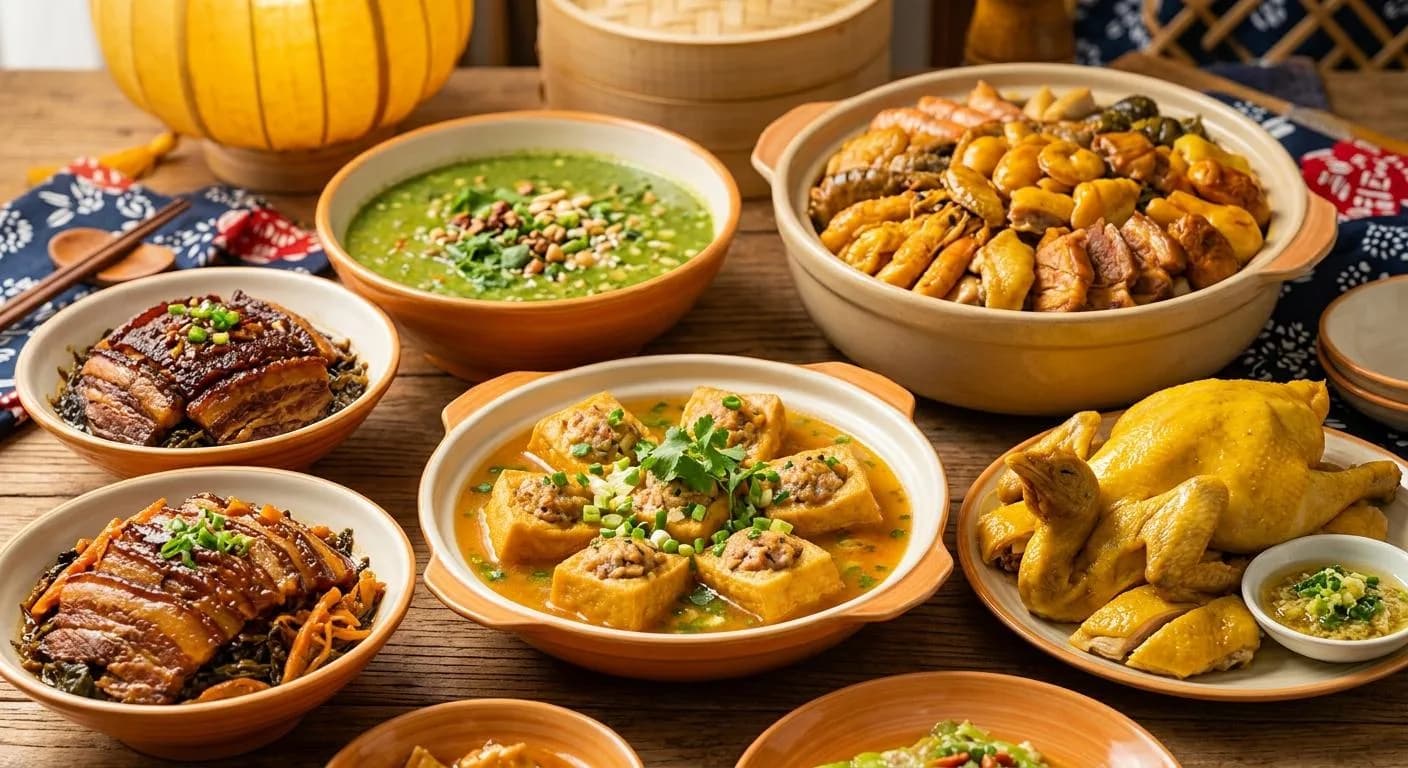
Hakka cooking grew out of hill-country life, where preserving food and stretching ingredients mattered more than fancy presentation. Expect savory, salty flavors and simple, satisfying techniques.
| Dish | Chinese | Pinyin | What it is |
|---|---|---|---|
| Stuffed tofu | 酿豆腐 | niàng dòufu | Tofu filled with seasoned minced meat or fish; the dish most associated with Hakka cuisine |
| Salt-baked chicken | 盐焗鸡 | yánjú jī | Whole chicken baked in salt for a deep, savory flavor |
| Braised pork with preserved mustard greens | 梅菜扣肉 | méicài kòuròu | Salty preserved greens layered with tender braised pork belly |
| Pounded tea | 擂茶 | léichá | Tea ground together with herbs, nuts, and seeds, traditionally shared as a communal drink |
| Poon choi | 盆菜 | pén cài | A layered feast served in one large basin, often tied to festival gatherings |
If you've spent time in Beijing, you'll notice the contrast. Southern Hakka cooking leans on preserved mustard greens and salt-cured meats, while a classic Beijing breakfast might feature fermented mung bean drink (豆汁儿, dòuzhīr) alongside fried dough rings (焦圈, jiāoquān). Same country, completely different flavor worlds, which is part of what makes regional Chinese food so rewarding to explore.
Hakka Customs, Family Values, and Festivals
Family and ancestors. Clan lineage sits at the center of Hakka social life, and ancestral halls (祠堂, cítáng) served as the physical and spiritual heart of a village, where families gathered to honor their forebears. Hakka women historically took on significant farm labor alongside men, a distinctive feature of Hakka village life compared with some neighboring communities.
Festivals and music. Hakka communities mark the same major holidays as the rest of China, Lunar New Year, Qingming, and Mid-Autumn Festival among them, often layered with their own local traditions. One living tradition worth knowing is 客家山歌 (Kèjiā shāngē), or Hakka mountain songs, a style of folk singing still performed and passed down today.
What Hakka Culture Teaches Mandarin Learners
The Hakka story is a good reminder that "Chinese" isn't one single language. It's a family of varieties that share a writing system but sound very different from region to region. Characters connect Hakka, Cantonese, and Mandarin speakers on the page even when their spoken languages aren't mutually understandable.
For beginners, this is actually good news. Putonghua, based on Beijing pronunciation, is the version taught in schools, tested on the HSK, and used in media nationwide, so it's the practical starting point no matter which regional culture you're most drawn to. If you want to start without overhauling your schedule, Connect Mandarin's Part-Time Group Classes run twice a week in small groups, with morning and evening slots in Beijing.
Frequently Asked Questions
Who are the Hakka people?
The Hakka are a Han Chinese subgroup who speak their own language and trace their roots to northern China. Their name, Kèjiā (客家), means "guest families," a nod to centuries of southward migration. Today they live mainly in Guangdong, Fujian, Jiangxi, and Taiwan, with large overseas communities across Southeast Asia and beyond.
Where does the name Hakka come from?
Hakka is how the community pronounces 客家 (Kèjiā in Mandarin), meaning "guest families." Local communities in southern China used the term for northern newcomers who arrived over time and settled in the surrounding hills. The name eventually became a source of shared identity rather than an outsider's label.
Where do the Hakka people come from?
The Hakka trace their origins to the Central Plains along the Yellow River. Over roughly a thousand years, families moved south in waves to escape war, famine, and unrest, settling in Jiangxi, Fujian, and Guangdong. The hill country they ended up in shaped their self-reliant, clan-centered culture.
Is Hakka the same as Mandarin?
No. Hakka and Mandarin are separate Chinese varieties and aren't mutually understandable when spoken. Hakka keeps older sounds that Mandarin lost over time and uses more tones. Mandarin's standard form, Putonghua, is based on Beijing pronunciation and serves as China's official spoken language, which most Hakka speakers also learn.
What are Hakka tulou?
Tulou are large, fortified earthen buildings that Hakka communities built in Fujian, with thick rammed-earth walls, a single main gate, and a circular or square shape that let entire clans live together safely. Several tulou clusters are recognized as UNESCO World Heritage Sites, making them the best-known symbol of Hakka architecture.
What is Hakka food known for?
Hakka cooking is hearty and built around preserved ingredients, shaped by generations of hill-country life. Signature dishes include stuffed tofu (niàng dòufu), salt-baked chicken, braised pork with preserved mustard greens (méicài kòuròu), and pounded tea (léichá). The flavors tend to be savory and salty rather than sweet.
Who are some famous Hakka people?
Figures commonly identified as being of Hakka descent include Deng Xiaoping, Zhu De, and Ye Jianying, all central to modern Chinese politics, along with Taiping leader Hong Xiuquan and Singapore's founding prime minister Lee Kuan Yew. Ancestry claims for some historical figures are debated, so these are best described as being of Hakka descent.
How many Hakka people are there?
Estimates vary widely, typically ranging from about 40 million to more than 80 million people worldwide, depending on whether the count is based on language, ancestry, or self-identification. Most live in southern China, particularly Guangdong, with significant communities in Taiwan, Hong Kong, and across Southeast Asia.
About the Author
Connect Mandarin Team
We are built by a team of native-speaking teachers and language educators who focus on real, usable Chinese - not just textbook phrases. With 15+ years of combined teaching experience.
Continue Reading
Famous Chinese People: 20 Figures Who Shaped History and Culture
Learn about 20 famous Chinese people who shaped China's history and culture, from Confucius to Jack Ma, with Hanzi, pinyin, and how to say each name.
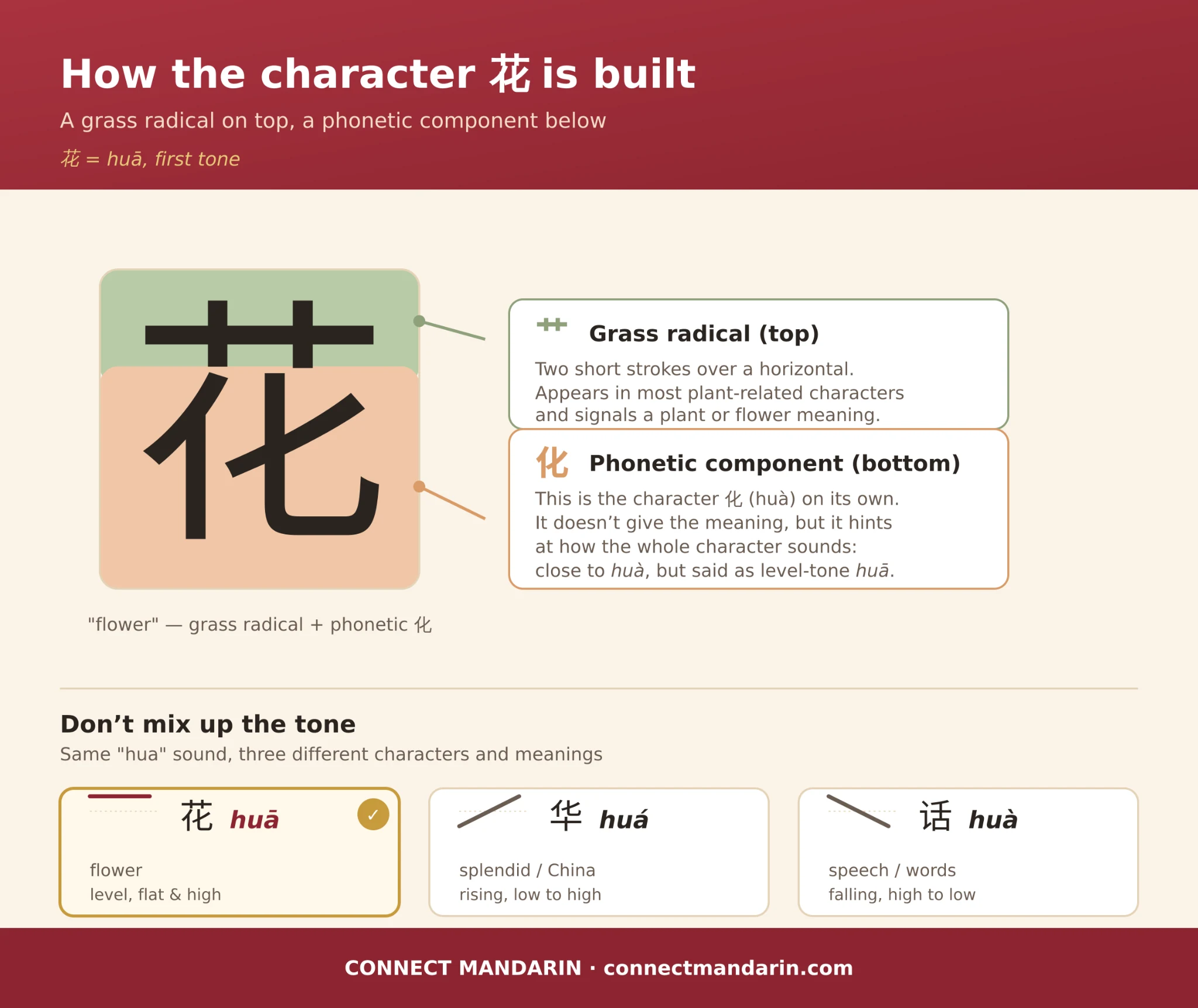
Flowers in Chinese: Names, Meanings, and Culture (花 huā)
Learn Chinese flower names like 玫瑰 (rose) and 牡丹 (peony), their cultural meanings, and how 花 shows up in idioms and Chinese New Year customs.
Chinese Girl Names: 50+ Meaningful Names with Pinyin & Pronunciation
Discover 50+ Chinese girl names with pinyin, tones & meanings from Beijing-based Mandarin teachers. Find the perfect name for your daughter.