
The Chinese Gender Calendar in 2026: How It Works and Why It Is Great for Learning Mandarin
Learn how the Chinese gender calendar works with 2026 dates, try our free calculator, and pick up Mandarin words like 农历, 虚岁 and 怀孕 along the way.
Chinese Gender Calendar Calculator
Enter two dates to see whether the Chinese gender calendar predicts a boy or a girl.
Every year, a few of our students come to class with the same story. A Chinese friend or a mother-in-law found out about a pregnancy, grabbed a pen, and started counting on a piece of paper. Then came the question: "What's your lunar age?"
That piece of paper was the Chinese gender calendar, and it is a nice way to see how Chinese families think about time, age, and family. In this post we will show you how it works, how to use it with 2026 dates, and which Mandarin words you will pick up along the way.
One thing before we start. This is a tradition, not a medical test. We will say more about that below.
What Is the Chinese Gender Calendar?
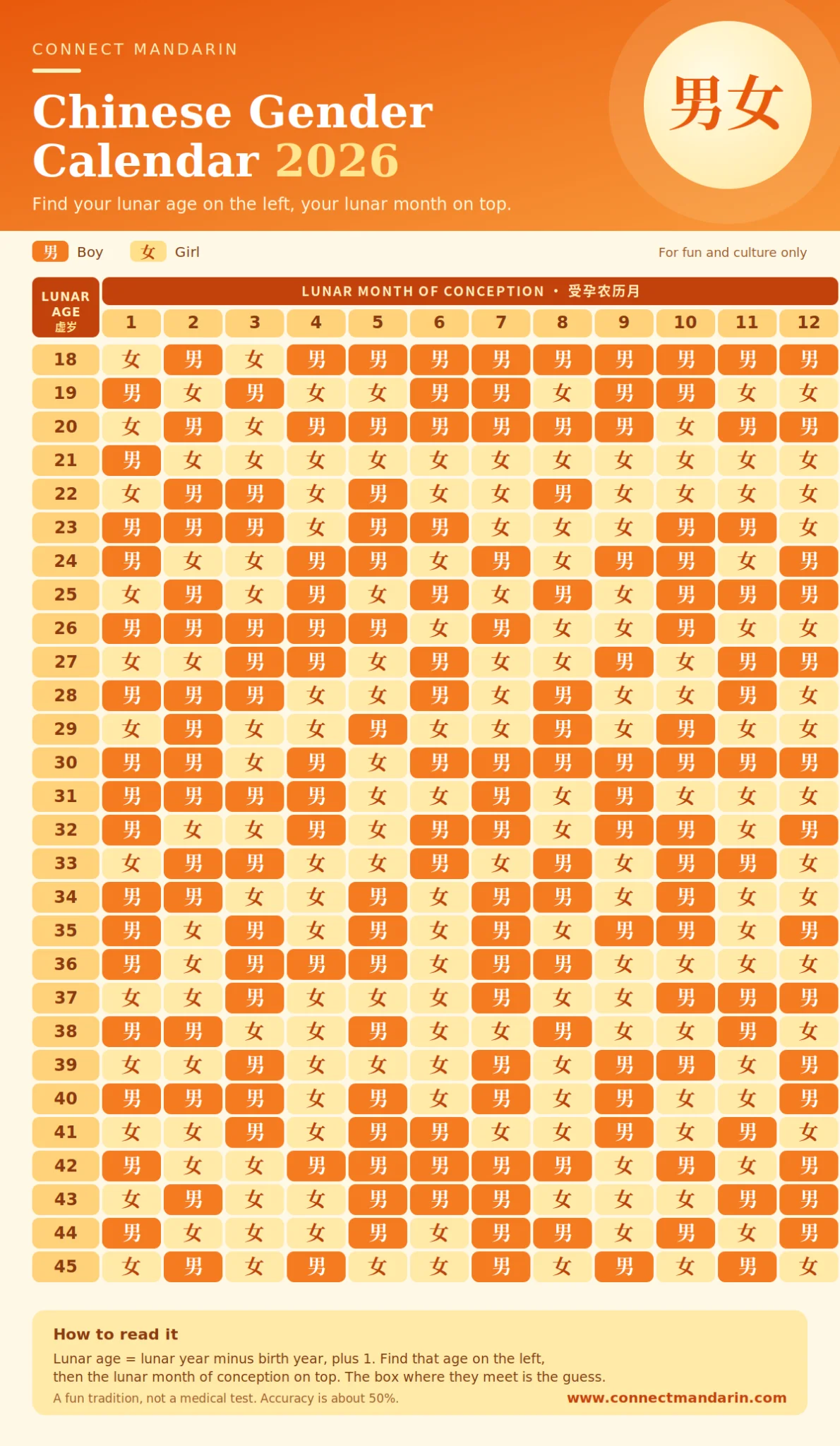
It is a chart with two sides. The mother's age is listed down the left, and the twelve months of the lunar year run across the top. Every box says either 男 (nán, boy) or 女 (nǚ, girl). You find your age, find your month, and read the box where they meet.
People call it the Chinese birth chart, the Chinese pregnancy calendar, or the Qing Palace Chart (清宫图, qīnggōng tú). It is all the same chart, and it does not change from year to year.
The tricky part is that it uses the lunar calendar (农历, nónglì). Your age and your month both need to be converted before you can use it. That is where most people get stuck, so let's go through it slowly.
Step One: Find Your Lunar Age
In traditional Chinese counting, a baby is one year old at birth. You then get a year older at Chinese New Year, not on your birthday. This is called 虚岁 (xūsuì). The age most of us use is 周岁 (zhōusuì).
A simple way to work it out:
lunar year minus your birth year, plus 1
Someone born in 1996 who is calculating for the lunar year 2026 gets 2026 - 1996 + 1 = 31.
The important detail is that "lunar year" means the year according to the Chinese calendar. In 2026, the lunar year began on February 17. If your date falls before that, you are still in lunar year 2025.
Step Two: Find Your Lunar Month
Lunar months begin with the new moon, so they do not match the months on your phone. Here are the 2026 start dates for the first few:
| Lunar month | Starts around |
|---|---|
| 1 | February 17, 2026 |
| 2 | March 19, 2026 |
| 3 | April 17, 2026 |
Use your estimated conception date, which is usually about two weeks after your last period began. If it is close to the edge of a month, check it with a lunar date converter. A day or two can change the result.
Two Examples
Mei was born in 1996 and conceived around March 5, 2026. That date is after Chinese New Year, so she is in the lunar year 2026, and her lunar age is 31. March 5 falls between February 17 and March 19, so she is in lunar month 1. On the chart, she looks at age 31 and month 1.
Anna was also born in 1996, but she conceived around January 25, 2026. That is before Chinese New Year, so for the chart she is still in the lunar year 2025. Her lunar age is 2025 - 1996 + 1 = 30, and the date falls in the last month of that lunar year, month 12. She looks at age 30 and month 12.
Same birth year, different results, just because of one date. This is the mistake we see most often. Don't want to count by hand? Use our calculator at the top of this page.
What About the Year of the Fire Horse?
2026 is the Year of the Horse (属马, shǔ mǎ), and in the traditional sixty-year cycle it is a Fire Horse (火马, huǒ mǎ). It runs from February 17, 2026 until February 5, 2027.
Many people assume the animal changes the prediction. It does not. The zodiac is a lovely part of Chinese culture, but it is separate from the chart. What changes each year is only the date of Chinese New Year and the way months line up with the lunar calendar. If you are planning for 2027, Chinese New Year falls on February 6, and the Year of the Goat begins.
So Does It Work?
Not really. With only two possible answers, boy or girl, any guess will be right about half the time, and studies of the chart have found nothing better. You may see websites claiming 90% accuracy, but there is no research behind those numbers.
It still feels accurate to many people, and the reason is simple. When the chart gets it right, everyone remembers and tells the story. When it gets it wrong, nobody mentions it again.
Please do not use it to make decisions about your pregnancy. If you want to know the baby's sex, a NIPT blood test can show it from around 10 weeks, and an ultrasound scan usually confirms it at 18 to 20 weeks. Your doctor can tell you which is right for you.
Where Did It Come From?
The honest answer is that no one knows. One popular story says the chart is about 700 years old and was found in a tomb near Beijing. Another says it was kept in the Qing palace for the imperial family. Neither story has solid proof. What we can say is that Chinese families have shared it for a long time, and it has become a well-known pregnancy tradition around the world.
Mandarin Words You Can Learn From the Chart
This is our favorite part. A chart like this is a great way to practice real, everyday Chinese.
| Chinese | Pinyin | English |
|---|---|---|
| 农历 | nónglì | lunar calendar |
| 阳历 | yánglì | solar (regular) calendar |
| 虚岁 | xūsuì | traditional lunar age |
| 周岁 | zhōusuì | age by the Western count |
| 春节 | chūnjié | Spring Festival |
| 怀孕 | huáiyùn | to be pregnant |
| 男孩 | nánhái | boy |
| 女孩 | nǚhái | girl |
| 预产期 | yùchǎnqī | due date |
Here are three sentences to try out loud:
- 我怀孕了。(Wǒ huáiyùn le.) I'm pregnant.
- 你的虚岁是多少?(Nǐ de xūsuì shì duōshao?) What is your lunar age?
- 预产期是什么时候?(Yùchǎnqī shì shénme shíhou?) When is the due date?
A good tip from our teachers: say these to a Chinese-speaking friend and ask them to work out your lunar age. Most people love to help, and you will get real conversation practice.
Frequently Asked Questions
Do I use my regular age or my lunar age?
Your lunar age. Use the formula in this post.
What if my cycle is irregular?
Your conception date will only be an estimate, which makes the prediction even less reliable. Your doctor can give you a better due date after an early scan.
Is there a different chart for 2026?
No. The chart stays the same. Only the date conversion changes.
Can it predict twins?
No. It gives one answer, boy or girl.
Do people in China still use it?
Some do, mostly for fun. Many families know about it, but today most people rely on medical tests.
Can non-Chinese parents try it?
Of course. Just treat it as a cultural tradition and have fun with it.
Final Thoughts
The Chinese gender calendar is a charming piece of tradition, and it is a good excuse to learn about the lunar calendar, the way Chinese people count age, and a handful of useful words. Enjoy the guess, and leave the real answer to the scan.
Learn Mandarin With Us
If you enjoyed words like 农历 and 虚岁, you will enjoy our classes too. At Connect Mandarin, our teachers help students speak real Chinese from the first lesson, using topics from everyday life and culture, just like this one.
About the Author
Connect Mandarin Team
We are built by a team of native-speaking teachers and language educators who focus on real, usable Chinese - not just textbook phrases. With 15+ years of combined teaching experience.
Continue Reading

Chinese Breakfast: Popular Foods, Dishes & What People Eat in China
Explore Chinese breakfast foods like baozi, youtiao, congee and jianbing. See regional dishes, key Mandarin phrases, and how to order breakfast in China.

Hakka People: History, Language, and Culture Explained
The Hakka people (客家人) are a Han Chinese subgroup known for their own language, fortified earthen homes, and a cuisine built around preserved ingredients. Here's where they came from, how they live today, and what their story teaches Mandarin learners.
Famous Chinese People: 20 Figures Who Shaped History and Culture
Learn about 20 famous Chinese people who shaped China's history and culture, from Confucius to Jack Ma, with Hanzi, pinyin, and how to say each name.