
What Are You Doing in Chinese? 你在做什么 (Nǐ Zài Zuò Shénme) Explained
Learn how to say "what are you doing" in Chinese, from the textbook-standard 你在做什么 to the casual Beijing favorite 你在干嘛, with pinyin, tone tips, and real dialogues.
The standard way to ask "what are you doing" in Mandarin is 你在做什么?(Nǐ zài zuò shénme?). It's neutral and works in almost any situation, which is why it's the phrase most textbooks teach first. Break it down: 你 (nǐ, "you") + 在 (zài, marks an action in progress) + 做什么 (zuò shénme, "do what").
But if you've spent time around Beijing locals, you've probably also heard 你在干嘛?(Nǐ zài gànma?). Same meaning, far more casual, and it's the version friends actually use with each other. Both are correct, the right one just depends on who you're talking to and how well you know them.
The Beijing Way to Ask — 你在干嘛 (Nǐ Zài Gàn Má?)
干嘛 rarely shows up in early textbook chapters. It's colloquial, spoken, and often skipped over in favor of the "safer" 做什么. That's a shame, because it's one of the most common things you'll actually hear in daily conversation, especially in Beijing.
Our instructors at Connect Mandarin are based in Beijing, and 干嘛 is part of how they talk day to day, not just a vocabulary item they teach from a syllabus. Ask a friend what they're up to on WeChat and 你在干嘛呢 comes up far more than the textbook version. The feel is different too: 做什么 is polite and neutral, while 干嘛 has a breezy "hey, what's going on" energy, closer to "what're you up to?" than the more formal "what are you doing?"
干嘛 is strongly associated with Beijing and the north. You'll still hear it further south, but other casual phrasings may be more common there depending on the region and generation. If you're learning Mandarin with Beijing specifically in mind, whether for travel, work, or just talking to Beijing-based friends online, this is a phrase worth getting comfortable with early, rather than picking it up by accident months in.
Want to practice phrases like this with people who use them daily? Our Part-Time Group Class is built around real conversational Mandarin, not just textbook drills.
6 Ways to Ask "What Are You Doing?" in Mandarin (With Pinyin & Tones)
| Chinese | Pinyin (toned) | Literal / register |
|---|---|---|
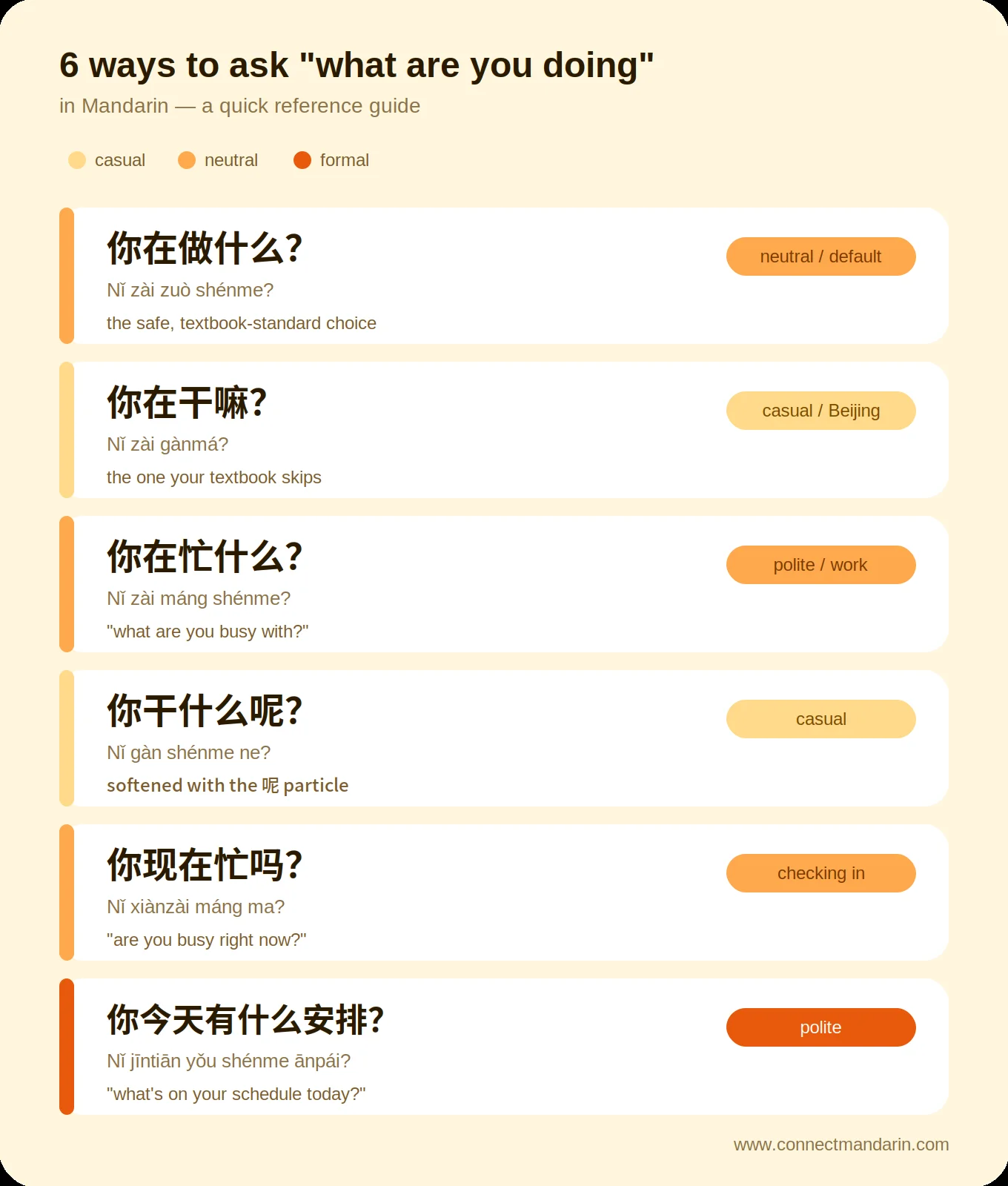
| 你在做什么? | Nǐ zài zuò shénme? | Neutral, most common, textbook standard |
| 你在干嘛? | Nǐ zài gàn má? | Beijing/Northern colloquial, casual, friend-to-friend |
| 你在忙什么? | Nǐ zài máng shénme? | "What are you busy with?" Polite, work-appropriate |
| 你干什么呢? | Nǐ gàn shénme ne? | Casual, softened with the 呢 particle |
| 你现在忙吗? | Nǐ xiànzài máng ma? | "Are you busy right now?" Checking availability |
| 你今天有什么安排? | Nǐ jīntiān yǒu shénme ānpái? | Polite, "What's on your schedule today?" |
你在忙什么 is a good middle ground, considerate rather than nosy, and works well with people you're friendly with but not close to. 你干什么呢 carries the same casual energy as 干嘛 but uses the more standard verb 干, so you'll sometimes see it written where 干嘛 wouldn't be. And 你今天有什么安排 is less "what are you doing right now" and more "what's the plan," useful when you're trying to set something up rather than just checking in on someone.
Tone Guidance & Pronunciation Tips
你在做什么 stacks a 3rd tone, a 4th tone, another 4th tone, then a 2nd tone plus neutral, all in a row, which is exactly where most learners trip up.
| Syllable | Pinyin | Tone | Learner note |
|---|---|---|---|
| 你 | nǐ | 3rd (dip) | Let your voice dip low before rising slightly |
| 在 | zài | 4th (falling) | Sharp, fast drop, don't draw it out |
| 干 | gàn | 4th (falling) | Same sharp fall as zài |
| 嘛 | má | 2nd (rising), often neutral in fast speech | Rises in careful speech, flattens when spoken quickly |
| 做 | zuò | 4th (falling) | Round the "uo" vowel fully |
| 什么 | shénme | 2nd + neutral | Second syllable is unstressed and short |
Practice the phrase slowly first, hitting each tone deliberately, then speed it up. At native pace, some of these distinctions soften noticeably, which is why 嘛 often flattens toward a neutral tone in casual speech rather than the textbook 2nd tone. Get the careful, accurate version into your ear first. Once that's solid, the fast, blurred version people actually use in real conversation becomes much easier to catch.
Sample Conversations (Beijing Context)
Scenario 1: Hutong Tea Stall
Two old classmates run into each other at a small tea stall tucked into one of Beijing's hutongs.
A: 哎,你在干嘛呢?好久不见!
Āi, nǐ zài gàn má ne? Hǎojiǔ bújiàn!
"Hey, what are you up to? Long time no see!"
B: 没干嘛,就在喝茶,你呢?
Méi gànmá, jiù zài hē chá, nǐ ne?
"Not much, just having some tea. What about you?"
A: 我刚下班,路过这儿。要不要一起坐会儿?
Wǒ gāng xiàbān, lùguò zhèr. Yàobuyào yìqǐ zuò huìr?
"I just got off work and was passing by. Want to sit for a bit?"
Scenario 2: Catching Up Near Gulou
A language exchange partner texts to check in about weekend plans near the Drum Tower.
A: 你今天有什么安排?要不要去鼓楼那边转转?
Nǐ jīntiān yǒu shénme ānpái? Yàobuyào qù Gǔlóu nàbiān zhuànzhuan?
"What's on your schedule today? Want to walk around Gulou?"
B: 还没什么安排,听起来不错,几点见?
Hái méi shénme ānpái, tīngqǐlái búcuò, jǐ diǎn jiàn?
"Nothing planned yet, sounds good, what time should we meet?"
Follow-Up Questions to Keep the Conversation Going
| Chinese | Pinyin | Meaning |
|---|---|---|
| 你在哪儿呢? | Nǐ zài nǎr ne? | Where are you right now? |
| 你什么时候有空? | Nǐ shénme shíhou yǒu kòng? | When are you free? |
| 那你忙完了吗? | Nà nǐ mángwán le ma? | Are you done with that now? |
| 一起吃饭吧? | Yìqǐ chīfàn ba? | Want to grab food together? |
To answer 你在做什么 yourself, use 我在 (wǒ zài) plus the activity: 我在吃饭 (wǒ zài chī fàn, "I'm eating"), 我在学中文 (wǒ zài xué Zhōngwén, "I'm studying Chinese"). 在 here works much like "-ing" does in English, marking something as happening in the moment rather than a habitual or completed action.
Formal vs. Casual: Choosing the Right Phrase
| Situation | Best phrase |
|---|---|
| Close friends, classmates | 你在干嘛?/ 你干什么呢? |
| Coworkers, acquaintances | 你在忙什么? |
| Elders, formal settings | 您在做什么?(with 您, the polite "you") |
| Making plans, checking availability | 你今天有什么安排?/ 你现在忙吗? |
| Safe, all-purpose default | 你在做什么? |
When in doubt, 你在做什么 won't get you in trouble in any setting. Save 干嘛 for people you already know well, and reach for 您在做什么 if you're speaking with someone older or in a more formal context, like a first meeting with a client or a teacher.
FAQs
What's the most common way to say "what are you doing" in Chinese?
你在做什么?(Nǐ zài zuò shénme?) is the most widely used and neutral way to ask "What are you doing?" in Mandarin. It works in almost any casual or semi-formal setting, with friends, colleagues, or family, and is the safest default for beginners.
Is 你在干嘛 (Nǐ zài gàn má) rude or too casual?
No, 你在干嘛?is simply informal, not rude. It's especially common in Beijing and Northern China among friends, classmates, and family. Save it for people you already know well; with strangers or in formal settings, 你在做什么?is the safer choice.
How do I ask "what are you doing" more formally in Chinese?
Use 你在忙什么?(Nǐ zài máng shénme?), meaning "What are you busy with?", or 您在做什么?(Nín zài zuò shénme?) using the polite pronoun 您 (nín). Both soften the question and suit workplace or first-meeting conversations better than casual alternatives.
What's the difference between 做 (zuò) and 干 (gàn)?
Both mean "to do," but 做 (zuò) is neutral and used in writing and formal speech, while 干 (gàn) is more colloquial and spoken. 干嘛 (gànmá), built from 干, only appears in casual speech, you won't see it in formal or written Chinese.
How should I answer when someone asks 你在做什么?
Reply with 我在 (wǒ zài) plus the activity, for example 我在吃饭 (wǒ zài chī fàn, "I'm eating") or 我在学中文 (wǒ zài xué Zhōngwén, "I'm studying Chinese"). This 在 + verb structure marks an action in progress, similar to English "-ing."
Ready to Speak Chinese Like a Local?
Knowing the textbook phrase is a good start. Knowing when to swap it for the version people actually use in conversation is what makes you sound less like you're reciting a lesson and more like you're actually talking to someone.
If you're working toward real conversational fluency, including the everyday phrases like 干嘛 that most courses skip past, our Part-Time Group Class is built around that gap: small groups, live instructors based in Beijing, and a focus on how Mandarin is actually spoken day to day rather than just how it's written.
你在做什么 will get you through almost any conversation. 你在干嘛 will get you sounding like you've actually spent time around Mandarin speakers rather than just a textbook. Both are worth having in your back pocket, along with the formal and situational variants covered above.
If you want to try this kind of conversational teaching for yourself and see how it fits your level, you can book a free trial class with Connect Mandarin.
About the Author
Connect Mandarin Team
We are built by a team of native-speaking teachers and language educators who focus on real, usable Chinese - not just textbook phrases. With 15+ years of combined teaching experience.
Continue Reading

Where Are You From in Chinese? (5 Natural Ways to Ask in Mandarin)
Learn 5 natural ways to ask "where are you from" in Chinese, from the everyday nǐ shì nǎlǐ rén to the formal nǐ láizì nǎlǐ, with pinyin and real conversation examples.

How to Say "Not This Time" in Chinese: 5 Natural Mandarin Phrases
Learn how to say 'not this time' in Chinese with 5 natural Mandarin phrases. Get pinyin, real examples, and tips on which one fits each situation.

Jokes in Chinese: Funny Phrases and Wordplay to Learn Mandarin
Learn jokes in Chinese, from dad-joke puns to internet slang, with pinyin, translations, and explanations of the wordplay behind each one.