
Chinese Tones Explained: Mastering Mandarin Pronunciation
Confused by Mandarin tones? Learn the 4 Chinese tones with simple examples, common mistakes, and practice tips from Connect Mandarin's native teachers.
One of the first things people notice when learning Mandarin is that it doesn't sound like many other languages. The same word can mean something completely different depending on how you say it, which is why pronunciation plays such an important role from day one. While this may sound intimidating at first, understanding Chinese tones is much simpler when you know what to listen for. In this guide, we'll walk you through the basics and show you how to make tones feel much more manageable.
Quick Answer: Mandarin has 4 main tones plus 1 neutral tone. Each tone is a distinct pitch pattern that changes a word's meaning — the syllable "ma" can mean mother, hemp, horse, or to scold depending on tone alone. Tones take consistent listening and speaking practice, not special talent, to master.
If you've just started learning Chinese, you've probably heard someone say, "The hardest part of Mandarin is the tones."
As Mandarin teachers, we hear this almost every week. Many beginners come to class feeling nervous because they've been told that Chinese tones are impossible to master.
The truth is much more encouraging. Yes, tones are different from what most learners are used to. But they are not impossible. Every fluent Mandarin speaker who learned Chinese as a second language started exactly where you are now.
With regular practice and the right guidance, your ears become better at hearing the differences, and your pronunciation improves naturally. Let's look at what Chinese tones are and how you can start using them with confidence.
New to Mandarin altogether? Start with our Chinese Phrases for Beginners guide before diving into tones.
What Are Chinese Tones?
Mandarin Chinese has four main tones and one neutral tone. You can think of a tone as the musical pitch of a word. In English, we often change our voice to show emotion or ask a question. In Mandarin, changing the pitch changes the meaning of the word.
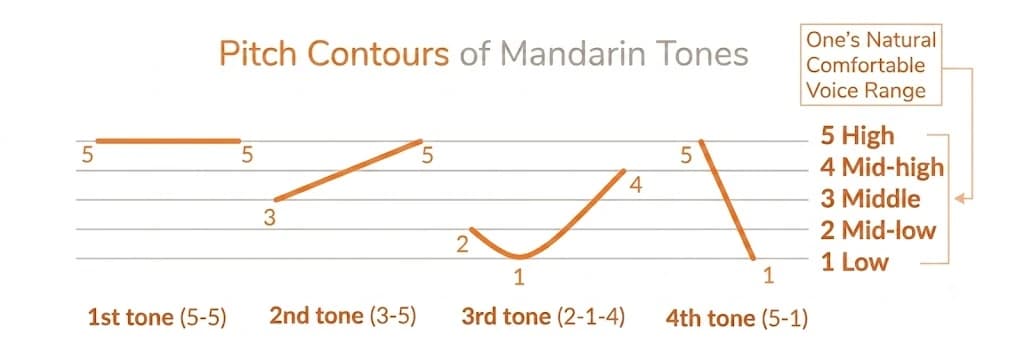
Take a look at the pitch chart above. Linguists map our comfortable vocal range on a scale from 1 (the lowest pitch your voice can comfortably make) to 5 (the highest). Visualizing where a tone starts and ends on this scale makes practicing them much easier!
Take the syllable "ma" as an example.
- mā (妈) means mother
- má (麻) means hemp
- mǎ (马) means horse
- mà (骂) means to scold
- ma (吗) is a question particle
The pronunciation looks almost identical in English letters, but each tone creates a completely different word. That is why learning tones is an important part of speaking Mandarin clearly.
The Four Mandarin Tones (Chart & Examples)
First Tone (ˉ)
The first tone is high and steady. Imagine holding one musical note without changing your voice.
Example: mā (妈) — mother
Keep your voice level from beginning to end.
Second Tone (ˊ)
The second tone rises upward. Think about how your voice naturally rises when you ask, "Really?"
Example: má (麻)
Start lower and finish higher.
Third Tone (ˇ)
The third tone drops down before rising again.
Example: mǎ (马) — horse
Many beginners find this tone the most difficult, and that's completely normal. It usually becomes easier after plenty of listening and speaking practice.
The Third Tone "Secret": When two third-tone words are spoken next to each other, the first one naturally changes to a second tone. For example, you write nǐ hǎo (你好 - hello), but you actually pronounce it as ní hǎo. Don't worry about memorizing too many rules right now, but keeping this shortcut in mind will make your speech flow much more smoothly!
Fourth Tone (ˋ)
The fourth tone starts high and falls quickly. Imagine saying, "No!" or "Stop!"
Example: mà (骂) — to scold
This tone is short, strong, and decisive.
Neutral Tone
The neutral tone is light and unstressed. It usually follows another syllable and is spoken quickly.
Example: 吗 (ma)
Instead of giving it a strong pitch, native speakers pronounce it softly.
Why Do Beginners Find Tones So Difficult?
The biggest challenge is usually not your voice. It's your ears.
When you first start learning Mandarin, many tones sound almost the same. That is perfectly normal.
Think about listening to music. Someone with musical training can hear tiny differences in pitch that others might miss. Learning Mandarin tones works in a similar way. The more you listen, the better your brain becomes at recognizing the different patterns.
This is why listening practice is just as important as speaking practice.
Common Mistakes Beginners Make with Chinese Tones
Here are a few mistakes we often notice in our classes.
Ignoring the Tone
Some students focus only on the letters and forget the tone. Even if the pronunciation is correct, using the wrong tone can change the meaning of what you want to say.
Learning Words Without Tone Marks
Don't memorize a word as simply "ma" or "shi." Always learn the pronunciation together with its tone. Treat them as one complete word.
Speaking Too Carefully
Many beginners are afraid of sounding silly, so they pronounce the tones very softly. In reality, it helps to exaggerate the tones a little when you're learning. As your confidence grows, your pronunciation will naturally become smoother and more relaxed.
How to Practice Chinese Tones
Here are a few techniques we recommend to our students.
- Listen to native Mandarin every day, even if it's only for ten minutes.
- Repeat words aloud instead of reading them silently.
- Copy short conversations and match the speaker's rhythm and pitch.
- Learn every new word together with its tone.
- Record yourself from time to time and compare your pronunciation with native speakers.
Remember, ten minutes of practice every day is much more effective than studying for two hours once a week.
Do Native Speakers Always Use Perfect Tones?
Not always. Just like English has different accents, Mandarin also has regional accents and speaking styles. However, the basic tone system stays the same. Learning standard Mandarin tones will help people understand you wherever you travel in China. Curious how tones compare to other Chinese varieties? See our Mandarin vs. Cantonese comparison.
Final Thoughts — Start Speaking with Confidence
Learning Chinese tones takes patience, but it does not require a special talent. Every learner makes mistakes in the beginning. That is simply part of the process.
Focus on listening carefully, speaking often, and practicing consistently. Little by little, your pronunciation will improve.
At Connect Mandarin, we've helped students from around the world build confidence in speaking Chinese. One thing we've learned is that steady practice always beats trying to be perfect.
So don't worry if you mix up the tones today. Keep listening. Keep speaking. Keep practicing. Before long, you'll notice that using the correct tones starts to feel natural.
If you're ready to improve your Mandarin pronunciation, we'd love to help. Join Connect Mandarin and learn with experienced native teachers who will guide you every step of the way — book a free trial class or view all courses to find the right fit.
Frequently Asked Questions
1. Why are Chinese tones important?
Chinese tones change the meaning of a word. Even if you pronounce the letters correctly, using the wrong tone can result in a completely different word. Learning tones correctly from the beginning helps you speak more naturally and communicate with confidence.
2. How many tones are there in Mandarin Chinese?
Mandarin has four main tones and one neutral tone. Each tone has its own pitch pattern, and mastering them is one of the first steps toward speaking clear and accurate Mandarin.
3. Are Chinese tones really difficult to learn?
Not as difficult as many people think. While tones may feel unfamiliar at first, regular listening, speaking practice, and guidance from experienced teachers make them much easier to understand and use.
4. What's the best way to practice Chinese tones?
The most effective approach is to combine daily listening with speaking practice. Shadowing native speakers, recording yourself, and receiving feedback from a qualified Mandarin teacher can help you improve much faster than studying on your own.
5. Should I memorize tone marks when learning new vocabulary?
Absolutely. Always learn a new word together with its tone. Treat the pronunciation and tone as one complete unit instead of memorizing only the spelling.
6. Do native Chinese speakers always pronounce tones perfectly?
Native speakers may have different regional accents, but the basic tone system remains the same. Learning Standard Mandarin pronunciation will help you communicate confidently across China and with Mandarin speakers worldwide.
7. How long does it take to improve my Chinese pronunciation?
Everyone learns at a different pace, but most students notice improvement within a few weeks of consistent practice. Even 10–15 minutes of focused listening and speaking every day can make a noticeable difference.
8. Can I learn Chinese pronunciation online?
Yes. With structured lessons, live speaking practice, and personalized feedback from native teachers, online learning can be just as effective as studying in a classroom. Connect Mandarin offers both online and in-person Mandarin courses for learners of all levels.
9. Does Connect Mandarin help beginners with Chinese pronunciation and tones?
Yes. At Connect Mandarin, beginners learn tones from their very first lesson through interactive speaking exercises, listening practice, and personalized feedback from experienced native Mandarin teachers. Whether you choose private lessons, group classes, or HSK preparation, pronunciation is built into every course.
10. Can I take a trial class before enrolling?
Yes. If you'd like to experience the teaching style before committing to a course, you can book a free trial class and meet one of the school's experienced teachers.
11. Where can I learn Mandarin with experienced native teachers?
If you're looking for structured Mandarin lessons with small class sizes, experienced native teachers, and flexible online or in-person options, visit www.connectmandarin.com. The school offers beginner courses, HSK preparation, private lessons, intensive programs, and immersive cultural experiences to help students build real confidence in speaking Mandarin.
About the Author
Connect Mandarin Team
We are built by a team of native-speaking teachers and language educators who focus on real, usable Chinese - not just textbook phrases. With 15+ years of combined teaching experience.
Continue Reading

What Countries Speak Mandarin? Official Languages and Where It Is Spoken Worldwide
Which countries speak Mandarin? See where it's official (China, Taiwan, Singapore), where it's widely spoken, and which version to learn first.

What Are You Doing in Chinese? 你在做什么 (Nǐ Zài Zuò Shénme) Explained
Learn how to say "what are you doing" in Chinese, from the textbook-standard 你在做什么 to the casual Beijing favorite 你在干嘛, with pinyin, tone tips, and real dialogues.

Where Are You From in Chinese? (5 Natural Ways to Ask in Mandarin)
Learn 5 natural ways to ask "where are you from" in Chinese, from the everyday nǐ shì nǎlǐ rén to the formal nǐ láizì nǎlǐ, with pinyin and real conversation examples.