Chinese Word Symbols: Meanings, History, and How to Read Them
What do Chinese symbols actually mean? A guide to Hanzi history, popular characters like 福 and 爱, and how to read them accurately.
Chances are you found this page because you saw a character on a tattoo, a wedding invitation, or a piece of jewelry, and you want to know what it actually says. What you're looking at is a Chinese character, or Hanzi (汉字). Unlike a letter in the English alphabet, it's carrying a whole idea in a single shape. In this guide, we'll clear up what these "symbols" really are, walk through where they came from, show you how their meanings are built, and help you read a handful of the most common ones with confidence.
Chinese Word Symbols vs. Chinese Characters — What's the Difference?
There isn't much of a difference. "Symbol" and "character" describe the same thing, just with two different names. "Symbol" is simply the word English speakers reach for naturally, especially around tattoos, home decor, or gifts. "Character," or Hanzi (汉字), is the term teachers, linguists, and textbooks actually use.
The distinction is worth knowing because it changes how you should think about what you're looking at. A Chinese character isn't a letter that only stands for a sound, the way a Roman letter does. Each one represents a syllable and a unit of meaning at the same time. That's the reason a single character can hold a concept as big as fortune, strength, or family in just a few strokes, and it's why getting one "close enough" isn't the same as getting it right.
A Short History of Chinese Word Symbols
Chinese characters look intimidating at first, but they make a lot more sense once you see where they came from. Chinese writing is one of the oldest continuously used systems in the world, and its shapes have shifted gradually over roughly 3,000 years, through a handful of recognisable stages:
- Oracle bone script (甲骨文): the earliest known form, carved into turtle shells and animal bones for divination during the Shang dynasty.
- Bronze inscriptions (金文): cast into ceremonial bronze vessels, with rounder, more deliberate strokes.
- Seal script (小篆): standardized after China's unification, still used today on traditional name seals.
- Official script (隶书): flattened and streamlined for faster, everyday writing.
- Regular script (楷书): the clear, structured style that modern characters are still built on.
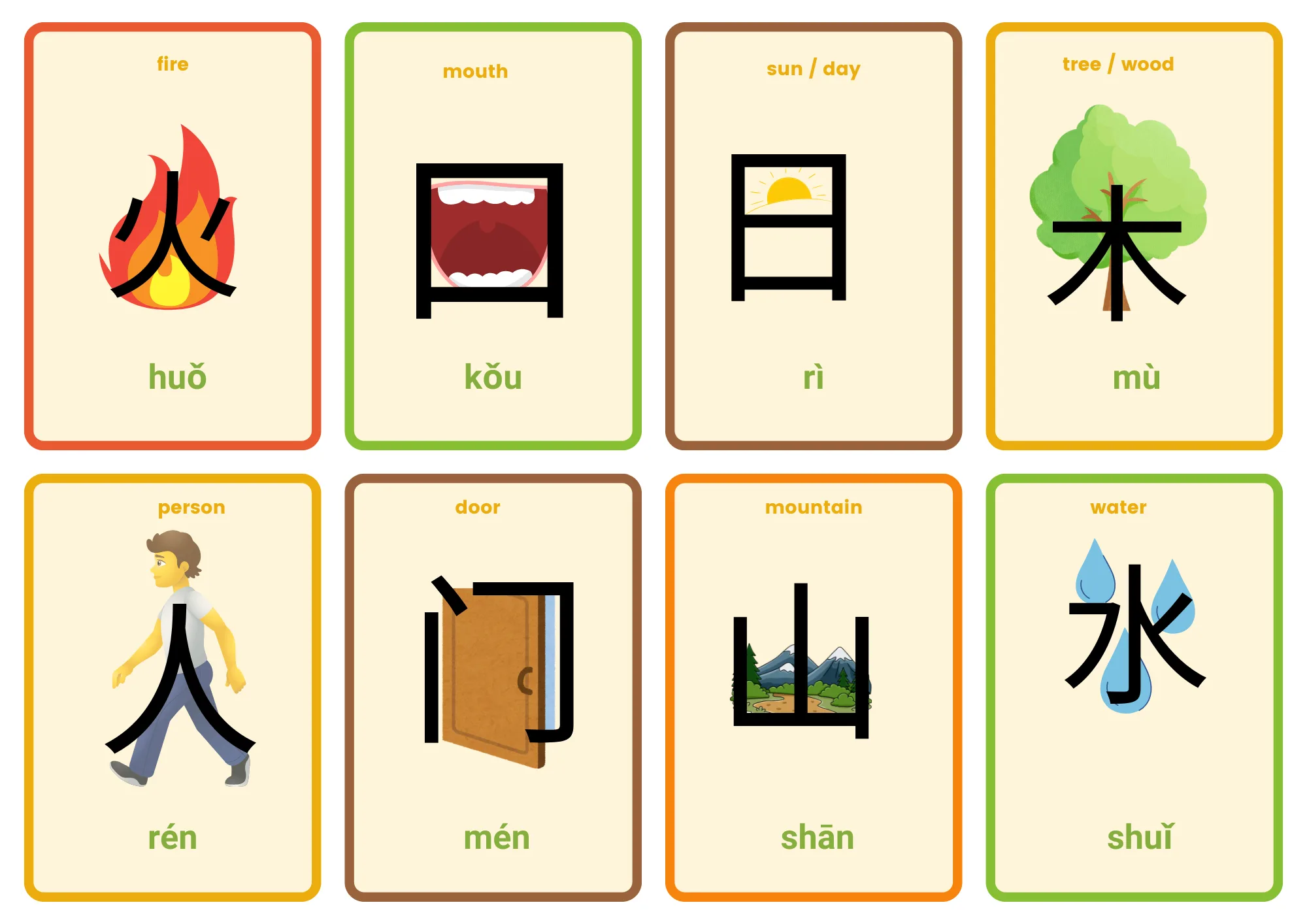
Chinese legend credits the invention of writing to a figure named Cangjie. As the story goes, he studied the tracks left by birds and animals and turned their shapes into the first written symbols: sun, mountain, person, each one simplified down to its essence. It's a legend, not a documented event, but it points at something true. A lot of early characters really did start life as small pictures before they hardened into the more abstract shapes used today.
One more piece of context is useful here. Two character systems exist side by side now. Traditional characters are still used in Taiwan, Hong Kong, and Macau. Simplified characters, introduced in mainland China in the 1950s and 60s, trimmed stroke counts to make literacy easier to reach at scale. If you want the full comparison, we break it down in Traditional vs. Simplified Chinese.
How Chinese Characters Get Their Meaning
Every character is built from three things working together: shape, sound, and meaning. Most characters aren't single, indivisible symbols either. They're made of smaller, meaningful building blocks called radicals.
Radicals work like meaning clues built right into the character. One with the water radical (氵) usually relates to liquid or rivers. One with the wood radical (木) usually relates to trees or plants. One with the heart radical (忄 or 心) usually relates to emotion.
Take 信 (xìn), meaning "trust" or "faith." It's built from "person" (亻) sitting next to "word" (言), literally, a person's word. That's not a coincidence; the meaning is built directly into the structure. It's a good reminder that a character can look simple and still be carrying a small story inside it, which is worth knowing before you put one on your skin permanently.
Popular Chinese Symbols and What They Mean
Some characters show up again and again on red envelopes, wedding banners, jewellery, and tattoos, because their meanings are strong and self-contained enough to stand alone. Here are ten of the most recognizable:
| Meaning | Character | Pinyin | Why It's Popular |
|---|---|---|---|
| Fortune / Luck | 福 | fú | The most common New Year and gift symbol, often hung upside down as a pun on "arrived" |
| Double Happiness | 囍 | xǐ | A wedding symbol formed from two joined 喜 characters |
| Longevity | 寿 | shòu | Common on gifts for elders and at birthdays |
| Strength | 力 | lì | A popular tattoo choice thanks to its simple stroke count and bold meaning |
| Love | 爱 | ài | Frequently seen in gifts, jewellery, and decor |
| Peace | 和 | hé | Represents harmony, used in home decor and calligraphy |
| Dragon | 龙 | lóng | Symbolizes power and imperial authority, common in art rather than spoken word |
| Trust / Faith | 信 | xìn | Person + word radical, literally "a person's word" |
| Family | 家 | jiā | A roof radical over "child": home and belonging |
| Path / Way | 道 | dào | A core Daoist concept meaning principle, method, or "the Way" |
Easy Chinese Characters to Recognise First
If you want to start recognising characters yourself instead of just looking meanings up one at a time, start with the ones that have the fewest strokes. They're easiest to hold in memory, and a few of them show up again later as building blocks inside more complex characters.
- 一 (yī): one, a single horizontal stroke
- 二 (èr): two, two horizontal strokes
- 三 (sān): three, three horizontal strokes
- 人 (rén): person, like a pair of legs standing
- 大 (dà): big, a person with arms stretched wide
- 口 (kǒu): mouth, a simple open square
Notice how "one," "two," and "three" follow their own logic, but that pattern breaks by the time you reach "four." Chinese numbers aren't a stroke counting system past three. They're their own set of characters to learn individually.
Are Chinese Symbol Tattoos Accurate?
Not always, and this is one of the most common regrets people run into after the ink is already permanent. A few mistakes come up again and again:
- Tone and context get dropped. Meaning in Chinese depends heavily on tone and on the characters around it. A symbol lifted from a design book without checking either can end up meaning something subtly different from what was intended, or something unrelated altogether.
- Some characters don't stand alone. Many Chinese words are actually two or more characters used together. Pull one character out of a compound word and it can look meaningless, or shift to mean something else entirely.
- Mirrored or upside-down errors. Because characters are built from precise, directional strokes, a flipped or rotated version isn't just a stylistic quirk. It can become a different character, or nothing recognisable at all.
If you're considering a Chinese character tattoo, it's worth the extra step of confirming the meaning with a native speaker or a teacher before it becomes permanent. We also have a longer Chinese language tattoo guide covering common mistakes and how to choose something that actually means what you think it does.
Frequently Asked Questions
What are Chinese word symbols?
"Chinese word symbols" usually refers to Chinese characters, or Hanzi (汉字), the written units of the Chinese language. Each character represents a syllable and a meaning rather than a sound alone, which is why they're often described as "symbols" by English speakers, even though linguists call them characters.
Are Chinese symbols the same as Chinese characters?
Yes, in everyday English use, "Chinese symbols" and "Chinese characters" refer to the same thing: Hanzi. The word "symbol" is common in casual or decorative contexts, like tattoos, while "character" is the accurate linguistic term used by teachers and learners.
What is the most popular Chinese symbol?
福 (fú), meaning "fortune" or "good luck," is the most widely recognised Chinese symbol. It appears on red paper during Chinese New Year, often hung upside down, since "upside down" (倒, dào) sounds like "arrived" (到, dào), creating the pun "luck has arrived."
How many Chinese characters are there?
Estimates range from about 50,000 to over 100,000 characters in total, but only 3,000–4,000 are used in everyday modern Chinese. Around 2,500 characters cover most newspapers and daily conversation, which is why HSK vocabulary lists focus on this smaller, high-frequency set.
How do Chinese characters get their meaning?
Most Chinese characters combine a radical, which hints at meaning or category, with a phonetic component, which hints at pronunciation. For example, 信 (xìn, trust) combines "person" (亻) and "word" (言), literally, "a person's word."
Are Chinese symbol tattoos accurate?
Not always. Many tattoo shops use symbols copied without checking tone, context, or whether the character makes sense on its own. Some characters only carry meaning in combination with others. It's worth confirming a symbol's meaning with a native speaker or teacher before committing to it.
Learn to Read and Write Chinese Characters With Connect Mandarin
Once you can spot a handful of characters and understand how their meanings are actually built, the natural next step is learning to read and write them yourself. Our Chinese classes take you from recognising individual symbols to reading and writing real Chinese with confidence, guided by qualified teachers. If you'd like to see how it works before committing, you can also book a free trial lesson to try a class for yourself.
About the Author
Connect Mandarin Team
We are built by a team of native-speaking teachers and language educators who focus on real, usable Chinese - not just textbook phrases. With 15+ years of combined teaching experience.
Continue Reading
What Are You Doing in Chinese? 你在做什么 (Nǐ Zài Zuò Shénme) Explained
Learn how to say "what are you doing" in Chinese, from the textbook-standard 你在做什么 to the casual Beijing favorite 你在干嘛, with pinyin, tone tips, and real dialogues.

Where Are You From in Chinese? (5 Natural Ways to Ask in Mandarin)
Learn 5 natural ways to ask "where are you from" in Chinese, from the everyday nǐ shì nǎlǐ rén to the formal nǐ láizì nǎlǐ, with pinyin and real conversation examples.
How to Say "Not This Time" in Chinese: 5 Natural Mandarin Phrases
Learn how to say 'not this time' in Chinese with 5 natural Mandarin phrases. Get pinyin, real examples, and tips on which one fits each situation.