Thinking About a Chinese Character Tattoo? Read This First
Thinking about a Chinese language tattoo? Learn how to avoid common meaning and translation mistakes before you commit to permanent ink.
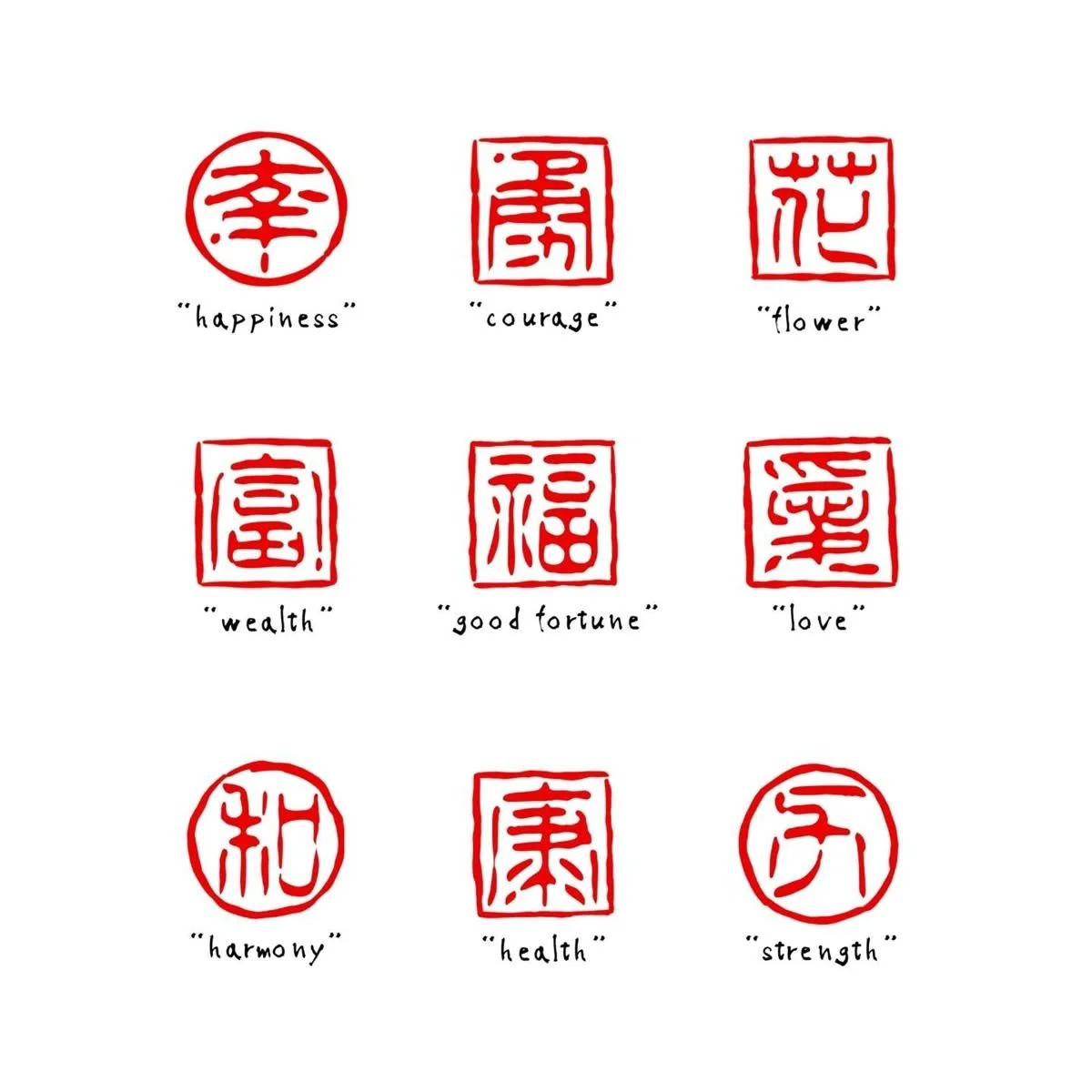
Quick question before we start: if you got a tattoo tomorrow, would you actually know what it says — or would you just be trusting the guy with the tattoo gun?
Be honest. Most people can't answer that with a confident "yes." And that's exactly why Chinese character tattoos have such a messy reputation. Done right, they're beautiful — a single character can carry centuries of meaning in a few brushstrokes. Done wrong, they turn into a permanent inside joke that everyone except you is in on.
It's worth remembering that tattoos in general spent a long time on the fringes in the West too — associated with sailors, soldiers, and rebels long before they showed up on runway models and CEOs. Chinese characters rode that same wave into the mainstream, boosted by a wave of celebrities in the 2000s and a general fascination with Eastern philosophy and aesthetics. Which is great — except the popularity grew a lot faster than the actual understanding of the language did.
Let's fix that.
Why Chinese Characters Aren't Just "Cool Symbols"
Here's something a lot of people don't realize: in China, tattoos carry a lot of historical baggage. For centuries, they were linked to punishment — criminals were literally tattooed on the face so everyone would know what they'd done. Add to that centuries of Confucian thinking, which held that your body was a gift from your parents and shouldn't be marked or altered, and you can see why tattoos still make a lot of older Chinese parents uncomfortable, even today.
But it's not all negative. Some communities tell a completely different story. Among certain minority groups in China, like the Li people, tattoos are a rite of passage for young women — a proud marker of identity, not shame. And China's literary history is full of tattoo folklore too: the classic novel Water Margin describes outlaws covered in ink, and there's the legendary tale of General Yue Fei, whose mother is said to have tattooed four characters on his back urging him to serve his country with total loyalty.
So when you put a Chinese character on your skin, you're not picking a random design. You're borrowing from a language with its own weight, history, and rules. Worth knowing before you sit in the chair.
Quick Detour: Chinese or Japanese?
Here's a mix-up that happens more than you'd expect: people asking for a "Chinese tattoo" and walking out with kanji, or vice versa. Japanese kanji actually originated from Chinese characters, so a lot of them look identical or nearly identical — but plenty have drifted apart over centuries and now mean something completely different in each language, or have simply fallen out of use in one of the two. A tattoo shop that isn't specifically staffed with someone who reads Chinese might not catch the difference. If Chinese is what you specifically want, say so clearly, and ask the artist to confirm the source language of the design, not just the "look."
The Tattoos That Went Horribly Wrong
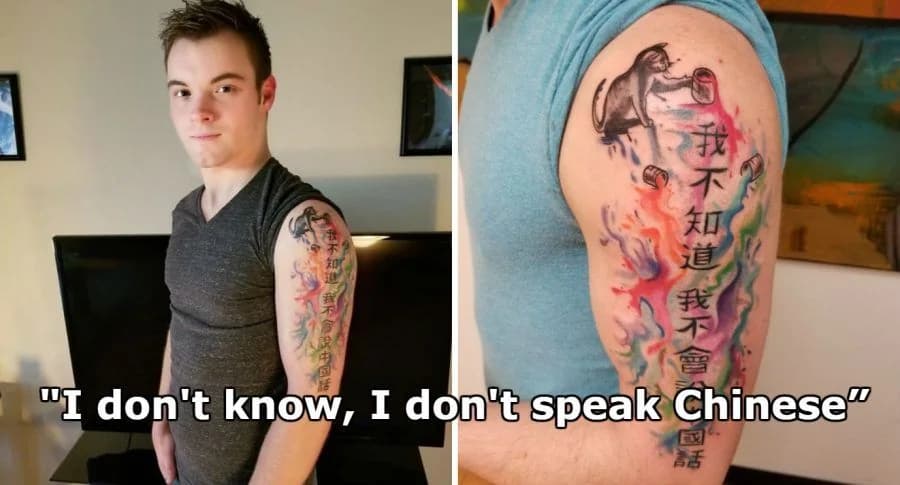
This is the part everyone loves, and honestly, it's the best argument for doing your homework.
- Someone wanted "free" as in freedom. They got 免费 — "free" as in no cost, like a buy-one-get-one deal.
- A guy wanted "wisdom." His tattoo actually said "meat."
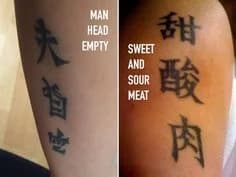
- Someone was going for "live for today" or "seize the day." What they got was decorative nonsense — characters that look nice together but form no real phrase in Chinese at all.
- One person wanted "vegetarian." They ended up with something closer to "made of vegetables."
- A well-known case: a tattoo meant to say "mysterious" instead landed on a character meaning "strange" or "odd."
Notice the pattern? Almost none of these are typos. They're the result of word-for-word translation — grabbing a dictionary, translating each English word separately, and stringing the characters together like Lego blocks. Chinese doesn't work that way. Meaning often comes from the combination and the context, not each character in isolation.
A good rule of thumb: if a tattoo shop's "translation" was done in five minutes with an app, treat it as a first draft, not a final answer.
What Actually Works
If you still want the tattoo (and you should, if it means something to you), here's what tends to age well:
1. Single, well-known characters.
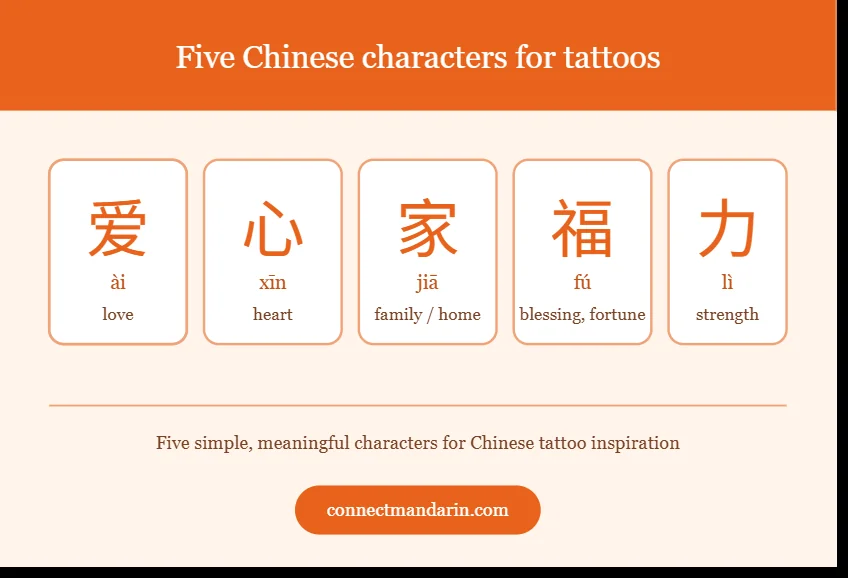
Characters like 爱 (ài – love), 家 (jiā – family/home), 心 (xīn – heart), and 福 (fú – blessing, good fortune) are simple, visually strong, and carry meaning that doesn't fall apart under scrutiny. 福 in particular is everywhere in Chinese culture — you'll spot it on doors during Lunar New Year, often hung upside down on purpose, because the phrase for "upside down" sounds like the word for "arrive." Fú dào (福倒) sounds just like Fú dào (福到) "blessing has arrived." Basically a built-in pun.
2. Four-character idioms (chengyu).
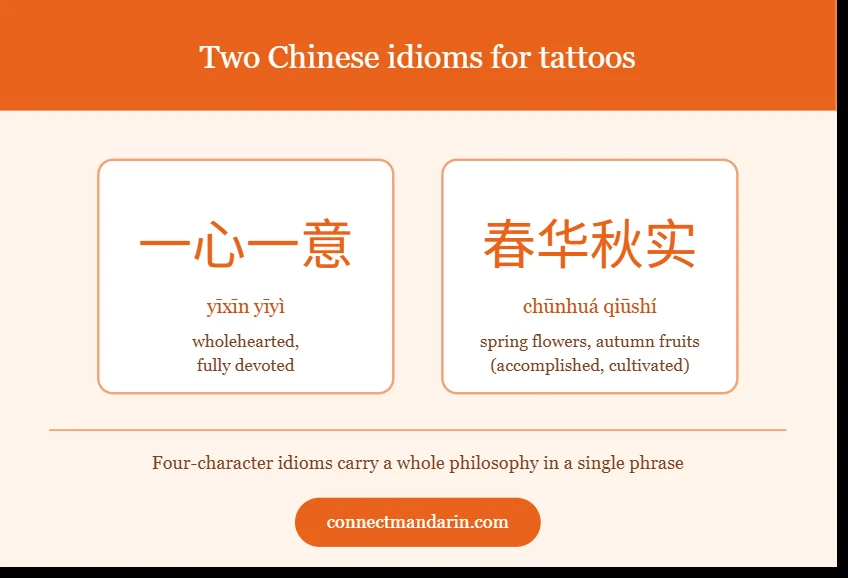
Chinese is full of these compact little proverbs that pack a whole philosophy into four characters. 一心一意 (yīxīn yīyì) means throwing yourself into something wholeheartedly. 春华秋实 (chūnhuá qiūshí) — literally "spring flowers, autumn fruits" — is often used to describe someone accomplished and cultured, the kind of person whose effort visibly pays off over time. These idioms read as more intentional than a single word, and they're much harder to accidentally get wrong, since they're fixed phrases rather than assembled from scratch.
2.5. Pairing a character with a symbol.
A popular middle ground between "just text" and "just image" is combining the two — a lotus flower wrapped around 心 (heart), or a small wave under 自由 (freedom). It gives the tattoo more visual weight without diluting the meaning, as long as the symbol you pick doesn't clash with the character (a dragon paired with a word about "peace," for instance, sends a mixed message).
3. Names — done properly.
Chinese names aren't just phonetic stand-ins; good ones are chosen for the meaning of each character, not just the sound. If you're getting a name (yours, a partner's, a child's), it's worth having someone build it thoughtfully rather than transliterating letter by letter.
4. The script style matters too.
Chinese calligraphy has several traditional styles, and each gives off a completely different mood:
- 楷书 (kǎishū) — regular script. Clean, standard, easy to read. Good if you want something timeless.
- 行书 (xíngshū) — semi-cursive. A little flowing, a little relaxed, still legible.
- 草书 (cǎoshū) — cursive. Fast, expressive, almost like abstract art. Beautiful, but hard for anyone (including native speakers) to read at a glance.
- 隶书 (lìshū) — clerical script. An older, more angular style with a historic feel.
Pick the style the way you'd pick a font — not just for looks, but for what mood you want the tattoo to carry.
Zodiac Tattoos: A Different Way In
If picking a single character feels too open-ended, the Chinese zodiac (生肖, shēngxiào) is a popular shortcut — twelve animals, each tied to a birth year, each with its own personality baked in by tradition:
- 鼠 (shǔ) — Rat: quick-witted, resourceful
- 牛 (niú) — Ox: steady, hardworking
- 虎 (hǔ) — Tiger: bold, competitive
- 兔 (tù) — Rabbit: gentle, cautious
- 龙 (lóng) — Dragon: powerful, the only mythical animal in the set
- 蛇 (shé) — Snake: wise, a little mysterious
- 马 (mǎ) — Horse: energetic, freedom-loving
- 羊 (yáng) — Goat/Sheep: calm, artistic
- 猴 (hóu) — Monkey: clever, playful
- 鸡 (jī) — Rooster: confident, sharp-eyed
- 狗 (gǒu) — Dog: loyal, honest
- 猪 (zhū) — Pig: generous, easygoing
The appeal here is that the meaning is already locked in and well documented — much lower risk than freestyling a phrase, and it comes with a built-in personal connection (your birth year).
Where You Put It Matters Too
There's a loose but real tradition around tattoo placement that's worth knowing before you commit:
- Small, quiet characters (a single word like 爱 or 心) tend to go on the wrist, ankle, behind the ear, or the back of the neck — spots that read as personal and low-key rather than a statement piece.
- Long proverbs or full sentences — like David Beckham's back-and-ribs proverb — need more real estate, which is why they usually end up on the back, spine, or forearm, somewhere the calligraphy can actually flow.
- Visibility still carries weight in China itself. Even with tattoos far more socially accepted than a generation ago, visible ink can still raise eyebrows with parents, in some traditional workplaces, or during job interviews. Something worth factoring in if the meaning behind your tattoo is tied to Chinese family or culture — the placement can be as much a statement as the character itself.
The Three-Step Sanity Check
We hear this question a lot at Connect Mandarin — people wanting to double-check a tattoo, a gift, or a phrase before it becomes permanent. If getting it exactly right matters to you, it's worth going a step further than a one-off translation check.
A short Mandarin course, whether it's conversational, part-time, or one of our HSK programs, gives you the foundation to understand why a phrase works, rather than just taking someone else's word for it. But before you book the appointment, run your design through this:
- Ask a native speaker — not a translation app. Ideally more than one, since language nuance is exactly the kind of thing people disagree on.
- Confirm the orientation. Tattoos with characters printed upside down or mirrored are more common than you'd think, especially when the artist doesn't read Chinese themselves.
- Say the meaning out loud to someone who reads Chinese, without showing them the characters first. If their guess doesn't match what you're about to tattoo, that's your red flag.
Questions Worth Asking Your Tattoo Artist
Beyond checking the translation itself, it helps to vet the shop and artist directly. A few worth asking outright:
- "Can you show me this same design written by two different people?" (If the strokes don't match up, something's off.)
- "Do you or anyone on staff actually read Chinese, or is this design copied from a reference sheet?"
- "Can I see this on paper, full-size, before it goes on my skin?" — sizing and spacing can distort how a character reads.
- "Has this exact phrase been tattooed here before?" — not a dealbreaker either way, but a good gut check on how familiar they are with the language.
None of this guarantees perfection, but it filters out the "traced it from a font generator" situations fast.
Even Celebrities Get It Wrong (and Sometimes Right)
Chinese tattoos on celebrities are a fun case study, because they show both extremes:
- David Beckham has an entire proverb running down his torso, reportedly reading correctly and meaning something like life, death, wealth and honor are decided by fate.
- Justin Bieber has 曲 (qǔ) on his arm — which usually means "song," but depending on context can also mean "crooked" or "wrong." A bit of a gamble, symbolically.
- One pop star wanted a character meaning "mysterious" and ended up with one that reads closer to "strange."
Even people with unlimited resources and stylists sometimes skip the fact-check. Don't be that person.
The Bottom Line
A Chinese character tattoo can be genuinely stunning — visually and symbolically. But it's one of the few tattoo styles where a small mistake is instantly obvious to millions of people who can read it at a glance, even if you never notice. The fix isn't complicated: pick something simple, get it verified by more than one native speaker, double-check the orientation, and choose a script style that matches the feeling you're going for.
Do that, and instead of becoming someone's screenshot on a "tattoo fails" post, your tattoo becomes exactly what you wanted it to be — a piece of language, on your skin, that actually says what you meant.
Got a Chinese character tattoo already, or spotted a wild translation fail out in the world? Drop it in the comments — we'd genuinely love to see it (the good, the bad, and the "wait, what does that actually say").
FAQ
Is it rude to get a Chinese character tattoo if I'm not Chinese?
Not inherently — plenty of people outside the culture wear Chinese characters respectfully. What matters more is effort: knowing what it actually says, why you chose it, and getting it verified rather than picking something off a flash sheet because it "looks cool."
Can a translation app get it right?
Sometimes, for very simple words. But apps translate word-for-word, and Chinese meaning often comes from combinations and context, not individual characters — which is exactly how "wisdom" turns into "meat." Treat an app's output as a rough guess, not a final answer.
How do I find someone who actually reads Chinese to check my design?
A native-speaking friend works if you have one. If you don't, a Mandarin tutor is a solid option. At Connect Mandarin, this kind of question comes up often enough in our courses that students end up double-checking tattoos, gifts, and phrases as a natural side benefit of learning.
Does the script style (regular, cursive, etc.) change the meaning?
No — it changes the mood, not the meaning. Cursive (草书) looks expressive but can be hard to read even for native speakers; regular script (楷书) is clean and timeless. Pick based on the feeling you want, not just aesthetics.
What's the safest type of design to get?
Single, well-known characters (like 爱 or 家) or fixed four-character idioms (chengyu) tend to hold up best, since they're either universally understood or fixed phrases that can't be assembled incorrectly.
Is it worth learning some Mandarin before getting a tattoo in it?
If the language means enough to put on your skin permanently, it's worth knowing more than one phrase of it. Even a short conversational or part-time course gives you enough grounding to catch mistakes yourself — rather than relying entirely on someone else's word for it.
About the Author
Connect Mandarin Team
We are built by a team of native-speaking teachers and language educators who focus on real, usable Chinese - not just textbook phrases. With 15+ years of combined teaching experience.
Continue Reading
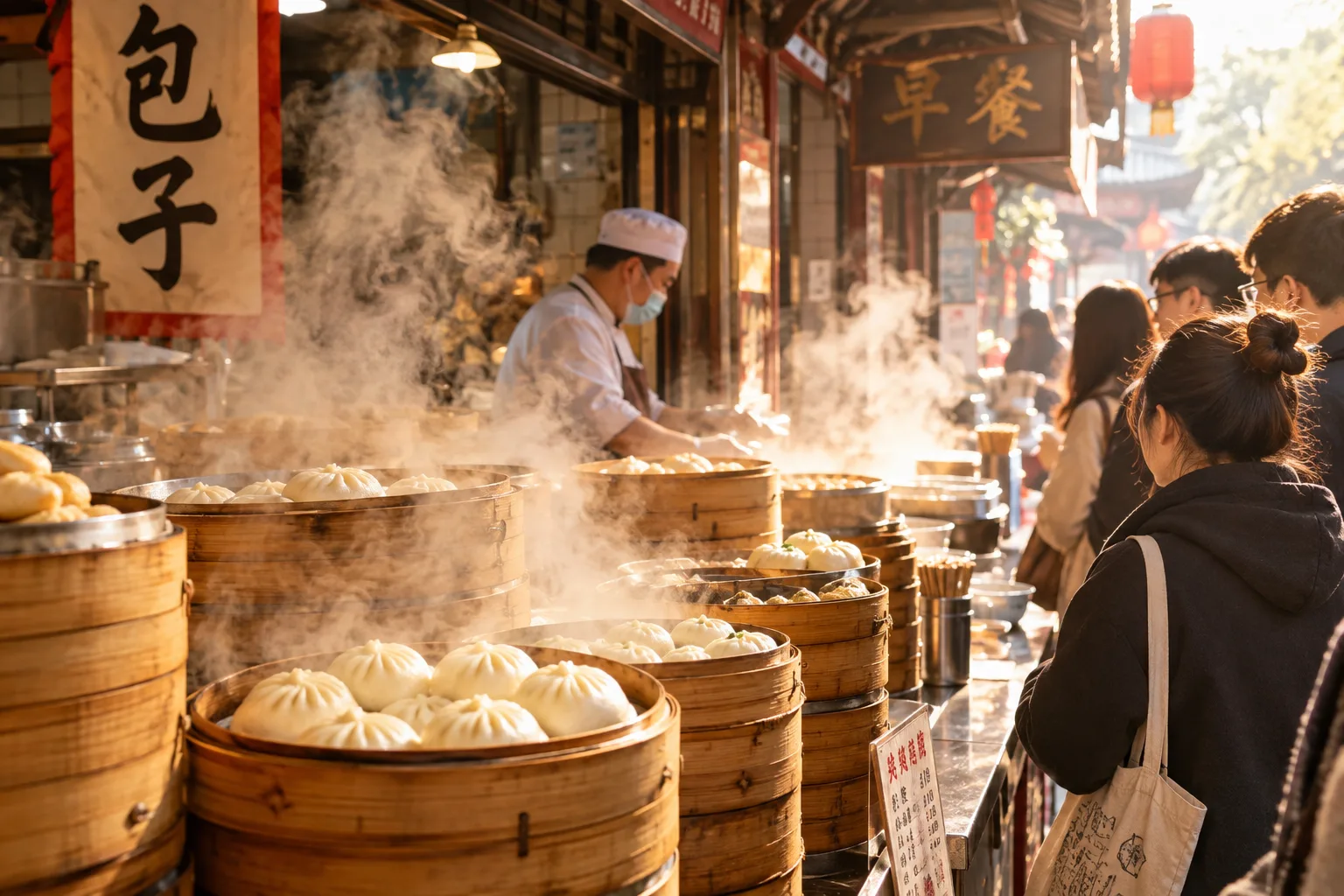
Chinese Breakfast: Popular Foods, Dishes & What People Eat in China
Explore Chinese breakfast foods like baozi, youtiao, congee and jianbing. See regional dishes, key Mandarin phrases, and how to order breakfast in China.
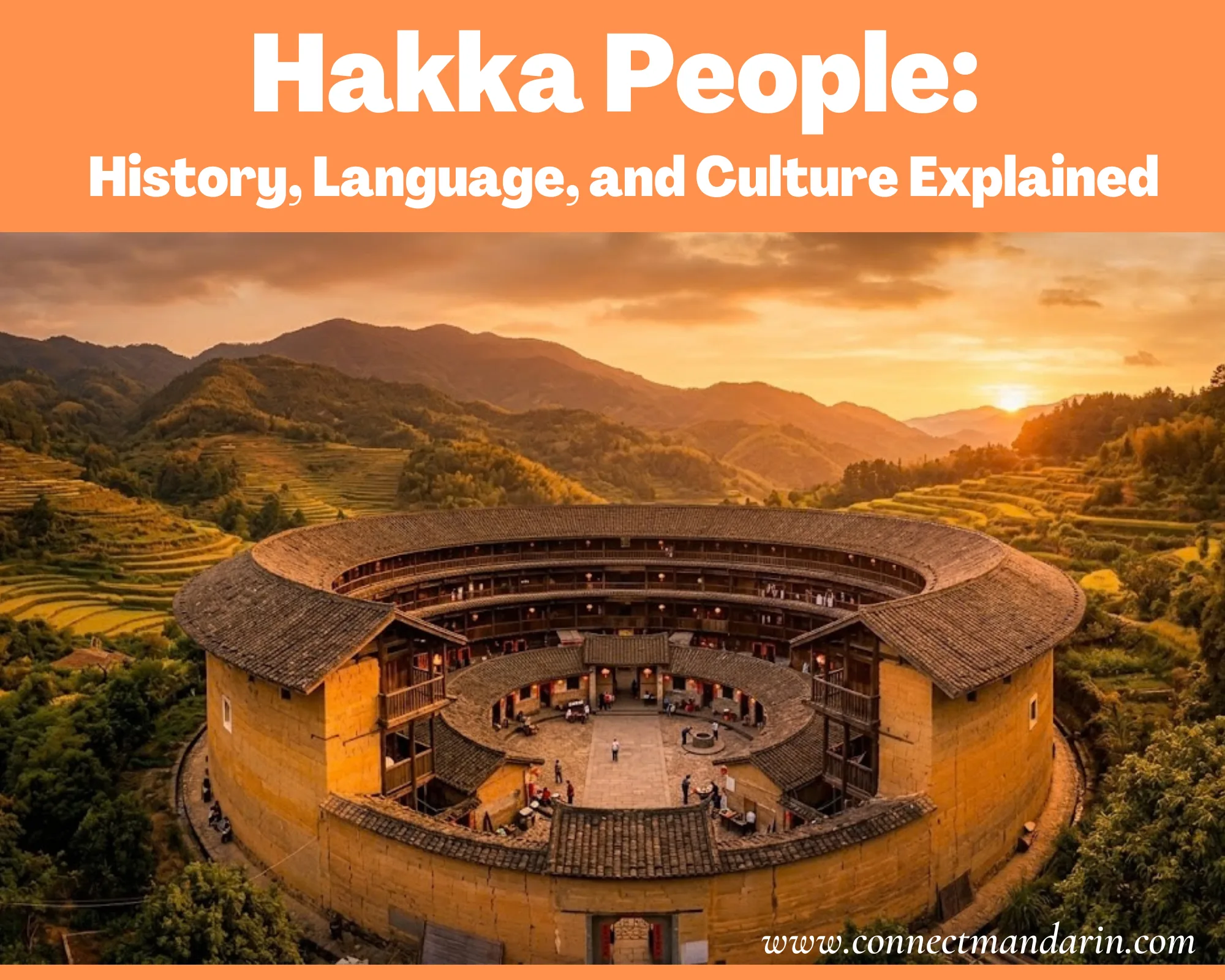
Hakka People: History, Language, and Culture Explained
The Hakka people (客家人) are a Han Chinese subgroup known for their own language, fortified earthen homes, and a cuisine built around preserved ingredients. Here's where they came from, how they live today, and what their story teaches Mandarin learners.
Famous Chinese People: 20 Figures Who Shaped History and Culture
Learn about 20 famous Chinese people who shaped China's history and culture, from Confucius to Jack Ma, with Hanzi, pinyin, and how to say each name.