
Why Learning Mandarin is Your Best Career Move in 2026: The Lang-cation Trend
Discover why learning Mandarin in 2026 is a smart career move—from Lang-cations in Beijing to ROI, cognitive benefits, and real-world industry demand.
Have you ever looked at your resume or your upcoming life choices and felt completely stuck? Maybe you just finished school, or you are staring at your fresh graduation degree, and you feel entirely unclear about what step to take next. The traditional path of jumping straight into a standard entry-level job application cycle feels uninspiring, and you want to do something that truly sets you apart for the long haul.
Three years ago, I found myself in a very similar position. I'm Yogita, and after leaving my previous job, I was hit by that familiar, anxious feeling of navigating an increasingly crowded, hyper-competitive market. I did not want to blindly send out hundreds of identical CVs. I wanted to actively build a skill that would make me stand out, not just for my next role, but for the next few decades of my career. That is what led me to pack my bags, dive headfirst into the world of Mandarin Chinese, and eventually start with Connect Mandarin.
If you are standing at a crossroads after school or graduation, unsure of your next move, learning Mandarin is the ultimate answer. During my own journey, I stumbled upon a concept that is completely changing how ambitious young professionals approach self-development: the "Lang-cation."
What exactly is a "Lang-cation"?
A blend of the words Language and Vacation, a Lang-cation means turning a standard break into a deliberate, hyper-focused period of personal and professional growth.
Instead of flying somewhere just to lie on a beach or take standard tourist photos, you travel to a country with the primary goal of completely immersing yourself in the local language and culture.
For someone fresh out of school, it looks like this:
- It is Not a Lazy Vacation: You typically spend your mornings in intensive language classes (around 15 hours a week) and your afternoons practicing in the real world. It is incredibly rewarding, but make no mistake, it is real work.
- Active Isolation: By taking yourself out of your comfortable home environment, you remove the daily distractions of your normal routine. You are abroad for one single reason: to focus entirely on your learning objective.
- 24/7 Practical Application: A Lang-cation forces you to use the language to survive. Whether you are ordering street food in Beijing, navigating the subway system, or making small talk with a local tech entrepreneur, you are constantly learning through real-life context.
- A Strategic Career Launchpad: It allows you to use a gap year or a post-graduation transition period wisely. You get the adventure of exploring a new corner of the world, but you return home with a massive, concrete skill upgrade on your resume that puts you leagues ahead of other applicants.
By choosing the political, cultural, and historical heart of China, Beijing, you position yourself at the very center of the language. Immersing yourself here forces a level of focus that practicing on an app at home simply cannot replicate. If you are looking to launch your career, target an international market, or future-proof your skills in an AI-driven world, a Mandarin Lang-cation in Beijing is the highest-yielding investment you can make.
The Real Return on Investment (ROI) of Mandarin
Let's address the elephant in the room: learning Mandarin is a massive commitment of time, mental energy, and money. When you look at the upfront costs of an intensive study program in Beijing, it's natural to ask if the payback is really worth it.
The corporate data says an absolute, resounding yes.
1. The "Bilingual Bonus" is Real
Economic studies have long proven that bilingualism acts as a direct salary premium. While knowing common European languages yields a modest salary bump, Mandarin operates in an entirely different financial league. Global job market data consistently reveals that Chinese is one of the highest-paid foreign languages, with fluent speakers frequently earning significantly more than the average annual salary in key international markets like trade, finance, and logistics.
2. Corporate Demand is Skyrocketing
Over a third of multinational businesses actively flag Mandarin as a highly useful, business-critical language to possess. Conversely, a lack of language skills carries a massive penalty for national economies, costing billions in lost trade opportunities every year due to communication gaps.
When you speak Mandarin, you are not just adding a line to your resume; you are filling an expensive operational gap for global employers.
Why Learning Mandarin is Your Ultimate Skill Upgrade This Year
The global marketplace looks radically different today than it did even a decade ago. Mandarin has become such a vital language for international business that China's economic growth has consolidated it. It's not just about manufacturing hubs—it's about leading global e-commerce, pioneer technology, and spearheading massive international developments.
Think of the Belt and Road initiative, which connects Asia, Africa, and Europe. The surge of investment in infrastructure is unprecedented, and businesses all over the world are seeking employees who can work out of the loop, deal with the Chinese business world, and develop direct relationships.
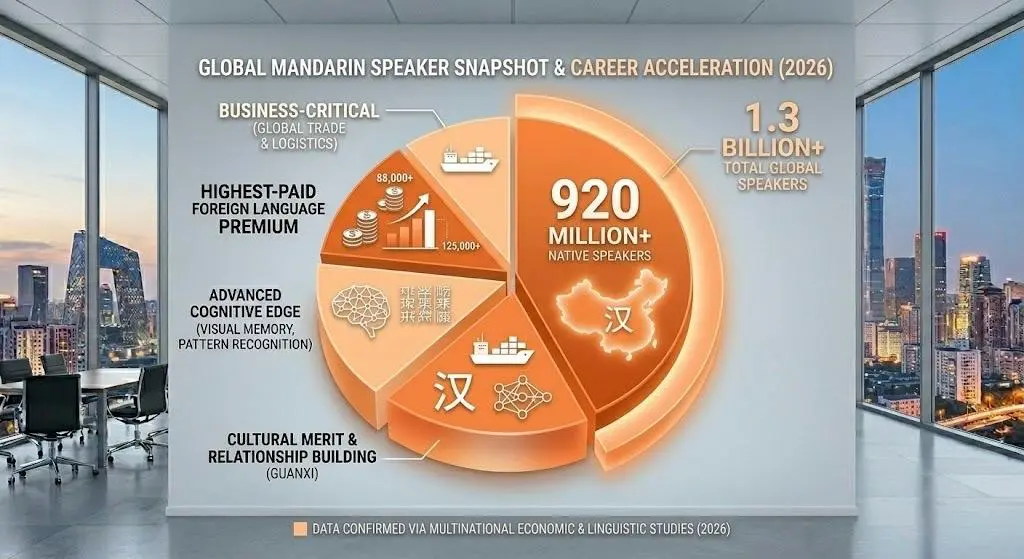
This is the largest language. More than 900 million people speak Mandarin as their native language. But its impact goes beyond the boundaries of mainland China and Taiwan. If you have aspirations to work in major commercial hubs of Southeast Asia such as Singapore, Malaysia, Indonesia, or Thailand, you will soon discover that Mandarin is a commercial must!
This worldwide presence is what gives the language its diplomatic importance and makes it one of the six official languages of the United Nations. Whether you're pursuing international trade, corporate finance, or global policy making, your ultimate destination is Mandarin.
Real-World Career Trajectories
How does Mandarin actually play out for professionals? It is not just for corporate boardrooms or high-level diplomats. People across vastly different industries use it to carve out highly profitable niches:
- Aviation and International Travel: Global airline and hospitality crews who speak Mandarin position themselves for the most competitive, high-demand international routes connecting major Western hubs to mainland China.
- Real Estate and Wealth Management: In competitive major cities, real estate professionals who master conversational Mandarin and understand Chinese business etiquette can tap into a massive pool of international buyers, creating a specialized market niche that standard agents simply cannot touch.
- Supply Chain and Public Relations: Mastering Mandarin allows freelancers, consultants, and PR experts to coordinate directly with global supply chains, factories, and tech hubs without relying on slow, expensive third-party translators.
The Surprising Cognitive Edge
The benefits of Mandarin stretch far beyond your bank account. Because Mandarin is a character-based, tonal language, learning it exercises your brain in unique ways.
- Advanced Visual Memory: Memorizing characters (Hànzì 汉字) trains your visual recall and pattern recognition, sharpening your overall observation skills.
- Heightened Listening Sensitivity: Mandarin relies on four distinct tones, where the exact same syllable can mean completely different things depending on how it is pitched. This constant auditory micro-tuning sharpens your ear, which studies show transfers directly to better attention to detail and general linguistic agility.
Navigating the Future: E-Commerce, Tech, and AI
A common objection in recent years is: "Why bother learning a hard language when AI and machine translation are getting so good?"
While translation software is excellent for reading basic emails or menus, it utterly fails at high-stakes business negotiation, cultural nuance, and relationship building (Guānxi 关系). In Chinese business culture, trust is everything. Speaking to a partner in their native tongue signals deep respect, commitment, and effort—qualities an AI tool can never convey.
Furthermore, China is the undisputed epicenter of global manufacturing, e-commerce innovation, and digital culture. Being based in Beijing gives you a front-row seat to this. Possessing the language allows you to navigate massive digital ecosystems like Alibaba, Taobao, WeChat, and Douyin to spot global consumer trends long before they filter down to the English-speaking world.
Direct Access to a Rich Cultural Heritage

Beyond the financial and professional metrics, learning Chinese opens doors to communicating with over 1.3 billion people worldwide. Chinese civilization spans over 5,000 years, offering unparalleled cultural depth. By learning the language, you gain direct access to classical literature, philosophy, and art that have influenced global thought for centuries.
When you travel through Chinese-speaking regions, speaking even basic Mandarin completely transforms your experience. Locals respond warmly to foreigners making an effort to speak their language. Being able to independently read signs, menus, and transportation routes builds immense personal confidence and allows you to form genuine, lasting friendships that transcend political differences.
How to Start Your Journey with Connect Mandarin
You do not need to master all 5,000 core characters by tomorrow morning. Every successful language journey starts with small, highly consistent milestones.
| Learning Phase | Core Focus | Career and Practical Benefit |
|---|---|---|
| Beginner (HSK 1-2) | Basic greetings (你好 - Nǐ hǎo), tones, numbers, and survival phrases. | Cultural respect, navigating transit, basic rapport building. |
| Intermediate (HSK 3-4) | Conversational fluency, business etiquette, reading digital media. | Conducting basic meetings, handling client relations, independent travel. |
| Advanced (HSK 5-6) | Nuanced negotiations, reading legal/financial documents, cultural literacy. | Leading cross-border mergers, international trade management, specialized consulting. |
If you can manage a full Lang-cation to completely immerse yourself in Beijing, do it. It is an unforgettable, life-altering experience. But if your current job or life commitments keep you at home, high-quality online, 1-on-1 human-led programs offer incredible efficiency, allowing you to build your skills steadily around your current workflow.
Mandarin Chinese is more than just a language. It is a passport to communicating with over 1.3 billion people, a massive differentiator on your resume, and a gateway to the world's most dynamic economic markets.
Are you ready to take your career to the next altitude? Let's take that first step together.
Want to jumpstart your skills? Head over to our resource page at Connect Mandarin to book your Mandarin lessons.
FAQ
1. I'm a total beginner. Can Mandarin actually help my resume right now?
Yes. Reaching even a basic level (HSK 1-2) stands out massively. It demonstrates to the world a high degree of initiative, adaptability, and cultural respect to employers around the globe. A mark of respect and basic greetings can often be all that is needed to establish important "trust" (Guānxi) in international business meetings.
2. Will you learn nothing if there are AI and translation applications?
Not at all. While AI can translate words, it cannot read a room or build relationships. Trust is a crucial component of Chinese business culture. It's cold and transactional to rely on an app during a high-stakes negotiation. When you speak the language yourself, you're giving a degree of personal commitment that an algorithm can't.
3. Which industries need Mandarin speakers the most?
There's a huge competitive advantage in:
- Supply Chain & Tech: Working directly with manufacturers.
- Finance: Global investment and foreign clientele.
- Aviation & Hospitality: Finding top-paying international flight or luxury travel jobs.
4. What does a typical day look like on a Lang-cation?
It is a structured blend of intensive learning and local exploration:
- Morning: 3 hours of interactive, practical Mandarin classes.
- Lunch: Hitting local Beijing spots to practice ordering food.
- Afternoon: Cultural workshops (like business etiquette) or exploring the city.
- Evening: Relaxing, exploring Beijing's tech hubs, or networking.
5. Why is Beijing so special?
Beijing is China's political and cultural centre. It is the gold standard of Putonghua or Standard Mandarin learning, and the purest accent you will get for communicating with people around the world in business. Not to mention that it puts you in the middle of 5,000 years of history and China's largest tech districts.
6. I don't know any Chinese yet. Am I going to get assistance when I get there?
Absolutely. Connect Mandarin takes care of the grunt work. We help you get your visa and housing sorted out, and upon arrival in Beijing, our in-house staff will help you get your SIM card, transport apps, and local bank accounts up and running to get you going.
About the Author
Connect Mandarin Team
We are built by a team of native-speaking teachers and language educators who focus on real, usable Chinese - not just textbook phrases. With 15+ years of combined teaching experience.
Continue Reading
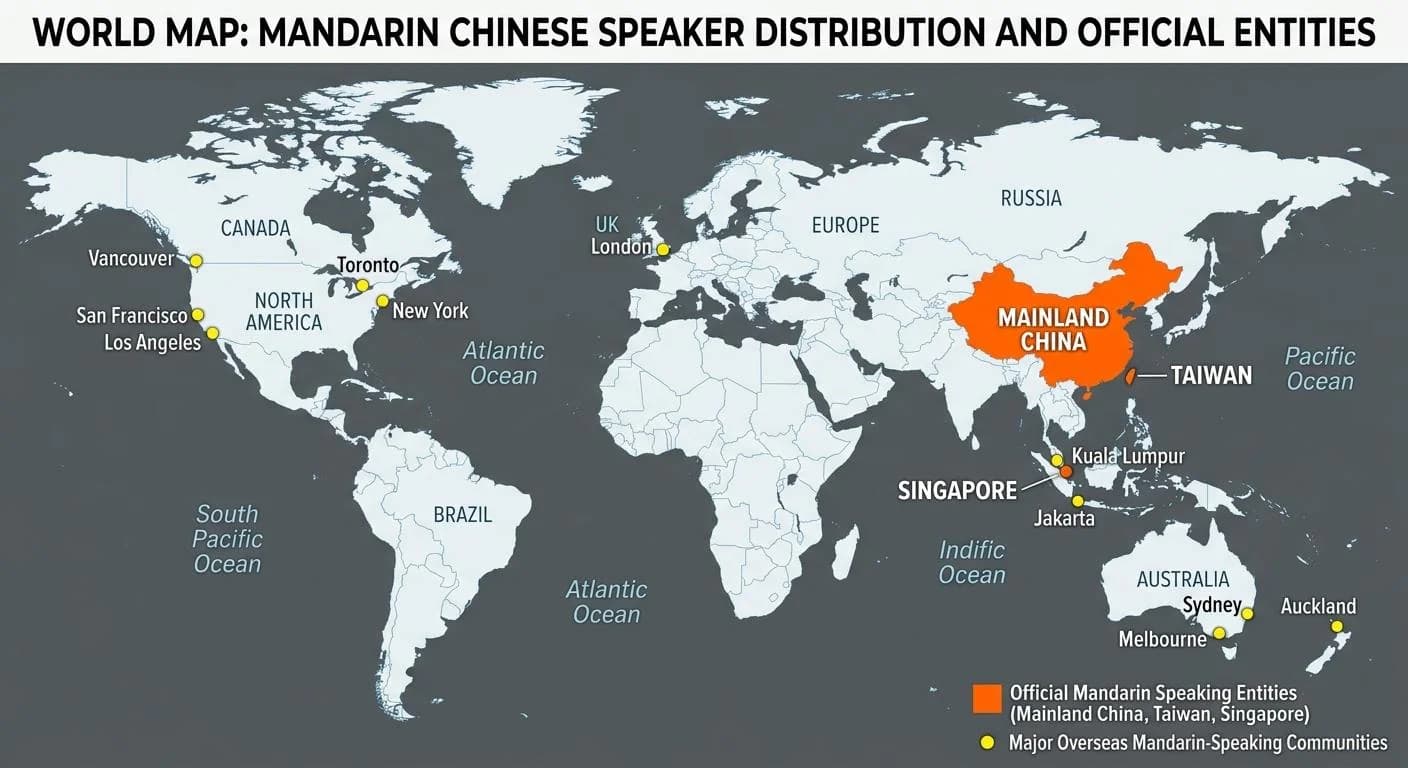
What Countries Speak Mandarin? Official Languages and Where It Is Spoken Worldwide
Which countries speak Mandarin? See where it's official (China, Taiwan, Singapore), where it's widely spoken, and which version to learn first.

What Are You Doing in Chinese? 你在做什么 (Nǐ Zài Zuò Shénme) Explained
Learn how to say "what are you doing" in Chinese, from the textbook-standard 你在做什么 to the casual Beijing favorite 你在干嘛, with pinyin, tone tips, and real dialogues.

Where Are You From in Chinese? (5 Natural Ways to Ask in Mandarin)
Learn 5 natural ways to ask "where are you from" in Chinese, from the everyday nǐ shì nǎlǐ rén to the formal nǐ láizì nǎlǐ, with pinyin and real conversation examples.