
How to Say "Long Time No See" in Chinese (好久不见): Full Guide
Discover how to say "long time no see" in Chinese: the standard phrase, 6 alternatives, natural responses, and sample dialogues from Connect Mandarin.

Running into an old friend, a former classmate, or a colleague you haven't seen in months is one of those small moments that can make or break a conversation's opening tone. In English, we reach for "long time no see" almost automatically. In Mandarin, there's an equally natural, and arguably richer, set of phrases for exactly this moment.
This guide, brought to you by Connect Mandarin, covers the most common way to say it, several alternatives depending on formality and closeness, how to respond naturally, and a few real conversation examples you can borrow directly. It's exactly the kind of everyday, practical phrase our students pick up fast in immersive Mandarin classes in Beijing, the sort of language that textbooks gloss over but native speakers use constantly.
1. The Standard Phrase: 好久不见
好久不见 (hǎojiǔ bújiàn) is the go-to expression, used constantly in both spoken Mandarin and text messages.
Breaking it down character by character:
- 好 (hǎo): here used as an intensifier, "very"
- 久 (jiǔ): "a long time"
- 不 (bú): "not"
- 见 (jiàn): "to see / meet"
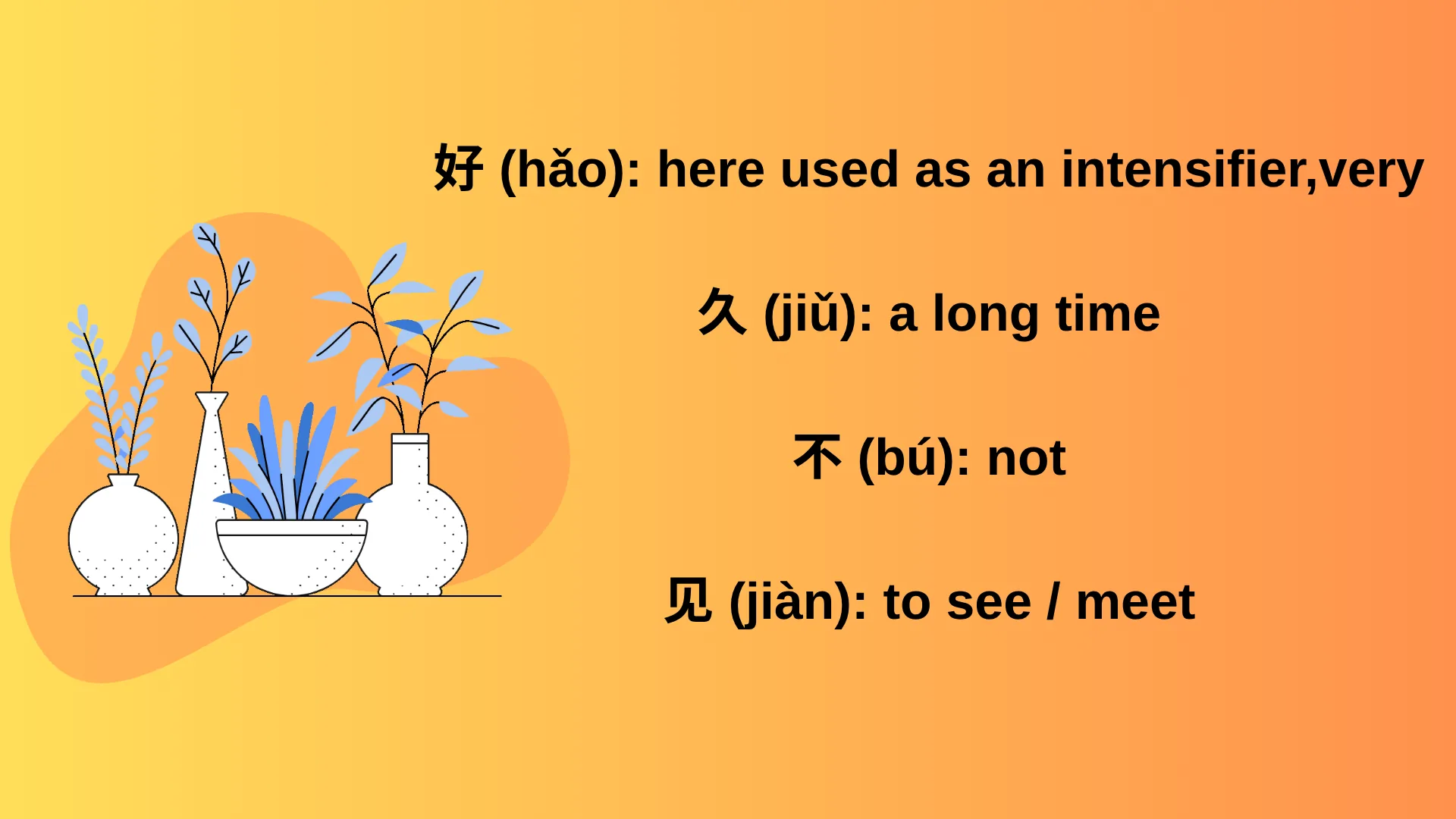
Literally: "very long time not see." It works in almost any setting, with friends, coworkers, distant relatives, or even a shopkeeper you used to visit regularly. Add 了 (le) at the end, as in 好久不见了, to add a slight sense of "it's really been a while, hasn't it," emphasizing that the gap in time is being acknowledged right now.
2. Why English Borrowed This Phrase
One detail that surprises a lot of learners: "long time no see" isn't originally natural English grammar. English doesn't normally allow "no" to modify a verb like that; you'd expect something like "I haven't seen you in a long time." Linguists generally trace the phrase back to 19th century Chinese immigrant communities in North America, where 好久不见 was translated word for word into English rather than idiomatically. Over time, the literal translation stuck and became standard English.
It's part of a small family of English expressions with Chinese roots. "To save face" and "to lose face" (from 面子, miànzi) are often cited as parallel examples of the same kind of direct borrowing.
3. Alternative Ways to Say "Long Time No See"
Depending on who you're talking to, these variations add nuance:
| Phrase | Pinyin | Tone / Use Case |
|---|---|---|
| 久违了 | jiǔwéi le | Slightly more literary/formal; common in writing or polite speech |
| 好久没见面了 | hǎojiǔ méi jiànmiàn le | Same meaning, slightly more explicit, common in speech |
| 好长时间不见 | hǎo chángshíjiān bújiàn | Emphasizes "such a long time," more casual |
| 好久没联系了 | hǎojiǔ méi liánxì le | "Haven't been in touch in a while," used for people you haven't talked to, not necessarily met in person |
| 有阵子没见了 | yǒu zhènzi méi jiàn le | Very casual, colloquial, common among younger speakers |
| 多年不见 | duōnián bújiàn | "Haven't seen each other in years," for genuinely long gaps |
A quick tip: 好久没联系 is useful specifically for people you've fallen out of touch with online or by phone, even if you technically saw them recently. It targets contact, not just sight.
4. How to Respond Naturally

If someone greets you with 好久不见, mirroring it back is completely normal, but native speakers usually add something after it rather than leaving it hanging. A few natural options:
- 是啊,好久不见了! (Shì a, hǎojiǔ bújiàn le!): "Yeah, it really has been a while!"
- 可不是嘛,最近怎么样? (Kě bú shì ma, zuìjìn zěnme yàng?): "Tell me about it, how have you been lately?"
- 对啊,你最近忙什么呢? (Duì a, nǐ zuìjìn máng shénme ne?): "Right, what have you been up to?"
- 是啊,都好久没见了,你气色不错啊! (Shì a, dōu hǎojiǔ méi jiàn le, nǐ qìsè búcuò a!): "Yeah, it's been forever, you're looking great!"
- 可不,一晃好几年了 (Kě bù, yī huǎng hǎo jǐ nián le): "Right, it's flown by, it's already been several years"
The particle 啊 (a) at the end of agreement words like 是啊 or 对啊 softens the tone and makes the response feel warmer and more conversational, rather than a flat statement of fact.
Learn it the way locals actually speak it. Phrases like these are easy to read but harder to use naturally without real conversation practice. In Connect Mandarin, you'll practice greetings, small talk, and everyday expressions like this with native speaking teachers from day one. Book a free trial class to see how it works.
5. Sample Dialogues
Casual, between friends:
A: 哎,好久不见啊!你怎么在这儿? (Hey, long time no see! What are you doing here?)
B: 是啊!我来出差的。你呢,最近还好吗? (Yeah! I'm here for work. How about you, doing well lately?)
Slightly more formal, former colleagues:
A: 王经理,好久不见了,最近工作顺利吗? (Manager Wang, it's been a while, how's work been going?)
B: 还不错,谢谢关心。你现在在哪家公司? (Pretty good, thanks for asking. Which company are you at now?)
6. Common Mistakes to Avoid
- Don't overuse 久违了 casually. It reads as slightly formal or even a bit theatrical between close friends; save it for more polite contexts, speeches, or writing.
- Don't forget the follow-up question. Saying just 好久不见 and stopping can feel abrupt in Mandarin conversation culture, where a quick check-in (最近怎么样, 忙什么呢) is expected immediately after.
- Match 好久没联系 to the right situation. Use it for "haven't been in touch," not for someone you literally just ran into after months apart; that calls for 好久不见.
Mastering a phrase like this is a small thing, but it's exactly the kind of detail that makes your Mandarin sound lived in rather than textbook learned. Next time you bump into someone after months (or years), you'll have more than one way to greet them, and know exactly how to keep the conversation going.
Want to Sound This Natural in Everyday Conversations?
Small, high-frequency phrases like 好久不见 add up fast once you're actually speaking Mandarin in real situations: at markets, with coworkers, or catching up with friends in Beijing. Connect Mandarin offers:
- Intensive and part-time group classes for all levels
- Private 1-on-1 lessons tailored to your goals
- HSK exam preparation with certified teachers
- Immersive cultural programs and city trips in Beijing
Book a free trial class and start putting phrases like this into practice with native speaking teachers, or explore more guides like this one on the Connect Mandarin blog.
FAQ
Is 好久不见 (hǎojiǔ bújiàn) formal or casual?
It's neutral, so it works with friends, coworkers, and acquaintances alike. For more formal settings, use 久违了 (jiǔwéi le) instead.
Can I use 好久不见 (hǎojiǔ bújiàn) over text or WeChat?
Yes, it's extremely common in messages, not just spoken greetings.
What's the difference between 好久不见 (hǎojiǔ bújiàn) and 好久没联系 (hǎojiǔ méi liánxì)?
好久不见 (hǎojiǔ bújiàn) is about not having seen someone in person. 好久没联系 (hǎojiǔ méi liánxì) is about not being in contact at all, even by phone or message.
Is "long time no see" really from Chinese?
Most linguists trace it to a direct translation of 好久不见 (hǎojiǔ bújiàn) by Chinese immigrant communities in 19th century North America, rather than standard English grammar.
Do I need to add anything after saying 好久不见 (hǎojiǔ bújiàn)?
It's natural to follow up with a question like 最近怎么样 (zuìjìn zěnme yàng), "how have you been," rather than leaving it as a standalone greeting.
What does 久违了 (jiǔwéi le) mean exactly?
Literally "long absent," it's a slightly more polite or literary way to say the same thing as 好久不见 (hǎojiǔ bújiàn).
Is it rude to say 好久不见 (hǎojiǔ bújiàn) to someone you saw last week?
Yes, it implies a genuinely long gap. For a shorter gap, just say hello normally or use 最近怎么样 (zuìjìn zěnme yàng).
How do I respond if I don't want to repeat 好久不见 (hǎojiǔ bújiàn)?
Try 是啊,又见面了 (Shì a, yòu jiànmiàn le), "yeah, we meet again," or jump straight into a follow-up question like 最近忙什么呢 (zuìjìn máng shénme ne).
About the Author
Connect Mandarin Team
We are built by a team of native-speaking teachers and language educators who focus on real, usable Chinese - not just textbook phrases. With 15+ years of combined teaching experience.
Continue Reading

Where Are You From in Chinese? (5 Natural Ways to Ask in Mandarin)
Learn 5 natural ways to ask "where are you from" in Chinese, from the everyday nǐ shì nǎlǐ rén to the formal nǐ láizì nǎlǐ, with pinyin and real conversation examples.

How to Say "Not This Time" in Chinese: 5 Natural Mandarin Phrases
Learn how to say 'not this time' in Chinese with 5 natural Mandarin phrases. Get pinyin, real examples, and tips on which one fits each situation.

Jokes in Chinese: Funny Phrases and Wordplay to Learn Mandarin
Learn jokes in Chinese, from dad-joke puns to internet slang, with pinyin, translations, and explanations of the wordplay behind each one.