HSK 3.0: What Changed and What It Means for Your Mandarin
HSK 3.0 moves from six levels to nine and tests what you can do in Chinese. See the 5 key changes, from vocabulary to translation, and how to study.
For fifteen years, HSK meant six levels and a format most learners could predict in their sleep. That is about to change. The World Chinese Language Conference met in Beijing in November 2025, and the official HSK 3.0 syllabus followed in December. If you are partway through your studies, you probably have questions.
We read the official documents and the expert commentary around them, and boiled everything down to five changes that matter to learners.
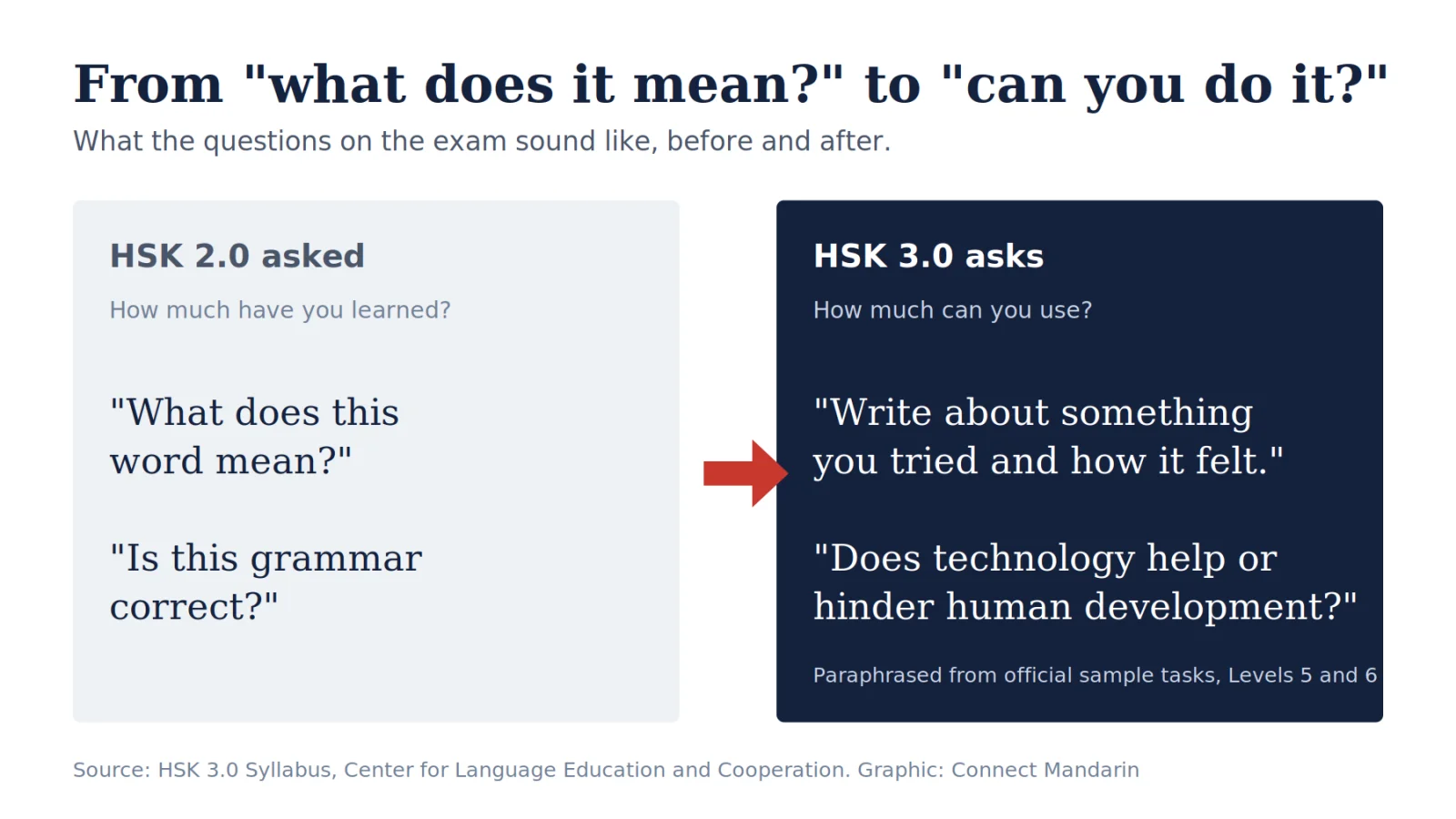
The big picture first. The new exam is not dramatically harder than the old one. It asks a different question. HSK 2.0 wanted to know how much Chinese you had learned. HSK 3.0 wants to know what you can do with it.
The five changes at a glance
| Change | What is new | What it means for you |
|---|---|---|
| New structure | Six levels become nine, in three stages | Advanced learners finally have a goal beyond Level 6 |
| Task-based questions | You are asked to do things in Chinese | Speaking and writing practice matter more |
| New vocabulary curve | Gentle start, quick middle, steep top | Set your pace by your stage |
| Translation | Levels 7-9 include translation into Chinese | Levels 1-6 are not affected |
| Critical thinking | Argument and analysis are central at the top | Practice defending ideas in Chinese |
1. Nine levels instead of six
Anyone who has reached HSK 6 knows the awkward moment that follows. You hold the highest certificate there is, and there is nothing left to aim for.
HSK 3.0 fixes that by stretching the system into three stages and nine levels: Elementary (Levels 1-3), Intermediate (Levels 4-6) and Advanced (Levels 7-9). The official descriptions give each level a single sentence, moving from simple everyday exchanges to precise, in-depth communication [4].
Levels 7-9 are built for high-level learners and lean toward academic Chinese and cross-cultural communication. You sit one paper, and your result decides whether you land at Level 7, 8 or 9. Think of the engineering student planning a PhD in China, the researcher who has to read papers in Chinese, or the manager sitting across the table in a negotiation. Until now, none of them had a proper yardstick.
The tasks at this stage cover daily life and social settings, work and career, and education and academia. They go well past casual conversation. Candidates may have to summarize an academic argument, spot a flaw in someone's reasoning, outline a research design, or answer challenges to their own position.
2. The exam asks what you can do
Look at the HSK 3.0 sample papers and you will see the shift quickly. Fewer questions ask what a word means or whether a sentence is grammatical. More of them ask you to complete a task in Chinese.
The Level 5 writing sample asks for an essay of at least 200 characters about something you tried and how it felt. At Level 6, the prompt is whether technology helps or hinders the all-round development of a person. At Levels 7-9, you might describe and analyze a chart, or take a line from the Analects and argue for your reading of it.
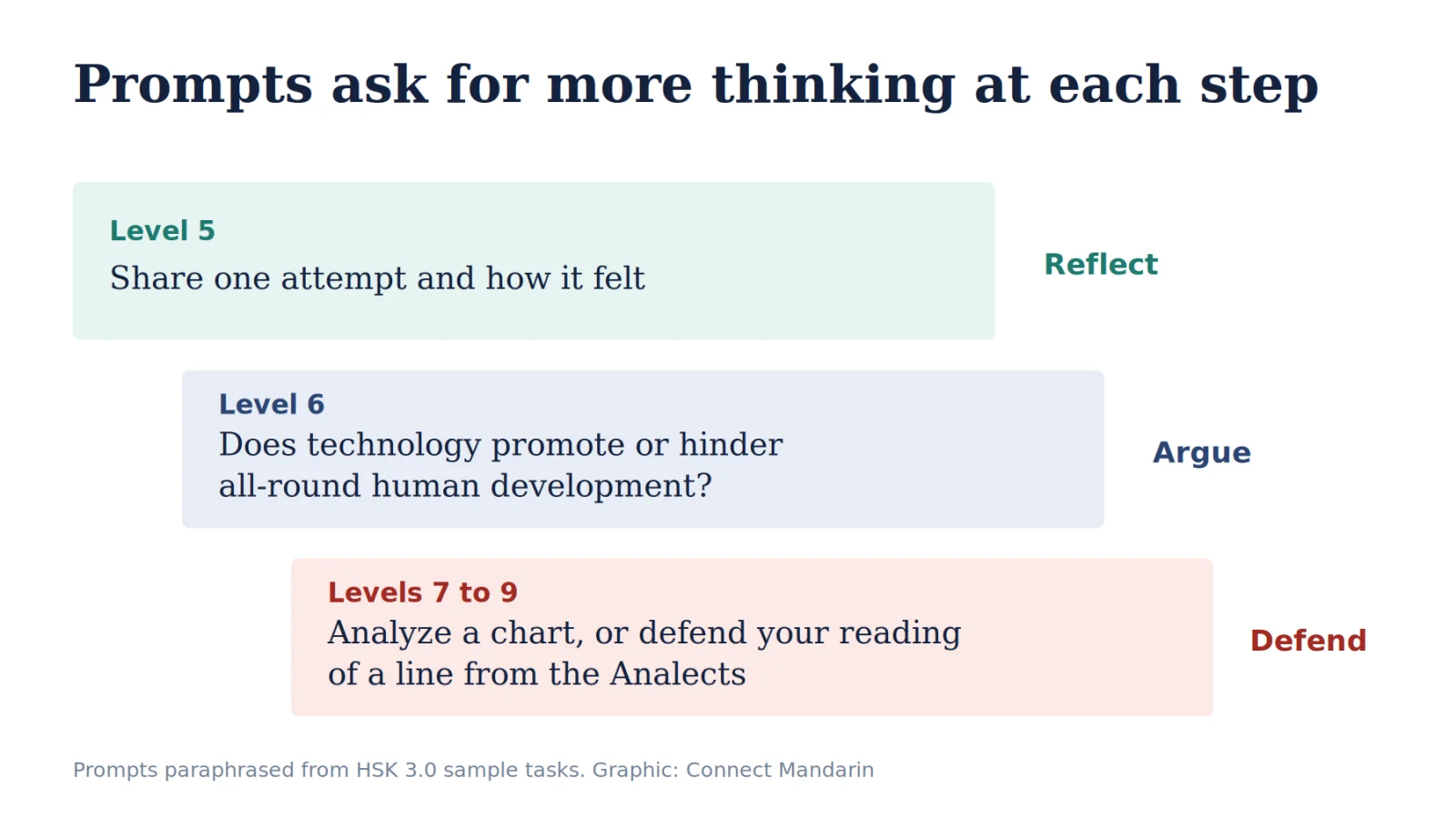
That is much closer to a university essay than to a vocabulary quiz. The thinking behind it is that real language ability shows up in situations: understanding information, organizing your thoughts, getting something done.
You may well know the word for "argument." Whether you can argue a point in Chinese is a separate skill, and the only way to build it is to practice. Expect to spend less time copying and memorizing, and more time speaking and writing.
3. A gentle start, a quick middle, a steep top
The new vocabulary syllabus contains 11,000 words in total. They are spread like this:
- Level 1: 300 words
- Level 2: 500 words cumulative
- Level 3: 1,000 words cumulative
- Levels 1-6 together: 5,400 words
- Levels 7-9: another 5,600 words
Compare that with the Chinese Proficiency Grading Standards, which asks for 500 words at Level 1, 1,272 by Level 2 and 2,245 by Level 3. The new beginner stage is clearly lighter, and on purpose. The official explanation is that learners outside China have fewer class hours and move more slowly, so an overloaded start tends to discourage people. A lighter opening helps beginners gain confidence and feel steady progress.
The middle stage speeds up, because by then you already know many characters and can build new words from familiar parts. The top stage jumps sharply, since Levels 7-9 target academic and professional use, and nobody can be assessed fairly there without a large vocabulary.
The grammar syllabus moved less. Official commentary sums up the changes as two additions, two supplements and two adjustments. In practice, the framework is familiar, the categories are finer, and a few points have shifted to a different level.
The rhythm, in short: beginners should build a solid base without rushing, intermediate learners can accelerate, and advanced learners should expect the workload to rise.
4. Translation arrives at Levels 7-9
The Chinese Proficiency Grading Standards have long counted translation among five language skills, next to listening, speaking, reading and writing. HSK 3.0 now puts it into the exam at Levels 7-9, currently for seven languages: English, Spanish, Japanese, Korean, Thai, Mongolian and Vietnamese. You translate from your own language into Chinese.
The reasoning is that a truly advanced learner acts as a bridge between languages and cultures. Understanding Chinese is one thing. Moving accurately and naturally between two languages is a skill that matters in academic work, business and everyday intercultural life.
If you are preparing for Levels 1-6, you can relax on this point. Those exams cover listening, reading and writing, with no translation items at any level. Translation appears only at Levels 7-9, and only into Chinese.
If you are aiming higher, it is worth starting early. At Levels 4 and 5, try turning short, simple sentences from your own language into Chinese. It trains you to switch between the two languages with confidence.
5. Critical thinking moves to the center
Of all five changes, this is the deepest, and the one learners most often miss.
Critical thinking here means analyzing information calmly, questioning and weighing it, and building a logical case. It includes spotting weak arguments, comparing viewpoints, supporting your own position with evidence, and recognizing the limits of your own thinking.
You can see it in the exam. The Level 5 prompt sounds easy, but a good answer to "tell us about something you tried" needs reflection, not just a list of events. The Level 6 technology essay needs a position, evidence and reasoning. At Levels 7-9, candidates are asked to find language problems and logical gaps in a text, and to explain and defend their view when challenged [2].
There is a good reason for this. Language and thought depend on each other. A clear thinker writes more coherently, and a huge vocabulary cannot rescue an argument that does not hold together. Many errors that look like grammar mistakes in intermediate and advanced learners turn out to be reasoning problems underneath. Vocabulary can carry a sentence. Only logic can carry a point of view.
In practice, this changes how you study. Take the topic of technology. The old approach might be to write sentences with a list of target words, or to read a passage and answer questions. The new approach looks more like a small debate: you state your view, someone challenges it, and you respond, all in Chinese. Reading critically, writing argumentative essays and joining discussions stop being extras and become core preparation.
How to plan your study
HSK 3.0 is an upgrade of HSK 2.0 rather than a replacement. The foundations stay in place: level certification, testing of language knowledge, reliability and fairness. What changes is the test construct, the question types and the scoring.
Three adjustments will serve you well:
- Use Chinese as much as you study it. Favor speaking, writing and realistic tasks over memorizing word lists.
- Match your pace to your stage. Build a firm base at the beginning, speed up in the middle, and focus on academic Chinese and reasoning at the top.
- From Level 5 onward, practice giving an opinion, backing it up and answering an objection in Chinese.
HSK 3.0 is still being rolled out, and some details will become clearer over time. The direction, though, is plain. The exam is moving from "how much Chinese do you know" to "what can you do with Chinese."
Frequently asked questions
What is HSK 3.0?
HSK 3.0 is the updated version of China's Mandarin proficiency exam. It expands the system from six levels to nine, adds task-based questions, uses a new vocabulary curve of 11,000 words and puts critical thinking at the top. The big shift is from asking how much Chinese you know to asking what you can do with it.
How many levels does HSK 3.0 have?
HSK 3.0 has nine levels in three stages: Elementary (Levels 1-3), Intermediate (Levels 4-6) and Advanced (Levels 7-9). At the advanced stage you sit one paper, and your result decides whether you land at Level 7, 8 or 9. These levels lean toward academic Chinese and cross-cultural communication.
Is HSK 3.0 harder than HSK 2.0?
Not dramatically. The beginner stage is lighter, with 300 words at Level 1 compared with 500 under the older standards, while the middle stage speeds up and Levels 7-9 are steep. The bigger change is the question style: HSK 3.0 asks you to complete tasks in Chinese, not just show what you have memorized.
How many words are in the HSK 3.0 vocabulary?
The HSK 3.0 syllabus contains 11,000 words in total. Levels 1-6 together cover 5,400 words, and Levels 7-9 add another 5,600. The start is gentle, with 300 words at Level 1, 500 cumulative at Level 2 and 1,000 cumulative at Level 3, before the curve steepens at the top.
Does HSK 3.0 include translation?
Translation appears only at Levels 7-9, where you translate from your own language into Chinese. It is currently offered for seven languages: English, Spanish, Japanese, Korean, Thai, Mongolian and Vietnamese. Levels 1-6 cover listening, reading and writing, with no translation items at any level.
How should I prepare for HSK 3.0?
Use Chinese as much as you study it, favoring speaking, writing and realistic tasks over memorizing word lists. Match your pace to your stage by building a firm base early and speeding up in the middle. From Level 5 onward, practice giving an opinion, backing it up and answering an objection in Chinese.
Preparing for HSK 3.0 with Connect Mandarin
At our Beijing campus, the HSK Exam Preparation Program covers HSK 1-9 with certified teachers, mock exams and official materials. If you would rather have one teacher focused entirely on you, our private 1-on-1 classes run online or offline and follow your own goals.
Not sure which level suits you? Book a free trial class or get in touch, and we will help you pick a plan.
Sources
- Center for Language Education and Cooperation, Ministry of Education. Chinese Proficiency Grading Standards for International Chinese Language Education (GF0025-2021). Beijing Language and Culture University Press, 2021.
- Center for Language Education and Cooperation. HSK Syllabus (HSK 3.0). Released December 2025.
- Center for Language Education and Cooperation. New HSK (Levels 1-6) Test Structure and Sample Items.
- Center for Language Education and Cooperation. HSK 3.0 Proficiency Descriptions.
- Yu Yunfeng. "An Evolving Chinese Proficiency Test That Promotes Learning and Teaching Through Assessment." Guangming Daily, November 11, 2025.
- Feng Liping, Wang Lei, Zhang Hui. "Interpreting the Development of the HSK Syllabus (HSK 3.0)." International Chinese Language Education, Issue 1, 2026.
- Wu Zhongwei. "Continuity and Innovation in HSK, in Step with the Development of the Field and Discipline." Studies in International Chinese Language Teaching, Issue 1, 2026.
- Wu Zhongwei. "Giving Greater Weight to Critical Thinking in Chinese Assessment and Teaching: The Innovative Development and Significance of the HSK 3.0 Assessment Philosophy." International Chinese Language Education, Issue 1, 2026.
This article is for general information. Please check the official HSK documents and announcements for the latest requirements.
About the Author
Connect Mandarin Team
We are built by a team of native-speaking teachers and language educators who focus on real, usable Chinese - not just textbook phrases. With 15+ years of combined teaching experience.
Continue Reading
One Character, Many Moods: How to Use 好 (hǎo) in Chinese
Learn what hao means in Chinese and how to use it as good, so, ready and okay. Compare hao de, hao a and hao ba with clear examples and tone tips.
Family in Chinese Letters: 家人 (Jiārén) and Family Words in Characters
Learn family in Chinese letters: jiārén is the most common word. See characters for mom, dad, grandparents, aunts and cousins, plus Beijing vs Shanghai terms.
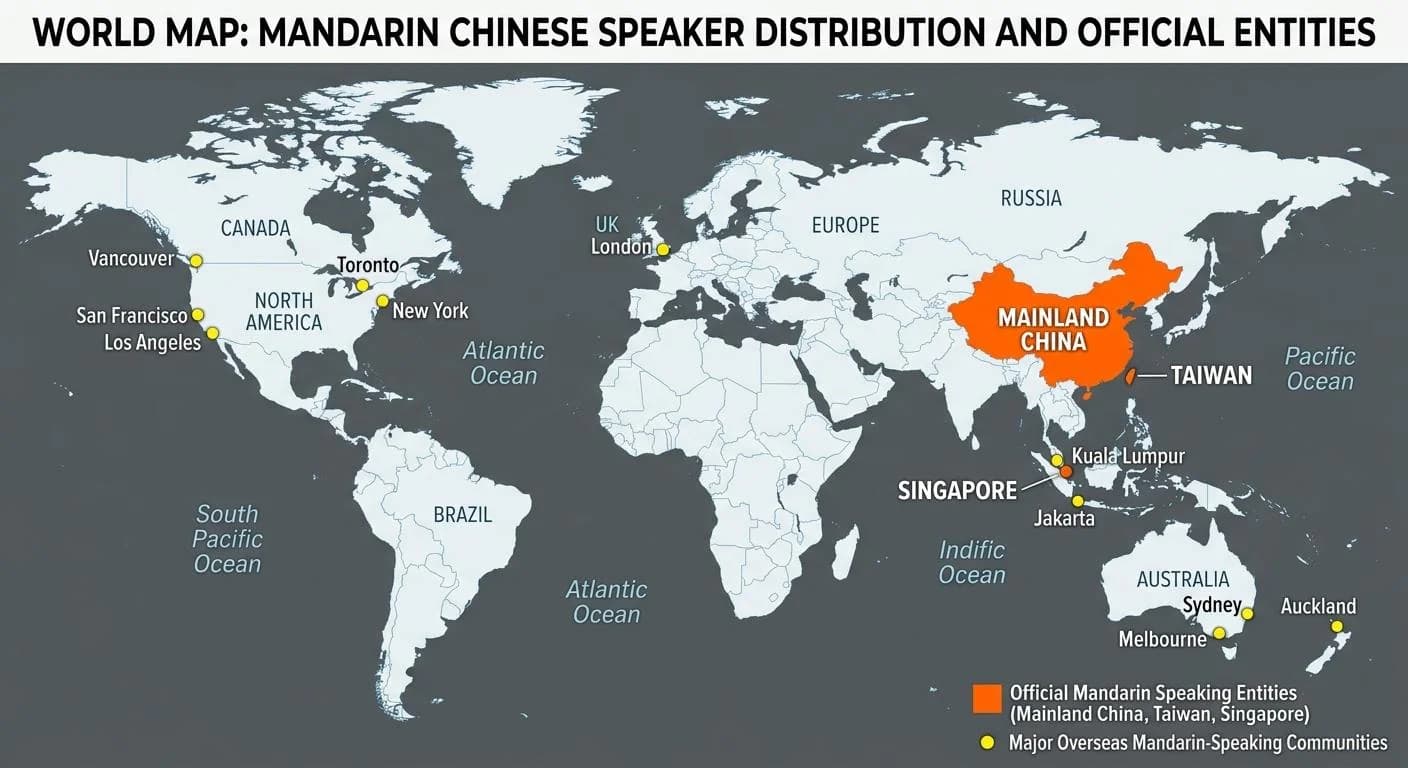
What Countries Speak Mandarin? Official Languages and Where It Is Spoken Worldwide
Which countries speak Mandarin? See where it's official (China, Taiwan, Singapore), where it's widely spoken, and which version to learn first.