
How to Say Hello in Chinese: A Complete Beginner's Guide
There's more than one way to say hello in Chinese. Learn how greetings change with strangers, friends, texting, and phone calls, the way locals use them.
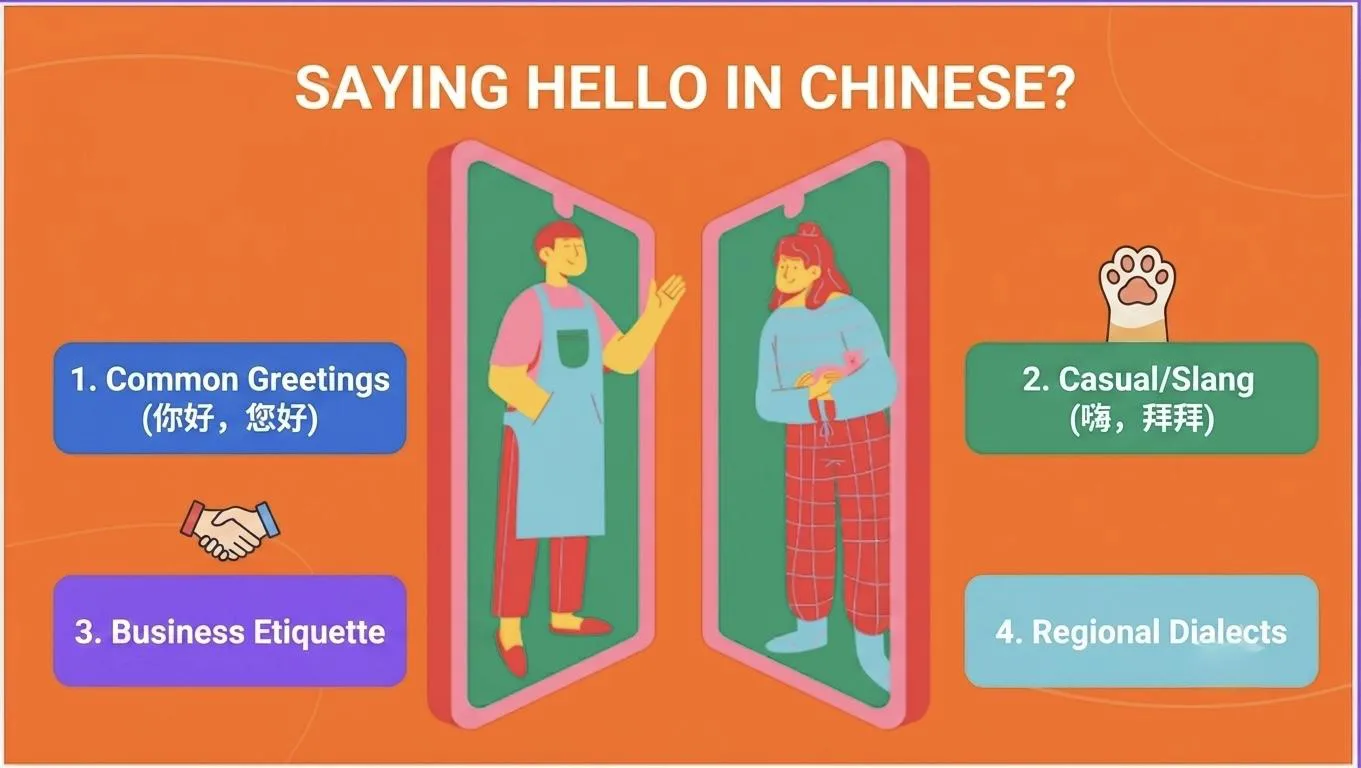
If you learned 你好 (nǐ hǎo) on day one and assumed that covered it, you're not alone, and you're also about to feel a little behind the curve. Chinese greetings aren't a fixed script; they shift depending on who you're talking to, how well you know them, and even whether you're texting or on the phone. Get the context right and you sound like a local. Get it wrong, and even perfect tones can come across stiff or oddly formal. Here's how native speakers actually greet each other, broken down by situation:
- Strangers & new acquaintances — when 你好 actually works
- Friends & regulars — the "not really a question" greetings
- Texting & chat apps — why 再见 can sound too final
- On the phone — the one greeting reserved just for calls
- Chinese New Year — two greetings you'll only hear once a year
- The biggest mistake learners make — and what to say instead
Most learners get taught 你好 (nǐ hǎo) in their very first class and then wonder for years why native speakers barely use it. Chinese greetings aren't really a fixed list you memorize. They change depending on who you're talking to and how close you are with them. A greeting that's totally normal with your landlord would sound stiff with your roommate, and the other way around too.
So instead of running through a list of phrases, it helps to think about greetings the way Chinese speakers actually use them, grouped by relationship.
With Strangers and People You've Just Met
This is the one place 你好 (nǐ hǎo) genuinely works well. It's neutral, safe, and fine with shopkeepers, new coworkers, or anyone whose name you don't know yet.
One small upgrade worth learning early: swap 你 (nǐ) for 您 (nín) when the person is older or in a position of authority, so 你好 becomes 您好 (nín hǎo). It costs nothing and buys you a bit of goodwill.
Worth knowing though: 您 (nín) is most alive today in the service industry. If you're working the front desk at a hotel, greeting guests at a spa, or in any role where you're serving a customer, 您好 is basically the default. Outside of that kind of setting, it's used a lot less than most textbooks make it seem, especially among younger speakers, so don't feel like you need to sprinkle it everywhere to sound polite.
If you do know someone's name or title but still want to keep things formal, Chinese speakers often skip 你 entirely and greet the person directly by role.
周经理好 (Zhōu jīnglǐ hǎo) means Hello, Manager Zhou. 王老师好 (Wáng lǎoshī hǎo) means Hello, Teacher Wang.
It reads almost like addressing someone by name in English instead of a plain "hey you." Small shift, warmer result.
With Friends and People You See Often
This is where things get more interesting, because a lot of everyday greetings between friends aren't really questions. They're closer to a nod of acknowledgment dressed up as a question.
If a friend passes you and asks 你去哪儿?(nǐ qù nǎr, Where are you headed?), they're rarely asking for your actual itinerary. A one word answer like 回家 (huí jiā, heading home) is a complete, satisfying reply. The exchange isn't really about information. It's about noticing each other.
Same idea with 吃了吗?(chī le ma, Have you eaten?), one of the most common greetings in Chinese and one that has almost nothing to do with wanting food details. A simple 对 (duì, yep) closes the loop just fine.
For friends you haven't seen in a while, 好久不见 (hǎojiǔ bújiàn, long time no see) fits well. As a bit of trivia, linguists generally agree this is where the English phrase "long time no see" originally came from, picked up by English speakers living in China generations ago.
If you want to go a level deeper than a quick hello, 你最近怎么样?(nǐ zuìjìn zěnmeyàng), How have you been lately? invites an actual update, unlike the quicker check-ins above.
In Texting and Chat Apps
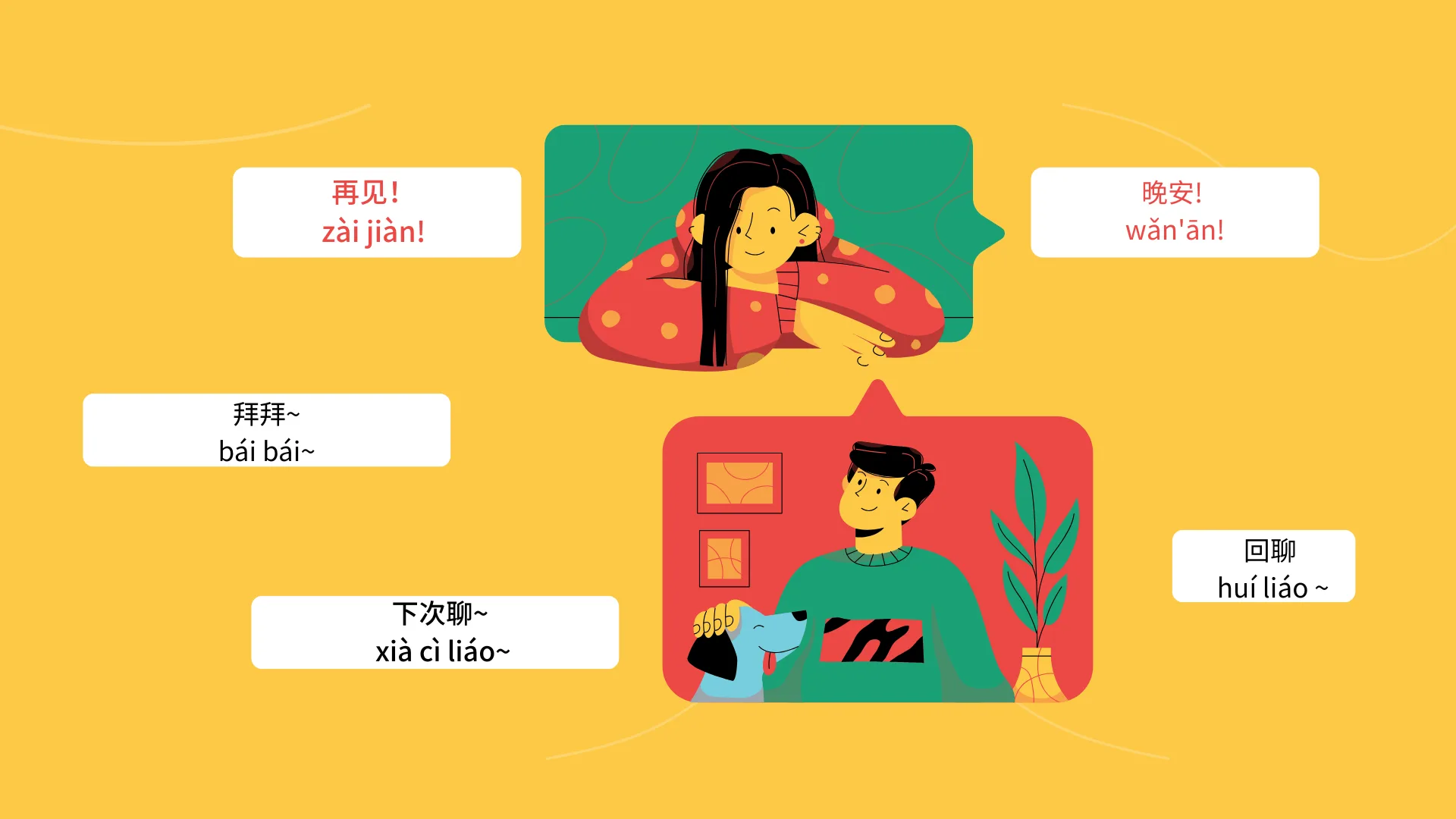
Texting has its own etiquette, and this is where a lot of learners accidentally sound too formal or too final without realizing it.
Ending a text conversation with 再见 (zàijiàn) is a common learner habit, but in spoken Chinese, 再见 carries real weight, closer to shutting a door than a casual sign off. It's the kind of goodbye you'd say out loud at the end of a phone call, not something to type at the end of a WeChat chat. A softer, more natural way to end is 下次聊 (xiàcì liáo, talk again soon), or 晚安 (wǎn'ān, good night) if it's evening.
The same goes for 一会儿见 (yíhuìr jiàn, see you later). In Chinese this specifically means soon, more like the next hour than "sometime next week." It's a much tighter promise than the English phrase implies.
On the Phone
Chinese has a greeting almost entirely reserved for answering calls: 喂 (wèi). It's not something you'd say walking into a room or meeting someone in person. It belongs to the moment you pick up the phone, sometimes softened into 喂你好 (wèi nǐ hǎo).
During Chinese New Year
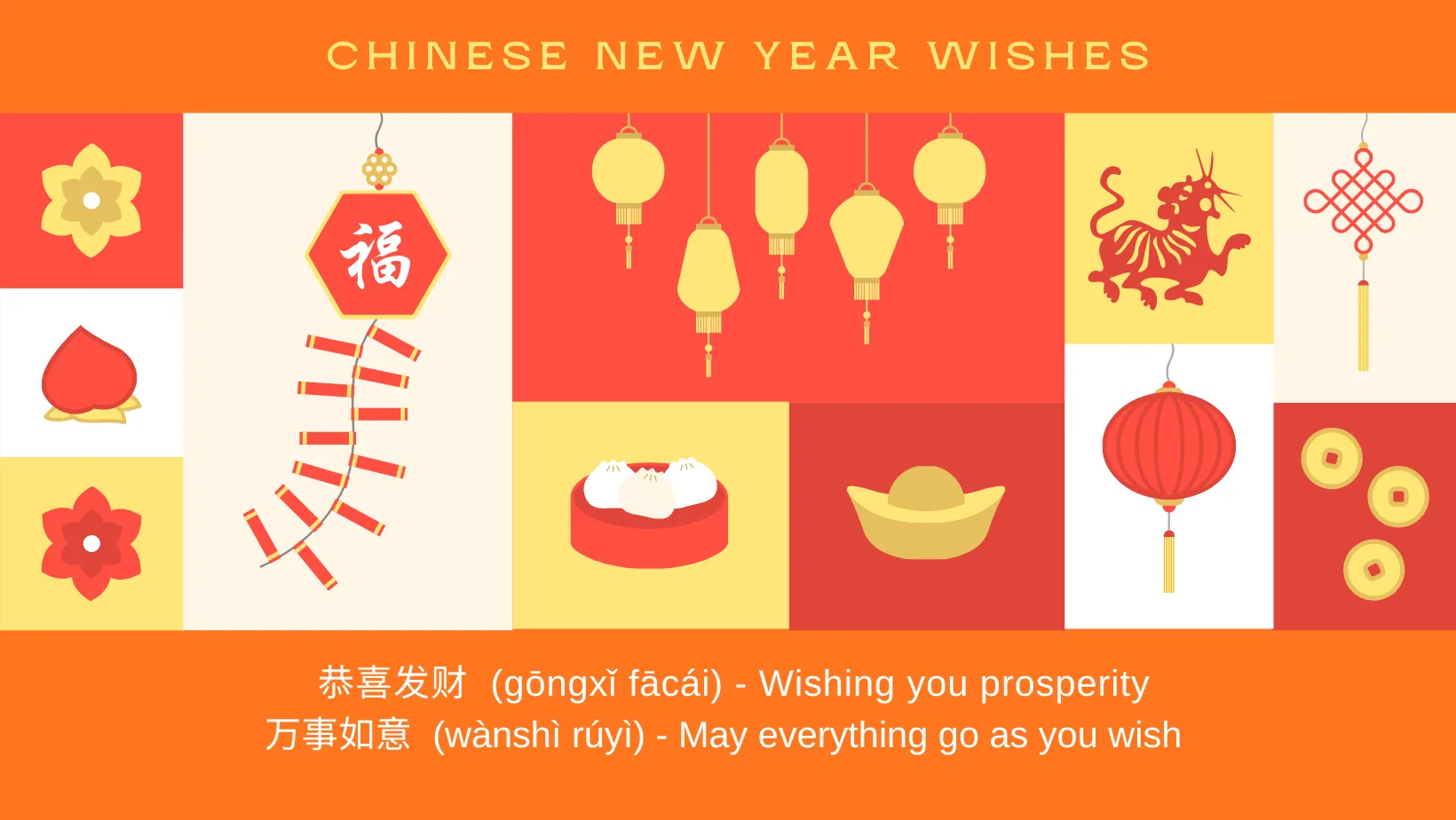
Two greetings show up almost exclusively during the holiday season.
恭喜发财 (gōngxǐ fācái) is a cheerful wish for wealth and prosperity, said more in good humor than literal expectation. 万事如意 (wànshì rúyì) simply wishes that everything goes as hoped.
Outside of Chinese New Year you won't hear either much, but they're essential once the holiday rolls around.
The One Everyone Gets Wrong: 你好吗?(nǐ hǎo ma)
If there's a single habit worth breaking, it's this one. 你好吗?reads as a direct translation of "How are you?" but in practice it can land as distant, even a little concerned, the kind of thing you'd ask someone who looks unwell or someone you barely know.
Native speakers tend to greet with something specific instead of something general. 周末怎么样?(zhōumò zěnmeyàng, How was your weekend?), 下班了啊?(xiàbān le a, Just got off work?), 吃了吗?(chī le ma, Have you eaten?). The specificity is the point. It signals you're actually paying attention to this particular person's day, not running through a script.
Why This Matters More Than Vocabulary
None of this is really about memorizing more words. It's about noticing that Chinese greetings track relationship and context much more closely than English ones do. Once that clicks, choosing the right greeting stops being a lookup problem and starts being instinct, the same way you'd never say "yo" to your boss in English without thinking twice.
Try picking one greeting from above that you don't currently use, and test it out this week with a classmate, tutor, or native-speaking friend. Small shifts like this tend to be what makes someone's Chinese start to sound lived in instead of studied.
None of this comes from memorizing more words — it comes from hearing these greetings used in real conversation, again and again, until picking the right one feels automatic instead of like a lookup. That's exactly the kind of instinct Connect Mandarin tutors help you build — real back-and-forth practice with a native speaker who'll actually tell you when something sounds a little too textbook. If you want to move past 你好 and start sounding like you've lived here, book your free trial class and put one of these greetings to use this week.
FAQ
Is 你好 (nǐ hǎo) the right way to greet everyone?
No — it's mainly for strangers or people you've just met. Friends and family use more specific, casual greetings.
What's the difference between 你好 and 您好?
您好 (nín hǎo) is the more respectful version, used for elders, authority figures, or in service settings like hotels and spas.
Why do Chinese speakers ask "Have you eaten?" as a greeting?
吃了吗 (chī le ma) isn't really about food — it's a casual check-in, similar to "How's it going?" in English.
Is it rude to answer "你去哪儿?" with just one word?
Not at all — a short reply like 回家 (heading home) is completely normal and expected.
Should I say 再见 at the end of a text message?
It's better to avoid it — 再见 feels final and formal, closer to hanging up a phone call. 下次聊 or 晚安 are more natural in chat.
What does 喂 mean and when do I use it?
喂 (wèi) is used specifically when answering the phone — not for greeting someone in person.
Is 你好吗 a good way to ask, "How are you?"
Not usually — it can sound overly formal or even concerned. Native speakers prefer specific questions like "How was your weekend?"
When should I use 恭喜发财?
Only around Chinese New Year — it's a wish for wealth and prosperity tied specifically to the holiday.
About the Author
Connect Mandarin Team
We are built by a team of native-speaking teachers and language educators who focus on real, usable Chinese - not just textbook phrases. With 15+ years of combined teaching experience.
Continue Reading

Jokes in Chinese: Funny Phrases and Wordplay to Learn Mandarin
Learn jokes in Chinese, from dad-joke puns to internet slang, with pinyin, translations, and explanations of the wordplay behind each one.

How to Say Good Morning in Chinese: Phrases, Pinyin & Culture
Learn how to say good morning in Chinese with pinyin, tones, and etiquette. Discover formal, casual, and texting phrases used across Mandarin culture.

How to Say I Love You in Chinese Mandarin: Phrases, Meanings & Culture
Learn how to say I love you in Chinese Mandarin, plus the number codes, family customs, and cultural etiquette behind expressing love and affection.