
Your Guide to Living and Working in Beijing as an Expat
Planning expat life in Beijing? Discover essential apps, neighborhoods, workplace culture, and practical tips for foreigners settling into life in China's capital.
Moving to Beijing is absolutely a thrilling adventure, but let's be honest: If you don't speak Mandarin and haven't downloaded the right apps, or let's say your phone isn't ready on arrival, your first few weeks can feel a bit like trying to read a map upside down while riding a unicycle.
Beijing is a massive, high-speed megacity where the ancient world crashes directly into the ultra-modern digital age. But don't worry! With the right toolkit and a little bit of local know-how, you will quickly transition from feeling like a confused outsider (lǎowài) to navigating the city like a "Beijing-ren."
Here is your essential survival guide to setting up your life, career, and routine in China's dynamic capital.
The Digital Survival Kit: 4 Apps You Need on Day One
Beijing is a virtually cashless society. If you try to pay for a coffee with a paper banknote, the barista might look at you like you just handed them a piece of parchment from the Qing Dynasty. Before you even unpack your bags, make sure these four apps are downloaded and linked to your international credit card, or after coming to Beijing buy a local SIM, download these apps, register on these apps, and make life super easy:
- WeChat (微信 - Wēixìn): Your everything app. It's WhatsApp, Facebook, and your digital wallet (WeChat Pay) all rolled into one. You will use it to buy groceries, split dinner bills, and message/call your landlord.
- Alipay (支付宝 - Zhīfùbǎo): The other massive digital wallet. It has an excellent built-in "Transport" mini-program that lets you scan your phone to ride the Beijing subway and public buses seamlessly; also it is a payment platform.
- DiDi (滴滴): China's version of Uber. It has a great English interface, and you can type your destinations in English, which is quite convenient.
- Meituan (美团) / Ele.me (饿了么): These are your lifelines for food, coffee, groceries, and even medicine delivered straight to your door within 30–40 minutes.
The Language Advantage
While the main app interfaces have English translations, the humans using them do not (as it is still rare in Beijing for everyday service workers to speak good English!).
When your DiDi driver calls to say he is waiting at the 西门 - xī mén (west gate), or your Meituan delivery driver messages you asking for your apartment code/block, knowing just a few basic Mandarin words transforms a stressful situation into a quick, easy interaction.
Finding Your Vibe: Beijing's Neighborhood Personality Test
Beijing is vast, and where you choose to live will define your expat experience, the place of your job, business, or university. The city is organized by "Ring Roads" that loop around the historical center. Most expats tend to cluster in a few key areas, each with its own unique personality:
| District / Neighborhood | The Vibe | Best For... |
|---|---|---|
| Sanlitun & CBD | Glitzy malls, skyscraper views, Western restaurants, and high-energy nightlife. | Expats who want maximum convenience and a Western comfort bubble. |
| The Hutongs (Gulou/Andingmen) | Winding historical alleyways, traditional courtyard houses, hip cafes, and craft beer bars. | Creative types, history buffs, and those who want an authentic, cultural daily life. |
| Shunyi Suburbs | Quiet, green, spacious suburban compounds and International schools. | Expat families with children who want a peaceful retreat from the city center, or those who are working with schools. |
| Wudaokou | A bustling, budget-friendly university hub packed with international students and cheap eats. | Younger expats, students, and budget travelers. |
Quick Note: If you stay exclusively in Sanlitun, you can survive using English. But if you dream of drinking coffee in a historic Hutong courtyard or buying fresh dragon fruit or watermelon from a local neighborhood market, speaking conversational Mandarin is the key that unlocks the door to "real" Beijing.
Workplace Culture: Mastering Mianzi and Guanxi

If you are moving to Beijing for professional reasons, succeeding in a Chinese office requires understanding a few "unwritten" social rules. Two concepts dominate the professional landscape:
Mianzi (面子) – "Face"
"Face" is a mix of reputation, social honor, and pride. In a Beijing office, avoiding public embarrassment is crucial.
- The Golden Rule: Never criticize a colleague, subordinate, or any senior openly in a meeting. If you disagree with a strategy, discuss it privately over a coffee or a casual lunch (as a lot of work things are discussed over lunch, dinners and coffees).
- Giving others "face" (gěi mianzi) will make you an incredibly respected team member.
Guanxi (关系) – "Networks / Relationships"
In the West, business is often transactional — you sign a contract and then build the relationship. In China, it's reversed: you build the relationship first, and then you do business. True guanxi is built over shared meals, casual tea tastings, and after-work dinners.
How to fast-track your career: You don't need a business degree in Mandarin to impress your Chinese partners. Simply showing the effort to say a few polite phrases during a business dinner, toast correctly (gānbēi!), or exchange digital WeChat business cards with the proper etiquette builds massive guanxi. It shows you respect the culture, and doors will open for you much faster.
The Expat Roadmap: Your First Six Months
Stepping off the plane is just the beginning. To give you an idea of how your life will evolve, here is what the typical, successful expat journey looks like over the first half-year:
- Phase 1: The First 2 Weeks — Survival Mode. Activate your local SIM card, link your international bank cards to Alipay/WeChat, and memorize your apartment address in Chinese characters for deliveries.
- Phase 2: Month 1 — Setting Root. Sign your apartment lease, learn the layout of your local neighborhood, and find your go-to supermarket, coffee shop, and subway station.
- Phase 3: Months 2–3 — Office Integration. Navigate local workplace dynamics, adapt to the city's rapid pace, and start expanding your professional network through networking events (which you can easily find in local WeChat groups; a lot of great free events happen over the weekends!).
- Phase 4: Month 6 & Beyond — The Transformation. The city stops feeling overwhelming and starts feeling like home. You can order food off a menu without pictures, comfortably chat with taxi drivers (as they also love to talk with foreigners), and travel out of the city via high-speed rail without stress.
Navigating the Language Landscape: What to Expect?
-
The Reality of "Beijing-hua" (北京话): While standard Mandarin (Pǔtōnghuà) is taught everywhere, old Beijingers love to add the "Erhua" (儿化) sound to the end of words. For example, while your textbook might teach you the word for "where" as nǎlǐ (哪里), a local taxi driver or shop owner will almost certainly say nǎr (哪儿). Don't let it confuse you! It's incredibly charming once you get used to it, and if you throw a little Erhua into your own vocabulary, the locals will absolutely love it.
-
The Tone Myth: While Mandarin tones can be intimidating at first, locals are incredibly patient and encouraging when foreigners try to speak. Even if your tones are completely flat, if you try to speak, locals will flash a massive smile and enthusiastically tell you:
"你的中文说得很好!" (Nǐ de Zhōngwén shuō de hěn hǎo!)
Meaning: Your Chinese is so good!
They will honestly say this even if the only words you have mastered are 你好 (Nǐ hǎo / Hello) or 谢谢 (Xièxie / Thank you)! It is their way of showing immense appreciation for your effort.
Daily Life Hacks: Navigating Public Transport & Weather
Here are two very practical tips that every seasoned Beijing expat knows:
- The Subway System: Beijing subway is incredibly cheap, clean, and entirely signposted in Pinyin/English. It's often much faster than taking a DiDi cab during the notorious third-ring-road rush hour traffic.
- Conquering the Seasons: Beijing has beautiful but intense seasons. Beautiful golden autumns, the freezing but dry winters (perfect for ice skating on Houhai Lake), and the springtime catkin fluff (yǎomáo) that floats around the city. So, you gonna enjoy every season here.
Ready to Turn Beijing into Your Hometown?
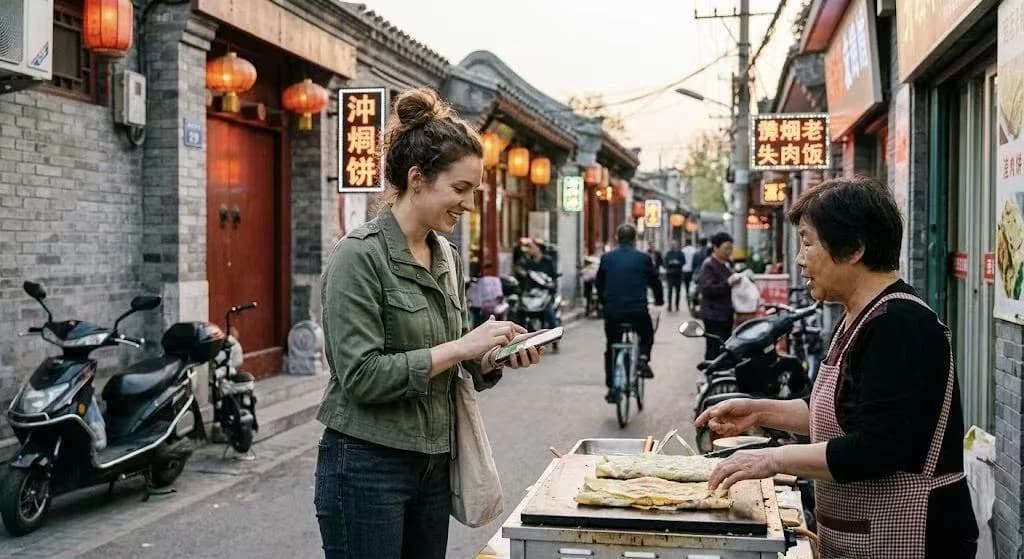
Beijing can feel vast and intimidating at first glance, but beneath the towering glass skyscrapers and busy ring roads is an incredibly warm, safe, and welcoming city. The speed at which you fall in love with Beijing depends entirely on how willing you are to step outside your comfort zone.
The fastest way to melt away the culture shock? Start learning the language.
You don't need to master thousands of characters overnight. Just learning how to greet your neighborhood āyí (auntie), order your favorite dumpling dish, or give directions to a taxi driver changes the way the city interacts with you.
Want to hit the ground running?
At Connect Mandarin, we specialize in practical, real-world Mandarin designed specifically for busy expats. Whether you need a 4-week survival crash course or flexible business classes around your work schedule, we are here to help you thrive in Beijing.
📥 Moving to Beijing Soon? Don't let the logistics overwhelm you. We've put together a gorgeous, print-ready 15-Step Moving to Beijing Checklist featuring your exact roadmap from 2 months before departure down to your first week on the ground. Click here to download your free copy!
👉 Explore Mandarin classes in Beijing
Frequently Asked Questions
Q1: Is it hard to live in Beijing without knowing any Mandarin?
Thanks to translation apps, you can survive your first few weeks smoothly. However, to truly settle in, handle deliveries, or feel comfortable outside of Western enclaves like Sanlitun, learning everyday survival Mandarin is highly recommended.
Q2: Is Beijing a safe city for expats?
Yes, Beijing is incredibly safe. It is widely considered one of the safest megacities in the world, with exceptionally low violent crime rates. You can confidently walk or bike around the city alone at any hour of the night.
Q3: What is the best way to get around the city?
The Beijing Subway is your best bet — it is cheap, immaculately clean, fast, and fully signposted in English. For door-to-door trips, the DiDi app (China's Uber) is highly affordable and convenient.
Q4: How long does it take to learn basic conversational Mandarin?
With consistent, practical practice, most expats can master basic survival phrases (ordering food, asking for directions, and greeting neighbours) within 4 to 6 weeks.
About the Author
Connect Mandarin Team
We are built by a team of native-speaking teachers and language educators who focus on real, usable Chinese - not just textbook phrases. With 15+ years of combined teaching experience.
Continue Reading

Chinese Breakfast: Popular Foods, Dishes & What People Eat in China
Explore Chinese breakfast foods like baozi, youtiao, congee and jianbing. See regional dishes, key Mandarin phrases, and how to order breakfast in China.

Hakka People: History, Language, and Culture Explained
The Hakka people (客家人) are a Han Chinese subgroup known for their own language, fortified earthen homes, and a cuisine built around preserved ingredients. Here's where they came from, how they live today, and what their story teaches Mandarin learners.

Famous Chinese People: 20 Figures Who Shaped History and Culture
Learn about 20 famous Chinese people who shaped China's history and culture, from Confucius to Jack Ma, with Hanzi, pinyin, and how to say each name.