
Flowers in Chinese: Names, Meanings, and Culture (花 huā)
Learn Chinese flower names like 玫瑰 (rose) and 牡丹 (peony), their cultural meanings, and how 花 shows up in idioms and Chinese New Year customs.
Flowers show up everywhere in Chinese language and culture: in gift-giving customs, festival traditions, classical painting, and the everyday idioms native speakers use without a second thought. Learn the word for "flower," a core list of flower names, what they symbolize, and how 花 (huā) shows up in modern slang, and you'll pick up vocabulary that's genuinely useful in conversation, not just a list of pretty words to memorize.
How to Say "Flower" in Chinese: 花 (huā)
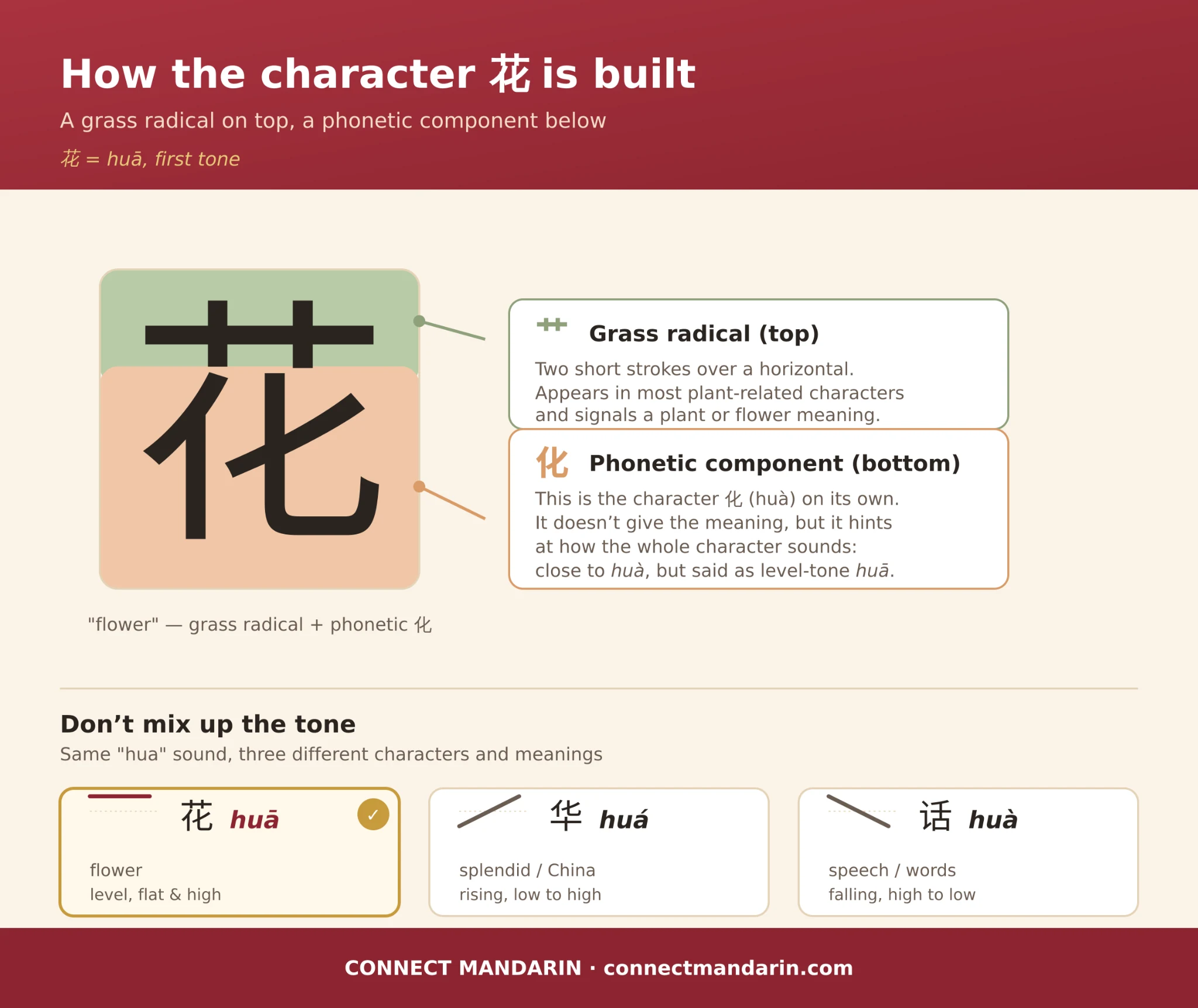
The Chinese word for flower is 花 (huā). Look closely at the character and you'll notice two parts: the "grass" radical (艹) on top, which signals a plant-related meaning, and a phonetic component below that hints at the pronunciation.
huā is a first-tone syllable. It's flat, high, and held steady from start to finish. That matters, because it's easy to mix up with huá (as in 华, "splendid," or in names like 中华) and huà (as in 话, "speech," or 画, "painting"). Keep the tone level and you'll avoid one of the more common beginner mix-ups.
Writing tip: start with the grass radical (两横一竖, roughly two short horizontal strokes over a vertical), then build the bottom component left to right. Once the radical becomes automatic, you'll start recognizing it in dozens of other plant-related characters.
Essential Flower Names in Chinese
Once you know 花, most specific flower names are built right on top of it. Here are twelve worth knowing: common gift flowers, plus a few with real cultural weight that we'll come back to later in this post.
| English | Chinese | Pinyin | Notes |
|---|---|---|---|
| Flower (generic) | 花 | huā | The base word, see above |
| Rose | 玫瑰 | méiguī | Love, romance |
| Peony | 牡丹 | mǔdān | "King of Flowers," wealth and honour |
| Lotus | 荷花 / 莲花 | héhuā / liánhuā | Purity, Buddhist symbolism |
| Chrysanthemum | 菊花 | júhuā | Longevity, Double Ninth Festival |
| Orchid | 兰花 | lánhuā | Elegance, noble character |
| Plum Blossom | 梅花 | méihuā | Resilience, blooms in winter |
| Peach Blossom | 桃花 | táohuā | Spring, romance, a Chinese New Year symbol |
| Sunflower | 向日葵 | xiàngrìkuí | Loyalty, optimism |
| Lily | 百合花 | bǎihéhuā | Purity, suits most occasions |
| Osmanthus | 桂花 | guìhuā | Autumn, exam success |
| Tulip | 郁金香 | yùjīnxiāng | Passionate love |
A few of these, peach blossom and osmanthus especially, carry meanings tied to specific seasons and even to exam season. More on that below.
What Chinese Flowers Symbolize
Chinese culture has assigned rich, specific meanings to individual flowers for centuries, especially through poetry and painting. Here are five of the most important.
Peony (牡丹, mǔdān): Wealth, Honour, and the "King of Flowers"
The peony is traditionally called 花王, or "King of Flowers," for its full, lush blooms. It stands for wealth, honour, and high social status, and it's a common motif in home décor and business settings where prosperity is the wish being expressed. In classical painting, a blooming peony is shorthand for abundance and good fortune.
Lotus (荷花, héhuā): Purity Rising From the Mud
The lotus grows up through muddy water yet opens into a clean, unstained bloom. That's exactly why it became a symbol of purity in Buddhist thought: staying true to your values despite difficult surroundings, enlightenment and moral integrity rising above circumstance.
Plum Blossom (梅花, méihuā): Resilience in Winter
Plum blossoms flower in the cold, often against snow, before most other plants show any sign of spring. That timing made the plum blossom a natural symbol of resilience, quiet strength, and perseverance through hardship, qualities Chinese scholars and poets have praised for centuries.
Chrysanthemum (菊花, júhuā): Longevity and the Double Ninth Festival
The chrysanthemum blooms in autumn, after most flowers have already faded. That's why it's associated with longevity, endurance, and dignified aging. It's the featured flower of the Double Ninth Festival (重阳节), a holiday traditionally centered on honouring elders.
Orchid (兰花, lánhuā): Elegance and Noble Character
The orchid stands for refinement, humility, and noble character. Unlike showier flowers, its beauty is understated rather than bold, which is why it's traditionally linked to scholars and to a person's inner cultivation rather than outward status.
The Four Gentlemen of Flowers (花中四君子)
In classical Chinese art and poetry, four plants are grouped together as the "Four Gentlemen" (花中四君子): the plum blossom (梅), orchid (兰), bamboo (竹), and chrysanthemum (菊). Each one represents a different facet of noble character: the plum blossom for resilience, the orchid for humility, bamboo for integrity and flexibility, and the chrysanthemum for quiet strength and endurance.
This grouping has been a favourite subject for Chinese painters and calligraphers for hundreds of years. Painting all four together lets an artist express a complete picture of moral character in a single composition. If you ever see these four plants painted or referenced as a set, you're looking at a deliberate reference to this classical grouping, not just a random selection of plants.
Common Chinese Idioms and Phrases With 花
花 doesn't just name flowers. It shows up in idioms and everyday slang too.
如花似玉 (rú huā sì yù), literally "like a flower, like jade," is used to describe someone's beauty, especially a young woman's, as delicate and refined.
A: 她真是如花似玉。(Tā zhēn shì rú huā sì yù.) "She's really as lovely as a flower."
B: 是啊,气质也特别好。(Shì a, qìzhì yě tèbié hǎo.) "Yeah, and she carries herself so gracefully too."
鸟语花香 (niǎo yǔ huā xiāng), literally "birds' song, flowers' fragrance," describes an idyllic, peaceful scene, think a spring morning in a park.
A: 这个公园环境真好。(Zhège gōngyuán huánjìng zhēn hǎo.) "This park has such a nice atmosphere."
B: 对,鸟语花香的,特别舒服。(Duì, niǎo yǔ huā xiāng de, tèbié shūfu.) "Right, birds singing, flowers blooming. Really pleasant."
花心 (huāxīn), literally "flower heart," is modern slang rather than classical vocabulary. It means someone is fickle or unfaithful in relationships, roughly equivalent to calling someone a "player" in English.
A: 我觉得他挺花心的。(Wǒ juéde tā tǐng huāxīn de.) "I think he's kind of a player."
B: 真的吗?看着挺老实的啊。(Zhēn de ma? Kànzhe tǐng lǎoshi de a.) "Really? He seems so honest."
Flowers in Chinese Festivals and Everyday Life
Flowers aren't just symbolic in the abstract. They show up in real customs you're likely to encounter.
- Chinese New Year: Peach blossom (桃花) branches and kumquat trees are common home decorations, believed to bring luck and, in the case of peach blossom specifically, good romantic fortune for the year ahead.
- Double Ninth Festival: Chrysanthemums are displayed and even steeped into tea or wine, tying back to the flower's association with longevity.
- Gift-giving etiquette: This one matters if you're ever choosing flowers for someone in China. White and yellow flowers, chrysanthemums especially, are strongly associated with funerals and mourning. Avoid all-white bouquets for birthdays, romantic occasions, or celebrations, and go with red, pink, or mixed colours instead.
FAQs
What is the Chinese word for flower?
The Chinese word for flower is 花 (huā), first tone. It's written with the "grass" radical on top, which signals a plant-related meaning. 花 is also the building block for most specific flower names, such as 玫瑰 (méiguī, rose) and 菊花 (júhuā, chrysanthemum).
How do you say "flowers" (plural) in Chinese?
Chinese nouns don't change form for plural, so 花 (huā) means both "flower" and "flowers." Context or a measure word makes the number clear, for example 一朵花 (yī duǒ huā, one flower) versus 很多花 (hěn duō huā, many flowers).
What flower symbolizes love in Chinese culture?
The rose (玫瑰, méiguī) is the most common symbol of romantic love in Chinese culture, much like in the West. The peony (牡丹, mǔdān) also carries romantic meaning, but leans more toward wealth, honour, and admiration than passion.
What are the "Four Gentlemen of Flowers" in Chinese culture?
The "Four Gentlemen of Flowers" (花中四君子) are the plum blossom, orchid, bamboo, and chrysanthemum. Chinese painters and poets have used these four plants for centuries to represent noble character traits like resilience, humility, integrity, and quiet strength.
What does 花心 (huāxīn) mean?
花心 (huāxīn) literally means "flower heart," but in everyday Mandarin it describes someone who is fickle or unfaithful in relationships, similar to calling someone a "player" in English. It's common slang, not classical vocabulary.
Is it okay to give white flowers in China?
White and yellow flowers, especially chrysanthemums, are strongly associated with funerals and mourning in Chinese culture. It's best to avoid giving all-white bouquets for birthdays, romance, or celebrations. Choose red, pink, or mixed colours instead.
Learn Real Mandarin With Connect Mandarin
Flower vocabulary is a great entry point into HSK word lists. Many of the terms above show up across HSK 2 through HSK 4. If you want to build this kind of vocabulary systematically rather than one topic at a time, our HSK Exam Preparation Program is built around exactly that. You can also book a free trial lesson to see how we teach.
About the Author
Connect Mandarin Team
We are built by a team of native-speaking teachers and language educators who focus on real, usable Chinese - not just textbook phrases. With 15+ years of combined teaching experience.
Continue Reading
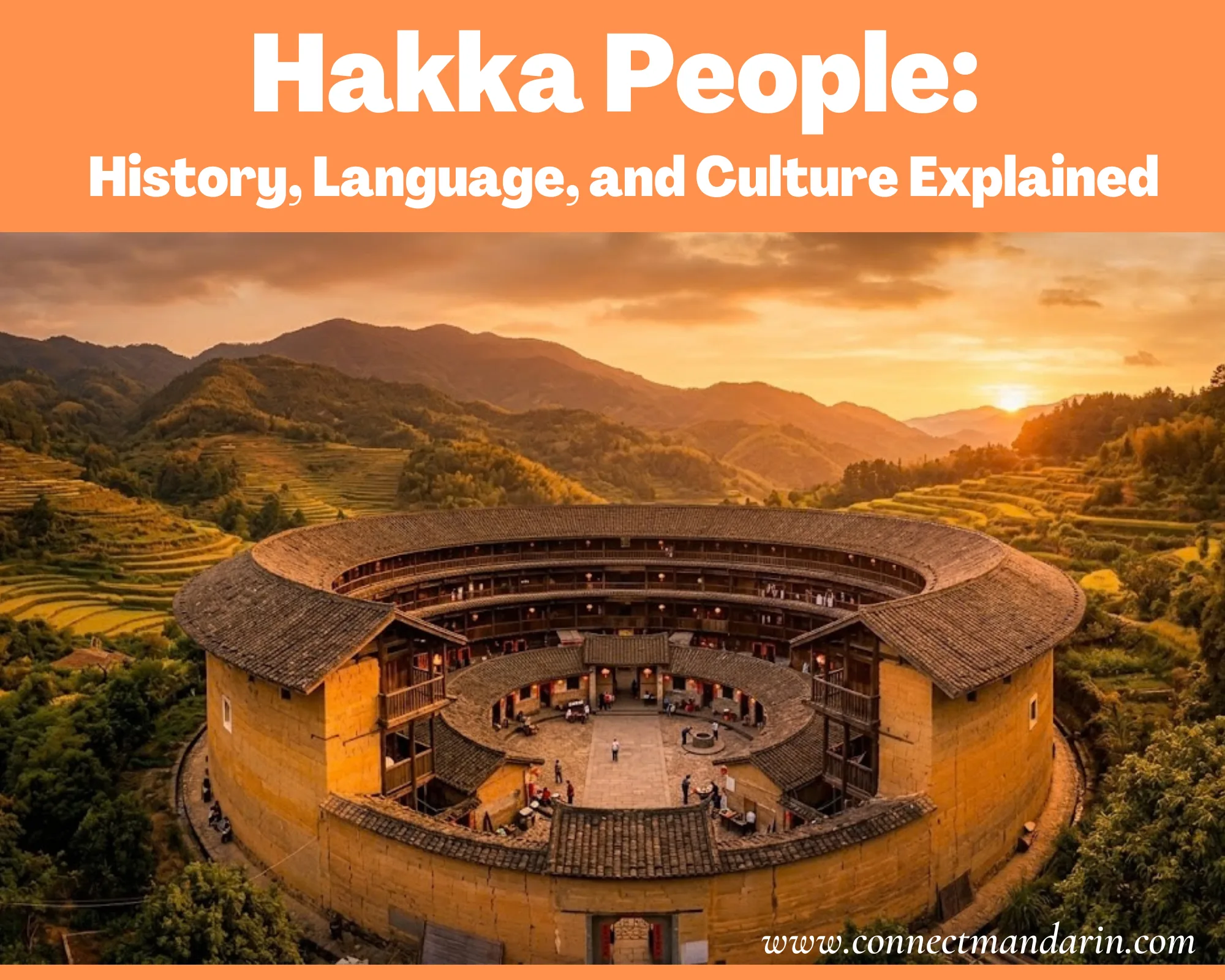
Hakka People: History, Language, and Culture Explained
The Hakka people (客家人) are a Han Chinese subgroup known for their own language, fortified earthen homes, and a cuisine built around preserved ingredients. Here's where they came from, how they live today, and what their story teaches Mandarin learners.
Famous Chinese People: 20 Figures Who Shaped History and Culture
Learn about 20 famous Chinese people who shaped China's history and culture, from Confucius to Jack Ma, with Hanzi, pinyin, and how to say each name.
Chinese Girl Names: 50+ Meaningful Names with Pinyin & Pronunciation
Discover 50+ Chinese girl names with pinyin, tones & meanings from Beijing-based Mandarin teachers. Find the perfect name for your daughter.