
East, West, North, South in Chinese: A Complete Guide to Directions
Learn east, west, north & south in Chinese, plus how Beijingers give directions by compass, not left/right.
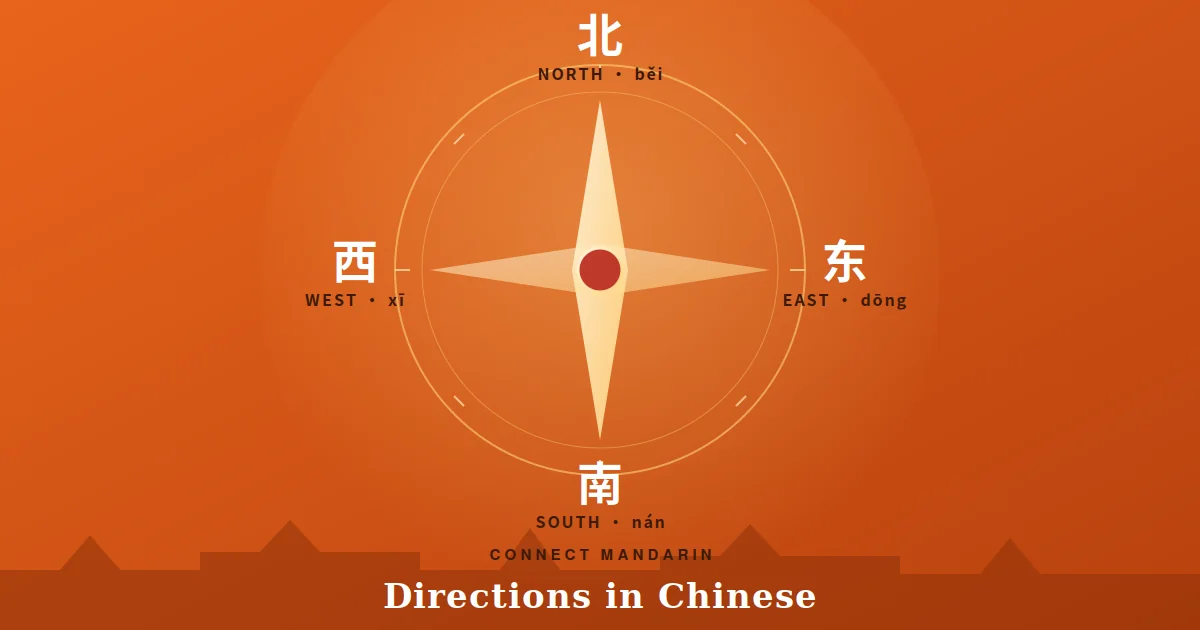
If you've spent any time wandering Beijing's hutongs, listening to subway announcements, or trying to tell a taxi driver where you're going, you've probably noticed something. People here don't say "turn left at the corner." They say "go east," "go north," or "it's on the south side of the building." For a lot of learners that's a surprise, but once you get comfortable with 东 (dōng), 南 (nán), 西 (xī), and 北 (běi), giving and understanding directions in Beijing gets a lot easier.
In this guide we'll go through all four cardinal directions, how they combine, why Beijingers rely on the compass instead of left and right, and the everyday phrases you'll actually need. If you want to build vocabulary like this into real conversation practice instead of memorizing it in isolation, a structured beginner course is a good place to start.
How to Say East in Chinese (东 dōng)
East in Chinese is 东 (dōng), said with a first tone, flat and level, held steady rather than rising or falling.
One way to remember it: the character 东 is traditionally explained as a picture of the sun (日) rising up behind a tree (木), the sun climbing over the horizon in the east. Once you've seen that image, the character tends to stick.
Example sentence: 太阳从东边升起。 Tàiyáng cóng dōngbiān shēngqǐ. "The sun rises from the east."
Here's a fun bit of trivia. The word 东西 (dōngxi), literally "east-west," actually means "things" or "stuff" in everyday Chinese. So next time someone asks 你买了什么东西? (Nǐ mǎile shénme dōngxi?), they're asking "what did you buy?" not asking for a compass bearing.
The Four Cardinal Directions in Chinese
Here are all four directions together:
| Chinese | Pinyin | English |
|---|---|---|
| 东 | dōng | East |
| 南 | nán | South |
| 西 | xī | West |
| 北 | běi | North |
One thing worth noting: in English we usually list directions starting with North (North, South, East, West), or sometimes go around the compass (North, East, South, West). In Chinese the fixed order is 东南西北, East, South, West, North. You'll see this order used consistently, whether it's on a map, in an address, or in casual conversation, so it's worth getting used to hearing "east" first.
Intercardinal Directions (Northeast, Southwest, and More)
Once you know the four basics, the in-between directions are just combinations:
- 东北 (dōngběi), Northeast
- 东南 (dōngnán), Southeast
- 西北 (xīběi), Northwest
- 西南 (xīnán), Southwest
Notice the pattern. East or West always comes first, then North or South. That's the opposite of English, where we say "Northeast" and "Southwest" with North/South leading. So if you're used to saying "northeast," just flip the order in your head and you've got 东北.
Why Beijingers Give Directions by Compass, Not Left/Right
This is really the heart of the matter for anyone living in or visiting Beijing. The city was historically laid out on a strict north-south, east-west grid, centered on the axis running through the Forbidden City. Streets, hutongs, and even apartment layouts tend to follow this grid closely, so locals naturally think in terms of compass direction rather than which way they happen to be facing at the moment. Ask someone in Beijing for directions, and you're far more likely to hear 往东走 (wǎng dōng zǒu, "go east") than "go straight and it's on your left."
This is a distinctly northern habit. Head south to cities like Shanghai or Guangzhou and you'll find people lean much more on 左 (zuǒ, left) and 右 (yòu, right) instead. Their streets don't follow the same rigid grid, so compass directions are less useful for everyday navigation there. If you're learning Mandarin in Beijing, getting comfortable with compass terms is genuinely how people around you will talk, not just a nice detail to know.
Position and Location Words in Chinese
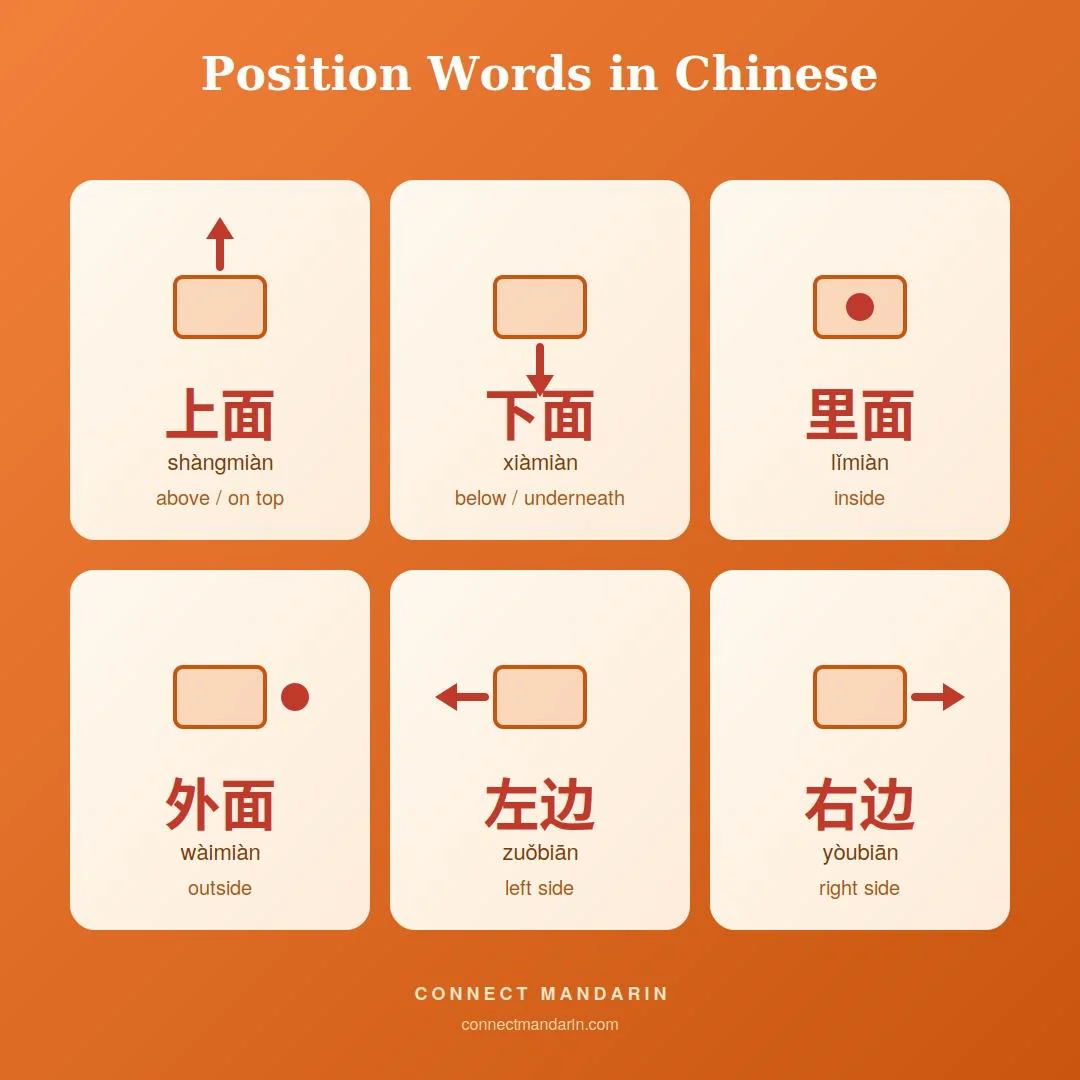
Beyond the compass, you'll also need everyday position words for describing where things are relative to each other:
- 左边 (zuǒbiān), left side
- 右边 (yòubiān), right side
- 里面 (lǐmiàn), inside
- 外面 (wàimiàn), outside
- 上面 (shàngmiàn), above or on top
- 下面 (xiàmiàn), below or underneath
Example sentences:
书在桌子上面。 Shū zài zhuōzi shàngmiàn. "The book is on top of the table."
银行在超市左边。 Yínháng zài chāoshì zuǒbiān. "The bank is on the left side of the supermarket."
我把钥匙放在包里面了。 Wǒ bǎ yàoshi fàng zài bāo lǐmiàn le. "I put the keys inside the bag."
外面在下雨。 Wàimiàn zài xiàyǔ. "It's raining outside."
How to Ask For and Give Directions in Mandarin
Are you also like this when it comes to directions? A foreigner asking a local in Beijing for directions, and the reply came so fast he barely had time to react. Watch the video and see how many words you can catch.
When you actually need directions, here are the phrases that come up again and again:
- 怎么走? (zěnme zǒu?), "How do I get there?"
- 往前走 (wǎng qián zǒu), "Go straight ahead"
- 左转 / 右转 (zuǒ zhuǎn / yòu zhuǎn), "Turn left / turn right"
- 往东走 (wǎng dōng zǒu), "Go east" (the same pattern works for west, north, south too)
A quick example dialogue, asking a local in Beijing for directions:
A: 请问,地铁站怎么走? Qǐngwèn, dìtiě zhàn zěnme zǒu? "Excuse me, how do I get to the subway station?"
B: 往前走,然后往东转,就在你左边。 Wǎng qián zǒu, ránhòu wǎng dōng zhuǎn, jiù zài nǐ zuǒbiān. "Go straight, then turn east, and it'll be on your left."
Notice how naturally a compass direction slides right in alongside "turn" and "left." That mix is very typical of how Beijingers actually talk, and it's exactly the kind of exchange we drill through role-play in our spoken Chinese classes.
Common Mistakes Learners Make with Chinese Directions

A few trip-ups to watch out for:
- Mixing up 东 and 西 tones. Both are common syllables that show up in other words, so it's easy to blur them together if your tones aren't crisp. Practice them side by side until the difference feels automatic.
- Defaulting to left/right when locals expect compass terms. It's a natural habit to fall back on, especially early on, but in Beijing it can genuinely confuse the person giving you directions.
- Getting the word order backwards. Remember, it's 东北, not "北东." East/West always comes before North/South in Chinese.
One fun way to lock in this word order: think about 北京 (Běijīng) itself. It literally means "North Capital." 北 (běi) is north, 京 (jīng) is capital, a name given to distinguish it from 南京 (Nánjīng), "South Capital." It's a small piece of etymology, but a good reminder of how deeply directional characters are woven into everyday Chinese.
A teacher catching your 东/西 tones in real time is usually faster than trying to self-correct. Book your free trial class here and get that feedback early.
FAQs
How do you say "east" in Chinese?
"East" is 东 (dōng) in Mandarin. It's one of four cardinal directions, 东 (east), 南 (south), 西 (west), 北 (north), and appears in common words like 东西 (dōngxi), meaning "things." Getting the tones right early, ideally through a structured beginner course, helps avoid mixing up 东 with similar-sounding words.
What are the four directions in Chinese?
The four cardinal directions are 东 (dōng, east), 南 (nán, south), 西 (xī, west), and 北 (běi, north). Unlike English, Chinese always lists them starting with east, and combines them differently for intercardinal directions like 东北 (northeast).
Do Chinese people use left/right or compass directions?
It depends on the region. Northern cities like Beijing favor compass directions (东/南/西/北) because of the city's grid layout, while southern cities like Shanghai and Guangzhou rely more on 左 (left) and 右 (right) for everyday directions.
How do you ask for directions in Mandarin?
Say "怎么走?" (zěnme zǒu?), meaning "how do I get there?" Common replies use 往前走 (go straight), 左转/右转 (turn left/right), or compass terms like 往东走 (go east), especially common in Beijing.
Why does Beijing mean "North Capital"?
北京 (Běijīng) literally translates to "North Capital." 北 (běi) means north and 京 (jīng) means capital, distinguishing it historically from 南京 (Nánjīng), "South Capital." It's a simple, memorable example of directional characters showing up in real place names.
Is 东 (dōng) hard to pronounce for beginners?
Not really. It's a first tone, so you just hold it flat and even, no rise or dip. The trickier part is not confusing it with 冬 (dōng, "winter"), which sounds identical but has a different meaning, so context matters more than pronunciation here.
How do you say "compass" in Chinese?
"Compass" is 指南针 (zhǐnánzhēn), which literally means "point-south needle," since early Chinese compasses were designed to point south rather than north. It's a nice example of how directional logic shows up in everyday vocabulary too.
Do street addresses in Beijing use compass directions?
Yes, often. Many Beijing addresses and directions reference compass points directly, like 东三环 (Dōng Sān Huán, "East Third Ring Road"), so knowing 东西南北 isn't just conversational, it's genuinely useful for reading maps and getting around the city.
About the Author
Connect Mandarin Team
We are built by a team of native-speaking teachers and language educators who focus on real, usable Chinese - not just textbook phrases. With 15+ years of combined teaching experience.
Continue Reading
What Are You Doing in Chinese? 你在做什么 (Nǐ Zài Zuò Shénme) Explained
Learn how to say "what are you doing" in Chinese, from the textbook-standard 你在做什么 to the casual Beijing favorite 你在干嘛, with pinyin, tone tips, and real dialogues.

Where Are You From in Chinese? (5 Natural Ways to Ask in Mandarin)
Learn 5 natural ways to ask "where are you from" in Chinese, from the everyday nǐ shì nǎlǐ rén to the formal nǐ láizì nǎlǐ, with pinyin and real conversation examples.

How to Say "Not This Time" in Chinese: 5 Natural Mandarin Phrases
Learn how to say 'not this time' in Chinese with 5 natural Mandarin phrases. Get pinyin, real examples, and tips on which one fits each situation.